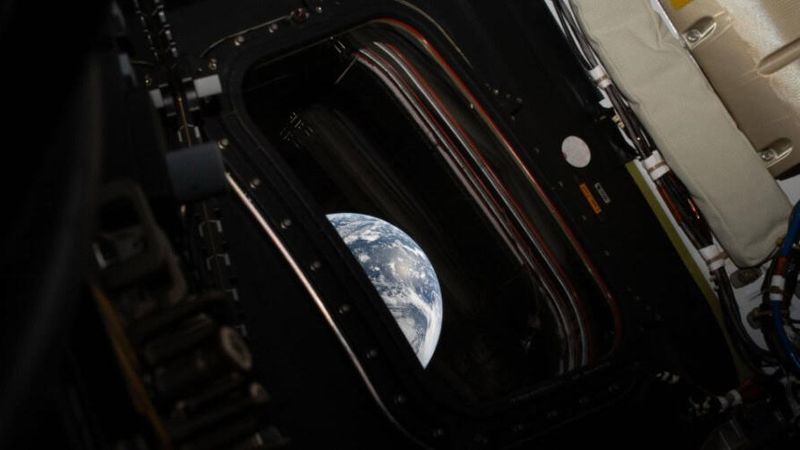
Infineon Technology once again proves itself in space during the Artemis II lunar mission.
Infineon IR HiRel's radiation-hardened semiconductors support the electronic system inside the Orion capsule.
(Source: NASA)
Radiation-hardened semiconductors from Infineon support the electronic backbone of NASA’s Artemis II Orion capsule for more than ten days in space. Since the 1970s, Infineon’s radiation-hardened technology has proven itself in hundreds of space missions. Infineon’s first JANS-qualified and internally produced GaN transistor with radiation hardness sets the standard for space semiconductors.
The NASA Artemis II mission has successfully returned after ten days in space, the closest approach to the moon and the furthest distance of manned spaceflight from Earth. Four astronauts have landed safely on Earth and with them renewed proof that the radiation-hardened semiconductor solutions from Infineon Technologies AG function reliably even under the extreme conditions of space. From the critical power supply to control systems and data communication, Infineon’s radiation-hardened technologies from the IR HiRel (High Reliability) division make an important contribution to the electronic backbone inside the Orion capsule.
“Space programs need technologies and partners that can be relied on for decades. Infineon is a critical technology partner and we are proud to have once again contributed to the success of a historic mission,” said Mike Mills, Senior Vice President and General Manager of IR HiRel at Infineon. “Space travel is evolving rapidly: more missions, more data, more electrification—while reducing size, weight and power consumption. In this equation, semiconductors are becoming a central focus point in space travel. The fact that our components worked perfectly from the first to the last minute of the Artemis II mission is no coincidence. It is the result of decades of engineering, rigorous qualification processes and a deep understanding of what semiconductors need to do in space.”
The Artemis II mission is not a first for Infineon in space. Back in the 1970s, Infineon’s predecessor companies supplied the first radiation-hardened (rad-hard) components for the NASA and ESA space programs. Since then, Infineon IR HiRel has supported hundreds of space missions, from navigation satellites to the International Space Station (ISS) and today’s Artemis program. Infineon’s rad-hard components have traveled a greater distance than any other man-made object—more than 20 billion kilometers (approx. 12 billion miles) from Earth. As a technology leader, Infineon continuously invests in the development and manufacture of the highest performing radiation-hardened semiconductors to support the global space industry.
The demands placed on semiconductors in space are enormous. Beyond the Earth’s protective magnetic field, high-energy particles hit electronic components unhindered and can permanently damage or destroy them. Infineon’s rad-hard technology counteracts these mechanisms not by passive shielding, but by a semiconductor architecture that is radiation-resistant from the ground up. All products are qualified to the most stringent international space standards, including MIL-PRF-38535 Class V, ESA ESCC standards and NASA EEE-INST-002, confirming their reliable performance.
Innovation at Infineon is created in the overall system: semiconductor technology, rad-hard safety and the stability of the chip packages are interlinked. An optimised overall system not only influences electrical performance, but also thermal behaviour and reliability—and can reduce weight and volume at the same time. In space travel, where every gram counts, this is a decisive system advantage.
Europe’s security landscape is changing rapidly
(Source: VCG)
As defence budgets rise and EU programmes expand, civil technology providers are becoming vital contributors to Europe’s strategic autonomy. The event will act as a neutral platform for dialogue between technology suppliers, integrators, and decision-makers shaping the next generation of European defence capabilities and aims to open doors between civil industry and defence procurement, providing practical insights.
In the process, Infineon is also focusing on completely new semiconductor materials in space applications. Gallium nitride (GaN) enables lower switching losses, higher power density and higher switching frequencies. This reduces power losses and the need for magnetics and enables further weight savings. Based on in-house manufacturing and thus controllable process and quality stability, Infineon’s radiation-hardened 100 V GaN transistor, which is JANS (Joint Army Navy Space) qualified according to MIL-PRF-19500, takes GaN from vision to reliable technology in demanding space missions. Infineon’s JANS-qualified device is the first and only internally manufactured rad-hard GaN transistor on the market.
Date: 08.12.2025
Naturally, we always handle your personal data responsibly. Any personal data we receive from you is processed in accordance with applicable data protection legislation. For detailed information please see our privacy policy.
Consent to the use of data for promotional purposes
I hereby consent to Vogel Communications Group GmbH & Co. KG, Max-Planck-Str. 7-9, 97082 Würzburg including any affiliated companies according to §§ 15 et seq. AktG (hereafter: Vogel Communications Group) using my e-mail address to send editorial newsletters. A list of all affiliated companies can be found here
Newsletter content may include all products and services of any companies mentioned above, including for example specialist journals and books, events and fairs as well as event-related products and services, print and digital media offers and services such as additional (editorial) newsletters, raffles, lead campaigns, market research both online and offline, specialist webportals and e-learning offers. In case my personal telephone number has also been collected, it may be used for offers of aforementioned products, for services of the companies mentioned above, and market research purposes.
Additionally, my consent also includes the processing of my email address and telephone number for data matching for marketing purposes with select advertising partners such as LinkedIn, Google, and Meta. For this, Vogel Communications Group may transmit said data in hashed form to the advertising partners who then use said data to determine whether I am also a member of the mentioned advertising partner portals. Vogel Communications Group uses this feature for the purposes of re-targeting (up-selling, cross-selling, and customer loyalty), generating so-called look-alike audiences for acquisition of new customers, and as basis for exclusion for on-going advertising campaigns. Further information can be found in section “data matching for marketing purposes”.
In case I access protected data on Internet portals of Vogel Communications Group including any affiliated companies according to §§ 15 et seq. AktG, I need to provide further data in order to register for the access to such content. In return for this free access to editorial content, my data may be used in accordance with this consent for the purposes stated here. This does not apply to data matching for marketing purposes.
Right of revocation
I understand that I can revoke my consent at will. My revocation does not change the lawfulness of data processing that was conducted based on my consent leading up to my revocation. One option to declare my revocation is to use the contact form found at https://contact.vogel.de. In case I no longer wish to receive certain newsletters, I have subscribed to, I can also click on the unsubscribe link included at the end of a newsletter. Further information regarding my right of revocation and the implementation of it as well as the consequences of my revocation can be found in the data protection declaration, section editorial newsletter.
Infineon offers a broad rad-hard portfolio, from silicon power MOSFETs and GaN transistors to gate drivers, solid-state relays, radiation-hardened memories and radio-frequency (RF) devices. With its own radiation test capacities and guaranteed long-term availability, Infineon sees itself not only as a component supplier, but also as a strategic technology partner for the entire space industry.



:quality(80)/p7i.vogel.de/wcms/f6/95/f6954fa7c09ba58863a3730f5e384a62/arek-socha-on-pixabay-1707x960v1.jpeg "A new national space strategy brings together UK’s plans for growth, defence, and national security to help reindustrialise the UK. (Source: Arek Socha on Pixabay)")
:quality(80)/p7i.vogel.de/wcms/63/0f/630f214fa760b8c7f7f7d6279d411fcf/d4ceed8f2f52-2026-08-30-hydef-06--msc4159-1200x675v1.webp "(Source: Diehl Defence)")
:quality(80)/p7i.vogel.de/wcms/4e/7d/4e7d38327c6c928b403249e3c24a2a7c/0132118791v1.jpeg "Porsche Holding SE announces that it is once again turning to rocket technology. Following its investment in Isar Aerospace, the company is now acquiring a stake in a U.S. firm ... (Source: Porsche)")
:quality(80)/p7i.vogel.de/wcms/1c/08/1c082bbd9d05b634168b617aa26fcdcf/safe-bg-lv-ro-v1-991x557v1.png "(Source: European Commission)")
:quality(80)/p7i.vogel.de/wcms/0a/14/0a1495d9b570ae32a5a7cc748b9a3c60/st-hannover-035-1920x1079v1-999x562v1.jpeg "Fastening technology you can experience first-hand—visitors to Schraubtec in Bochum (Germany) can see it for themselves at the Ruhr Congress on September 30, 2026. (Source: PHOTOVISION-DH GmbH)")
:quality(80)/p7i.vogel.de/wcms/cd/a9/cda92b173afa9d0b455d4f11b281c9ea/0094-to-image--capstone-cdr-1440x810v1.png "(Source: Terran Orbital)")
:quality(80)/p7i.vogel.de/wcms/e0/45/e045bc5414d7263fb308bdd501b5fcc1/0133113962v1.jpeg "The HSWL 354 is the transmission used, for example, in the Leopard 2 main battle tank. Renk manufactures this system and is now preparing to significantly increase its cycle time. As a result, Renk is placing greater emphasis on the military sector as a customer ... (Source: Renk)")
:quality(80)/p7i.vogel.de/wcms/a1/5c/a15c2aeba563d5bc3e11fb879b21eb2c/0132989650v1.jpeg "FSS, the flexible clamping system for varying free-form surfaces, is designed for the aerospace industry and other sectors. (Source: Römheld GmbH Friedrichshütte)")
:quality(80)/p7i.vogel.de/wcms/46/8e/468effa87546a2b036dc88ca40e2843e/129fbcac92ce7da872b13af0281b0799-l-png-1920x1079v1.webp "(Source: Arianespace)")
:quality(80)/p7i.vogel.de/wcms/8f/10/8f10697d4bfbd70edf615cca76eaedfd/pete-linforth-on-pixabay-1920x1080v1.jpeg "(Source: Pete Linforth on Pixabay / AI-generated)")
:quality(80)/p7i.vogel.de/wcms/0f/99/0f99561bf51818af92b2960656405aa5/roland-4d-pippes-on-pixabay-1460x820v1.jpeg "(Source: Roland 4D Pippes on Pixabay)")
:quality(80)/p7i.vogel.de/wcms/05/49/054906f874b94ef08b09d5920396e27d/airbus-h160-1920x1079v1.jpeg "Airbus H160 (Source: Airbus)")
:quality(80)/p7i.vogel.de/wcms/9d/8a/9d8addea8cc4e6f7a4793563ca397f2a/ai-im-milit-r-1672x940v1.png "(Source: KI-generiert / Gemini)")
:quality(80)/p7i.vogel.de/wcms/7f/5f/7f5fba2c729ec3aa256bf1a18d74529b/ai-chip-1672x940v1.png "(Source: KI-generiert / Gemini)")
:quality(80)/p7i.vogel.de/wcms/64/1b/641b6474b2a614cde7730c89ef2a3015/2026-09-09-rheinmetall-veroeffentlicht-battlesuite-schnittstellen-e8c18194-1225x690v1.jpeg "Rheinmetall’s Battlesuite provides a modular digital platform for connecting and integrating sensors, hardware and software components. (Source: Rheinmetall AG)")
:quality(80)/p7i.vogel.de/wcms/6f/fe/6ffef325e7f233cc3521943158eb1ebd/0132763535v1.jpeg "Two companies are planning to establish, for the first time in 2027, an optical laser communication link directly between a satellite in low Earth orbit (LEO) and a re-entering spacecraft. (Source: ATMOS Space Cargo)")
:quality(80)/p7i.vogel.de/wcms/8f/f9/8ff91b78b26cb5a2b8a29e39835005b1/2026-09-10-repmus-teaser-images-retouched-dsc01292-1024x683-1024x576v1.jpeg "(Source: Quantum Systems GmbH)")
:quality(80)/p7i.vogel.de/wcms/bf/4a/bf4a237e60d3d4bd1bbdbad918f3c697/airbus-defence-and-space-3-1280x720v1.jpeg "(Source: Airbus Defence and Space)")
:quality(80)/p7i.vogel.de/wcms/e0/d1/e0d112a0d54a4fa9603ec855f7d25b47/t-rex-content-photo-jpg-pc-adaptive-990-medium-988x556v1.jpeg "Swarm of UAVs conducting a fully autonomous collaborative swarm mission. (Source: Lockheed Martin)")
:quality(80)/p7i.vogel.de/wcms/79/fc/79fcaa7ca33e393b11a4740d7d8f3dbe/vilkasss-handshake-9459740-1911x1076v1.jpeg "(Source: Vilius Kukanauskas on Pixabay)")
:quality(80)/p7i.vogel.de/wcms/90/a8/90a849f0023f11d1eb642eb4751a0321/bild2-h-c3-a4nel-ict-20truck-20and-20trailer-20parts-4320x2429v1.jpeg "Product information is visible at all times and retrieval of items
is confirmed by employees directly on the display of the Hänel MP 14 N
controller. (Source: René Marks)")
:quality(80)/p7i.vogel.de/wcms/4e/ca/4ecaa39f247490eded591b652c33aee3/thilmann-hcp-web-20kleiner-20ausschnitt-1442x811v1.jpeg "Entering the defence market can be challenging for start-ups, says HCP Sense CEO Ansgar Thilmann. (Picture: HCP Sense)")
:quality(80)/p7i.vogel.de/wcms/7a/51/7a511b80041d3f1335f3a5aa56fe75da/delivery-7022432-1280-1280x720v1.png "(Source: Mohamed_hassan)")
:quality(80)/p7i.vogel.de/wcms/f9/2f/f92f1ef8c739c34c70d99f7b0997621b/stra007-20--20cover-20image-5472x3076v1.jpeg "(Source: Stratasys)")
:quality(80)/p7i.vogel.de/wcms/ec/a9/eca9062ccbe4b042f8515846340410d8/aerospace-and-defence-stairways-platforms-and-much-morev1.jpeg "Modular constructions enable flexible modification. That applies to larger structures such as stairways and platforms, too. And that means aerospace and defence companies can reconfigure their maintenance platforms fast (itemitem)")
:quality(80)/p7i.vogel.de/wcms/30/2a/302a7b5723ad38fbde812fd3a468ad04/safety-on-stairways-in-industry-key-considerationsv1.jpeg "Stairways and platforms are used widely in maintenance and assembly areas in the aerospace and defence sectors. (Source: item)")
:quality(80)/p7i.vogel.de/wcms/f3/4e/f34ed744bb30817d3432c7ad522e6f30/engine-1v1.jpeg "Engineering with aluminium profiles really can be this easy – the item Engineeringtool and its smart functions help you save valuable time. (Source: item)")
:fill(fff,0)/p7i.vogel.de/companies/64/fe/64fec73b1a2fb/logo-master-ggbbytimken-286blue.jpeg "logo-master-ggbbytimken-286blue (GGB)")
:fill(fff,0)/p7i.vogel.de/companies/69/6d/696de2483d115/logo--fastems-rgb-horizontal.jpeg "logo--fastems-rgb-horizontal (Fastems)")
:fill(fff,0)/images.vogel.de/vogelonline/companyimg/84700/84735/65.jpg "logo_item_rgb_neu.jpg ()")
:quality(80)/p7i.vogel.de/wcms/45/45/4545a2a2dc3cac03fafdd49d78812d8f/audun-wickstrand-iversen-dnb-16-800x450v1.png "Audun Wickstrand Iversen, Portfoliomanager DNB Disruptive Opportunities at DNB Asset Management (Source: DNB Asset Management)")

:quality(80)/p7i.vogel.de/wcms/96/18/961852680c343ab9f3fe29780e33a503/rad-hard-ic-artemis-ii-en-20-281-29-1920x1079v1.jpeg "rad-hard-ic-artemis-ii-en-20-281-29-1920x1079v1 (Source: Renesas)")
:quality(80)/p7i.vogel.de/wcms/7a/88/7a88fbc5900b17c847ba874496571439/0127804057v1.jpeg "Gallium nitride (GaN) solutions offer significant advantages for critical applications. (Image:EPC Space)")