Fraunhofer FKIE opens new site in Leipzig (Germany) for research and innovation in defence and security.
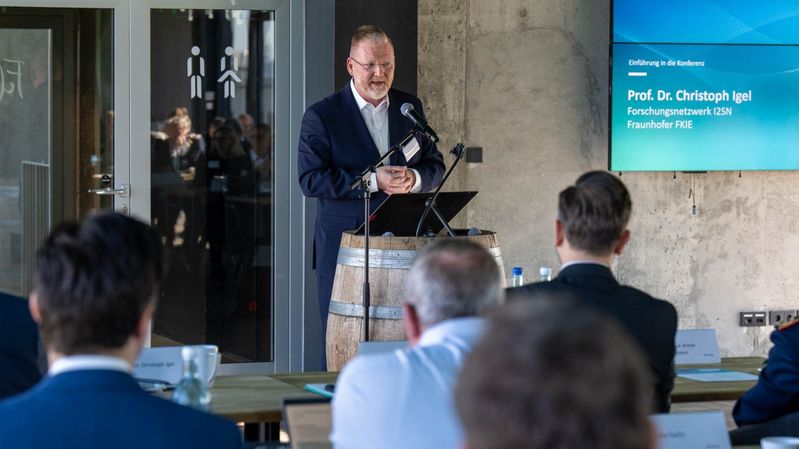
As part of a ceremonial conference on “whole-of-government defence and resilience”, Fraunhofer FKIE provided its first insights into research and innovation topics at its new institute site in Leipzig. Prof. Dr Christoph Igel, Deputy Director of Fraunhofer FKIE and network spokesperson for the Saxon research network “Innovation in Integrated Security and Sustainability” (I2SN), opened the conference.
(Source: Fraunhofer FKIE/Jörg Riethausen)
As part of a ceremonial conference on the topic of “whole-of-government defence and resilience”, the Fraunhofer FKIE provided initial insights into its research and innovation topics at its new site in Leipzig on 23 April 2026. More than 150 participants from politics, academia and industry, as well as from NATO, the Bundeswehr and authorities and organisations with security responsibilities, attended the event. The conference also served as the opening event for the new Saxon research network “Innovation in Integrated Security and Sustainability” (I2SN). Within this network, Fraunhofer FKIE is responsible for the “Cyber/IT” field and, through its Deputy Director, Prof. Dr Christoph Igel, also provides the network spokesperson.
With around 650 employees, Fraunhofer FKIE is one of the leading institutes for defence and security research in Germany. More than 60 years of international research, technology and innovation alongside the Bundeswehr and NATO, as well as in cooperation with the security and defence industry, shape the institute, which covers all domains of whole-of-government defence: on land, at sea, in the air, underwater, in cyberspace and in space. Technologies are developed to identify, minimise and manage existential risks at an early stage.
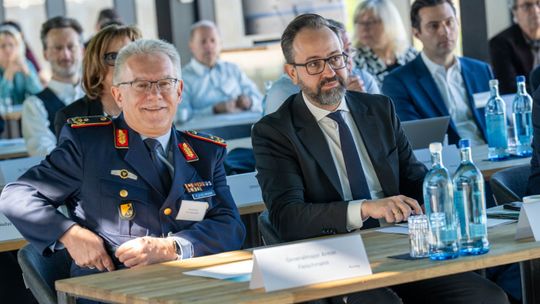
More than 150 participants from politics, academia and industry, as well as from NATO, the Bundeswehr and authorities and organisations with security responsibilities, accepted Fraunhofer FKIE’s invitation. Supporters and guests also included Major General Armin Fleischmann, Head of Planning CIR and Digitalisation of the Bundeswehr at the Cyber and Information Domain Command, as well as Saxon Science Minister Sebastian Gemkow (from left to right).
(Source: Fraunhofer FKIE/Jörg Riethausen)
On 23 April, the new institute site in Leipzig was officially opened during the conference “whole-of-government defence and resilience”, where 15 employees will already be working this year. More than 150 participants attended, including representatives from NATO, the German Federal Ministry of Defence, the Bundeswehr, numerous rectorates and presidiums of universities in the Free State of Saxony, heads of non-university research institutions and companies from across Germany. The Saxon State Minister for Science, Sebastian Gemkow, opened the event.
pooling expertise alongside industry
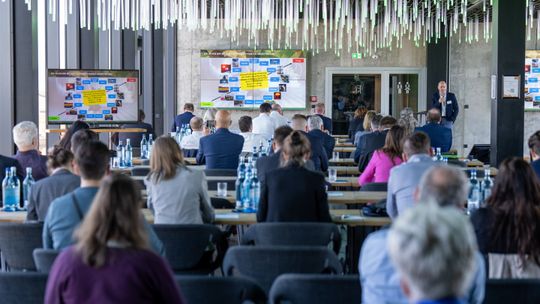
Researchers from the defence-focused Fraunhofer FKIE presented examples of current projects and work contributing to whole-of-government defence and resilience. High-ranking external keynote speakers complemented the programme with insightful contributions.
(Source: Fraunhofer FKIE/Jörg Riethausen)
“Security and defence research are of the highest priority for Fraunhofer. With our interdisciplinary expertise and application-oriented research, we are specifically strengthening Germany’s and Europe’s technological sovereignty, contributing to the development of a resilient security architecture and creating innovative solutions to effectively address current and future threats,” said Prof. Dr.-Ing. Holger Hanselka, President of the Fraunhofer-Gesellschaft.
“Currently of particular importance: cyberattacks, disinformation or sabotage affect our society across time and space. Especially with the increasing hybrid nature of warfare, it is crucial in defence research that solutions move quickly from the laboratory into application. At the new Fraunhofer FKIE site, we are pooling our expertise in Software Defined Defence as well as cybersecurity and resilience, and together with industry we are developing application-oriented technologies to detect such complex threats at an early stage and respond quickly.”
strengthening innovation capacity in saxony
“The innovative strength of Saxon research in technology development and methodology holds great potential,” said Science Minister Sebastian Gemkow. “This potential must also be made available for Germany’s security and defence. With Fraunhofer FKIE and the research network ‘Innovation in Integrated Security and Sustainability’ (I2SN), Saxony has now created the conditions for this. I am convinced that this will make a decisive contribution to greater security and, in the future, increased industrial value creation.”
With “Software Defined Defence” as well as “cybersecurity and resilience”, Fraunhofer FKIE is focusing at its new Leipzig site on topics that are among the institute’s core research areas and are gaining increasing importance for the future security and defence structure in Germany. In addition, the institute is also active in central and eastern Germany through the “Cybersecurity Learning Lab” for digital forensics at Mittweida University of Applied Sciences and a “Joint Research & Testing Lab”, currently under development, for transfer and innovation in land-based operations in Löbau (Upper Lusatia).
Date: 08.12.2025
Naturally, we always handle your personal data responsibly. Any personal data we receive from you is processed in accordance with applicable data protection legislation. For detailed information please see our privacy policy.
Consent to the use of data for promotional purposes
I hereby consent to Vogel Communications Group GmbH & Co. KG, Max-Planck-Str. 7-9, 97082 Würzburg including any affiliated companies according to §§ 15 et seq. AktG (hereafter: Vogel Communications Group) using my e-mail address to send editorial newsletters. A list of all affiliated companies can be found here
Newsletter content may include all products and services of any companies mentioned above, including for example specialist journals and books, events and fairs as well as event-related products and services, print and digital media offers and services such as additional (editorial) newsletters, raffles, lead campaigns, market research both online and offline, specialist webportals and e-learning offers. In case my personal telephone number has also been collected, it may be used for offers of aforementioned products, for services of the companies mentioned above, and market research purposes.
Additionally, my consent also includes the processing of my email address and telephone number for data matching for marketing purposes with select advertising partners such as LinkedIn, Google, and Meta. For this, Vogel Communications Group may transmit said data in hashed form to the advertising partners who then use said data to determine whether I am also a member of the mentioned advertising partner portals. Vogel Communications Group uses this feature for the purposes of re-targeting (up-selling, cross-selling, and customer loyalty), generating so-called look-alike audiences for acquisition of new customers, and as basis for exclusion for on-going advertising campaigns. Further information can be found in section “data matching for marketing purposes”.
In case I access protected data on Internet portals of Vogel Communications Group including any affiliated companies according to §§ 15 et seq. AktG, I need to provide further data in order to register for the access to such content. In return for this free access to editorial content, my data may be used in accordance with this consent for the purposes stated here. This does not apply to data matching for marketing purposes.
Right of revocation
I understand that I can revoke my consent at will. My revocation does not change the lawfulness of data processing that was conducted based on my consent leading up to my revocation. One option to declare my revocation is to use the contact form found at https://contact.vogel.de. In case I no longer wish to receive certain newsletters, I have subscribed to, I can also click on the unsubscribe link included at the end of a newsletter. Further information regarding my right of revocation and the implementation of it as well as the consequences of my revocation can be found in the data protection declaration, section editorial newsletter.
Prof. Dr habil. Christoph Igel, Deputy Director of FKIE and responsible for activities in central and eastern Germany, stated: “As a defence institute, we have stood firmly alongside the Bundeswehr and security authorities for decades. With our new activities in central and eastern Germany, we are strengthening transfer into regional industry and the economy and laying the foundation for new innovation in the Free State of Saxony. Acting close to industry and delivering quickly deployable solutions for defence and security needs is part of our DNA as an institute of the Fraunhofer-Gesellschaft.”
research network with cyber/it focus
The conference “whole-of-government defence and resilience” also marked the launch of the new research network “Innovation in Integrated Security and Sustainability” (I2SN). Funded by the European Regional Development Fund (ERDF) of the Saxon State Ministry for Science, Culture and Tourism, research is being conducted at 18 institutes and professorships in the Free State of Saxony on requirements for external, internal and civil security in the fields of Cyber/IT, energy and materials, with innovations being developed jointly with industry. Fraunhofer FKIE is responsible for the “Cyber/IT” field. Deputy Director Professor Christoph Igel serves as spokesperson for the I2SN research network.




:quality(80)/p7i.vogel.de/wcms/a5/e5/a5e5eecaf9443bd94c6833c158d7cced/20260924-en-5431005-1-640x360v1.jpeg "(Source: Saab AB)")
:quality(80)/p7i.vogel.de/wcms/e0/e7/e0e7bcd804912a34cd152be69b05a70f/rfa-esaboost-uk-1024x682-1024x576v1.jpeg "(Source: RFA)")
:quality(80)/p7i.vogel.de/wcms/32/42/3242e8a344e00905a0d8c7fc465178a9/defence-industry-sruvey-990x557v1.jpeg "(Source: European Commission)")
:quality(80)/p7i.vogel.de/wcms/b2/db/b2db599d38480ee76cb0632c3c5ac968/sentinel3c-sadeploymentthalesaleniaspace-alban-pichon-3-1680x944v1.jpeg "(Source: Thales Alenia Space, A. Pichon)")
:quality(80)/p7i.vogel.de/wcms/13/12/1312059ec82b1ed9e3df080350b29dc4/f46335bf-a581-4786-959f-4a0e9a74aed1-1671x940v1.png "Military radar architecture using distributed RF sensor nodes connected through optical fibre to central processing. (Source: KI-generiert / Gemini)")
:quality(80)/p7i.vogel.de/wcms/0a/14/0a1495d9b570ae32a5a7cc748b9a3c60/st-hannover-035-1920x1079v1-999x562v1.jpeg "Fastening technology you can experience first-hand—visitors to Schraubtec in Bochum (Germany) can see it for themselves at the Ruhr Congress on September 30, 2026. (Source: PHOTOVISION-DH GmbH)")
:quality(80)/p7i.vogel.de/wcms/cd/a9/cda92b173afa9d0b455d4f11b281c9ea/0094-to-image--capstone-cdr-1440x810v1.png "(Source: Terran Orbital)")
:quality(80)/p7i.vogel.de/wcms/e0/45/e045bc5414d7263fb308bdd501b5fcc1/0133113962v1.jpeg "The HSWL 354 is the transmission used, for example, in the Leopard 2 main battle tank. Renk manufactures this system and is now preparing to significantly increase its cycle time. As a result, Renk is placing greater emphasis on the military sector as a customer ... (Source: Renk)")
:quality(80)/p7i.vogel.de/wcms/5a/5a/5a5a0a2b51dbe1dd52c884b951db8cc7/aefa03eb-8efe-4b02-b8dd-824db7ae426f-1672x940v1.png "(Source: KI-generiert / Gemini)")
:quality(80)/p7i.vogel.de/wcms/1f/c2/1fc25ec2bd47a47b4617766e40033de2/image-2000-74f03b8e935a22580e24d2b05fe5ca3c-1920x1079v1.jpeg "The Airbus A310 ZERO-G stands ready for the 47th DLR parabolic flight campaign. It took place in Bordeaux from 7 to 18 September 2026. A total of twelve experiments from the fields of biology, physics, technology and materials science were on board. (Source: DLR (CC BY-NC-ND 3.0))")
:quality(80)/p7i.vogel.de/wcms/22/81/22812f686fd6ec1235f02392a3df56b9/34370ad9-163a-5941-9825-9c87a0e50000-1920x1079v1.png "Ariane 6 A64 flight VA267 with 32 satellites for Amazon LEO constellation, ready for launch at Europe's Spaceport in Kourou, French Guiana on 12 February 2026. (Source: ESA—M. Pédoussaut)")
:quality(80)/p7i.vogel.de/wcms/04/6b/046bda5de33193b13ebda873c3372868/iris2-1ceuropean-commission-1-1680x944v1.jpeg "(Source: European Commission)")
:quality(80)/p7i.vogel.de/wcms/cb/a2/cba2ecda891b2874327a30f69f773bdb/hexaforce-15-1920x1079v1.jpeg "(Source: Thales/Gauthier Chauffrut)")
:quality(80)/p7i.vogel.de/wcms/9d/8a/9d8addea8cc4e6f7a4793563ca397f2a/ai-im-milit-r-1672x940v1.png "(Source: KI-generiert / Gemini)")
:quality(80)/p7i.vogel.de/wcms/7f/5f/7f5fba2c729ec3aa256bf1a18d74529b/ai-chip-1672x940v1.png "(Source: KI-generiert / Gemini)")
:quality(80)/p7i.vogel.de/wcms/64/1b/641b6474b2a614cde7730c89ef2a3015/2026-09-09-rheinmetall-veroeffentlicht-battlesuite-schnittstellen-e8c18194-1225x690v1.jpeg "Rheinmetall’s Battlesuite provides a modular digital platform for connecting and integrating sensors, hardware and software components. (Source: Rheinmetall AG)")
:quality(80)/p7i.vogel.de/wcms/f1/c8/f1c88c768ba87dd2d71c708945c7df78/s960-applied-intuition04-960x640-960x540v1.jpeg "(Source: UK Government)")
:quality(80)/p7i.vogel.de/wcms/ef/1e/ef1eaddf8243b9c30cbfef17a4151def/aufmacherv1.jpeg "What works against drones—and what should be kept in mind when it comes to chain-based defence strategies? (Source: Mattheck)")
:quality(80)/p7i.vogel.de/wcms/b1/f0/b1f00d146f272acbef15ea82996259de/s960-halo-shield-2-960x540v1.png "Quell’s SkySpyke system in action (Source: UK Government)")
:quality(80)/p7i.vogel.de/wcms/2b/3d/2b3d42b7dc255aaaf5cadf57dab47d3b/43907b28dda9-sky-striker-demo-2-1600x899v1.webp "Diehl Defence and Elbit Systems demonstrate the capabilities of the SkyStriker loitering munition during a live demonstration. (Source: Diehl Defence)")
:quality(80)/p7i.vogel.de/wcms/90/a8/90a849f0023f11d1eb642eb4751a0321/bild2-h-c3-a4nel-ict-20truck-20and-20trailer-20parts-4320x2429v1.jpeg "Product information is visible at all times and retrieval of items
is confirmed by employees directly on the display of the Hänel MP 14 N
controller. (Source: René Marks)")
:quality(80)/p7i.vogel.de/wcms/4e/ca/4ecaa39f247490eded591b652c33aee3/thilmann-hcp-web-20kleiner-20ausschnitt-1442x811v1.jpeg "Entering the defence market can be challenging for start-ups, says HCP Sense CEO Ansgar Thilmann. (Picture: HCP Sense)")
:quality(80)/p7i.vogel.de/wcms/7a/51/7a511b80041d3f1335f3a5aa56fe75da/delivery-7022432-1280-1280x720v1.png "(Source: Mohamed_hassan)")
:quality(80)/p7i.vogel.de/wcms/f9/2f/f92f1ef8c739c34c70d99f7b0997621b/stra007-20--20cover-20image-5472x3076v1.jpeg "(Source: Stratasys)")
:quality(80)/p7i.vogel.de/wcms/ec/a9/eca9062ccbe4b042f8515846340410d8/aerospace-and-defence-stairways-platforms-and-much-morev1.jpeg "Modular constructions enable flexible modification. That applies to larger structures such as stairways and platforms, too. And that means aerospace and defence companies can reconfigure their maintenance platforms fast (itemitem)")
:quality(80)/p7i.vogel.de/wcms/30/2a/302a7b5723ad38fbde812fd3a468ad04/safety-on-stairways-in-industry-key-considerationsv1.jpeg "Stairways and platforms are used widely in maintenance and assembly areas in the aerospace and defence sectors. (Source: item)")
:quality(80)/p7i.vogel.de/wcms/f3/4e/f34ed744bb30817d3432c7ad522e6f30/engine-1v1.jpeg "Engineering with aluminium profiles really can be this easy – the item Engineeringtool and its smart functions help you save valuable time. (Source: item)")
:fill(fff,0)/p7i.vogel.de/companies/64/fe/64fec73b1a2fb/logo-master-ggbbytimken-286blue.jpeg "logo-master-ggbbytimken-286blue (GGB)")
:fill(fff,0)/p7i.vogel.de/companies/69/6d/696de2483d115/logo--fastems-rgb-horizontal.jpeg "logo--fastems-rgb-horizontal (Fastems)")
:fill(fff,0)/images.vogel.de/vogelonline/companyimg/84700/84735/65.jpg "logo_item_rgb_neu.jpg ()")
:quality(80)/p7i.vogel.de/wcms/9e/5c/9e5cb98581bf5ab7ab5db650b6ed7c3a/tum-4000x2248v1.jpeg "Launch of the TUM Security and Defense Alliance – center, from left: TUM President Thomas F. Hofmann, Bavarian Minister of Science Markus Blume, Prof. Eva-Maria Kern, President of UniBw M (Source: Technical University of Munich)")
:quality(80)/p7i.vogel.de/wcms/6e/20/6e207deb584466ef78a5f9afc4059234/undefined-3-510x287v1.webp "Prof. Dr. Johann-Dietrich Wörner kicked off the first day of the conference. (Source: DLR)")