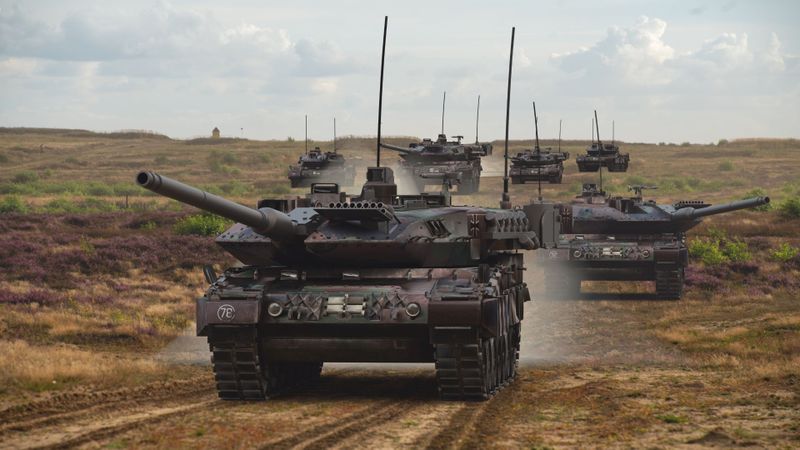
Modern ground combat vehicles have evolved from single-purpose devices with fixed hardware to software-defined, expandable systems. Such flexibility requires robust, highly reliable connector technologies.
(Picture: Mike Mareen Adobe Stock)
Those connectors should be able withstand multiple upgrades without requiring complete redesigns of wiring harnesses or structural components. Sean Fitall, European Product Manager at connector specialist PEI-Genesis, considers in this article the role of scalable connectors in the next generation of military ground vehicles.
Among the most widely used solutions supporting this transformation are connectors that comply with the MIL DTL 38999 specification. These circular connectors, which have proven themselves over decades in military applications and in aerospace, are particularly valued for their high-density contact arrangement, robust construction and flexibility in transmitting signals, data and power in a single interface.
These connectors are compatible with open standards such as VICTORY, NATO Generic Vehicle Architecture (GVA) and Modular Open Systems Approach (MOSA), which support interoperable, expandable systems via standardised interfaces.
By using uniform connector geometries, contact layouts and coupling mechanisms, system integrators can reduce the complexity of vehicle wiring harnesses and more easily integrate new mission systems from different suppliers.
Power Supply for Electrified Platforms
As open architectures become more prevalent, vehicle electrical systems must not only transmit signals and data, but also meet the high-voltage and high-current requirements of battery electric drives, traction inverters and energy-intensive subsystems. Conventional low-current connectors are often inadequate due to their limitations in terms of current capacity, heat dissipation and sealing performance.
To overcome these challenges, high-performance variants based on the MIL DTL 38999 form factor have been developed. With advanced contact technologies such as Amphenol's Radsok, these connectors can support up to 1000 A, depending on the configuration, while maintaining the sealing, vibration resistance and mating strength of their signal-capable counterparts. This allows designers to standardise the interfaces for power and signals across the entire platform.
Such standardisation simplifies integration, supports distributed power architectures and helps reduce system weight by allowing power components to be positioned closer to loads. Many variants also offer integrated voltage and temperature measurement, enabling predictive maintenance and improved fault diagnosis.
Europe’s security landscape is changing rapidly
(Source: VCG)
As defence budgets rise and EU programmes expand, civil technology providers are becoming vital contributors to Europe’s strategic autonomy. The event will act as a neutral platform for dialogue between technology suppliers, integrators, and decision-makers shaping the next generation of European defence capabilities and aims to open doors between civil industry and defence procurement, providing practical insights.
As a vehicle's digital infrastructure becomes increasingly important to the success of its missions, the seamless integration of new subsystems is also critical. LiDAR, EO/IR cameras, radar and AI support require high-speed, low-latency connections that can operate reliably in demanding electromagnetic environments. MIL-DTL-38999 connectors are well suited for this task, offering coax, twinax, quadrax and fibre optic contacts in a single-shell housing with robust EMI shielding.
Their effective shielding and mechanical resilience make them ideal for transmitting real-time data in an environment with high-performance systems, in-vehicle interference devices and severe vibration. By supporting high-bandwidth sensor fusion and AI-driven situational awareness tools, these connectors enable advanced combat capabilities without compromising system integrity.
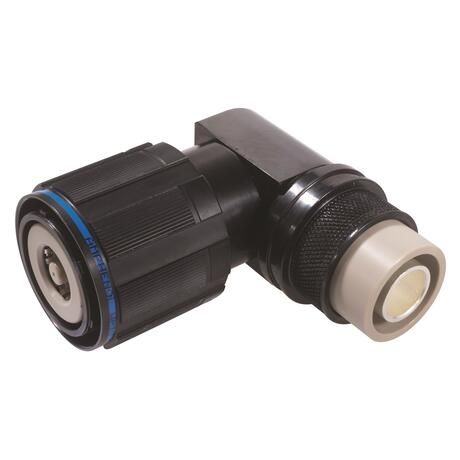
The Rhino38999 connector
(Source: PEI-Genesis)
Plug-and-fight Capabilities
Given increasing system complexity and growing mission requirements, platform flexibility has become a key design priority. Modern doctrine demands vehicle platforms that can be quickly reconfigured for different mission requirements.
For example, a vehicle may support electronic warfare operations one day and the next day it may need to transport a drone defence system or provide advanced communications systems. To ensure this level of flexibility, standardisation of signal and power interfaces is required. When platforms use the same MIL-DTL-38999 connector configurations for different payload types, mission kits can be quickly added, removed or exchanged without having to rewire or modify the base infrastructure.
Date: 08.12.2025
Naturally, we always handle your personal data responsibly. Any personal data we receive from you is processed in accordance with applicable data protection legislation. For detailed information please see our privacy policy.
Consent to the use of data for promotional purposes
I hereby consent to Vogel Communications Group GmbH & Co. KG, Max-Planck-Str. 7-9, 97082 Würzburg including any affiliated companies according to §§ 15 et seq. AktG (hereafter: Vogel Communications Group) using my e-mail address to send editorial newsletters. A list of all affiliated companies can be found here
Newsletter content may include all products and services of any companies mentioned above, including for example specialist journals and books, events and fairs as well as event-related products and services, print and digital media offers and services such as additional (editorial) newsletters, raffles, lead campaigns, market research both online and offline, specialist webportals and e-learning offers. In case my personal telephone number has also been collected, it may be used for offers of aforementioned products, for services of the companies mentioned above, and market research purposes.
Additionally, my consent also includes the processing of my email address and telephone number for data matching for marketing purposes with select advertising partners such as LinkedIn, Google, and Meta. For this, Vogel Communications Group may transmit said data in hashed form to the advertising partners who then use said data to determine whether I am also a member of the mentioned advertising partner portals. Vogel Communications Group uses this feature for the purposes of re-targeting (up-selling, cross-selling, and customer loyalty), generating so-called look-alike audiences for acquisition of new customers, and as basis for exclusion for on-going advertising campaigns. Further information can be found in section “data matching for marketing purposes”.
In case I access protected data on Internet portals of Vogel Communications Group including any affiliated companies according to §§ 15 et seq. AktG, I need to provide further data in order to register for the access to such content. In return for this free access to editorial content, my data may be used in accordance with this consent for the purposes stated here. This does not apply to data matching for marketing purposes.
Right of revocation
I understand that I can revoke my consent at will. My revocation does not change the lawfulness of data processing that was conducted based on my consent leading up to my revocation. One option to declare my revocation is to use the contact form found at https://contact.vogel.de. In case I no longer wish to receive certain newsletters, I have subscribed to, I can also click on the unsubscribe link included at the end of a newsletter. Further information regarding my right of revocation and the implementation of it as well as the consequences of my revocation can be found in the data protection declaration, section editorial newsletter.
This enables true plug-and-fight capabilities, allowing teams to reconfigure their platforms in the field without delays or high workshop costs. Power-carrying variants of these connectors ensure that even power-hungry payloads such as radar arrays or directed energy systems are supported safely and reliably. This not only simplifies integration, but also improves adaptability, operational readiness and speed of deployment in various combat situations.
Scalable Solutions for Long-Term Operational Readiness
To ensure long-term platform flexibility, connector systems are needed that can support frequent technical upgrades without requiring a redesign of the vehicle's core infrastructure. While military vehicles often remain in service for decades, on-board electronics typically evolve in much shorter cycles.
To bridge this gap, the connector infrastructure must be scalable, standardised and robust so that new technologies can be integrated without compromising physical or electrical integrity. Systems based on MIL-DTL-38999 offer this stability and therefore provide a reliable foundation for future capabilities.
The Rhino 7 connector
(Source: PEI-Genesis)
Whether integrating AI-enabled edge computing, advanced sensors or electrified drive systems, these connectors ensure that platforms remain compatible, reconfigurable and resilient, supporting the evolution towards open, modular and software-defined vehicles. An example of this scalability in practice is the Amphenol Rhino series, a high-performance connector solution based on the MIL-DTL-38999 mechanical platform.
The series was developed to meet the requirements of modern military systems and combines the robust design of Series III housings with Radsok heavy-duty contacts. This means that currents of up to 1000 A can be handled in a sealed, touch-safe housing, making the connectors particularly suitable for electrified propulsion systems, high-power subsystems and modular payloads.
To support the provision of these scalable solutions, PEI-Genesis offers extensive inventory, in-house technical expertise and rapid assembly services. This means fast delivery of customised Rhino assemblies, allowing integrators to shorten their lead times and respond quickly to changing system requirements, even late in the development cycle.
As modern ground vehicles become increasingly modular, electrified, and digitally connected, the importance of connector technology is greater than ever before. Whether you're managing high-speed data from advanced sensors or distributing high-voltage power to hybrid drives, scalable connectors based on the MIL-DTL-38999 standard offer the durability, flexibility and interoperability that modern military platforms require.
For more information on military specification connectors available from PEI-Genesis, visit www.peigenesis.com.




:quality(80)/p7i.vogel.de/wcms/a5/e5/a5e5eecaf9443bd94c6833c158d7cced/20260924-en-5431005-1-640x360v1.jpeg "(Source: Saab AB)")
:quality(80)/p7i.vogel.de/wcms/e0/e7/e0e7bcd804912a34cd152be69b05a70f/rfa-esaboost-uk-1024x682-1024x576v1.jpeg "(Source: RFA)")
:quality(80)/p7i.vogel.de/wcms/32/42/3242e8a344e00905a0d8c7fc465178a9/defence-industry-sruvey-990x557v1.jpeg "(Source: European Commission)")
:quality(80)/p7i.vogel.de/wcms/b2/db/b2db599d38480ee76cb0632c3c5ac968/sentinel3c-sadeploymentthalesaleniaspace-alban-pichon-3-1680x944v1.jpeg "(Source: Thales Alenia Space, A. Pichon)")
:quality(80)/p7i.vogel.de/wcms/13/12/1312059ec82b1ed9e3df080350b29dc4/f46335bf-a581-4786-959f-4a0e9a74aed1-1671x940v1.png "Military radar architecture using distributed RF sensor nodes connected through optical fibre to central processing. (Source: KI-generiert / Gemini)")
:quality(80)/p7i.vogel.de/wcms/0a/14/0a1495d9b570ae32a5a7cc748b9a3c60/st-hannover-035-1920x1079v1-999x562v1.jpeg "Fastening technology you can experience first-hand—visitors to Schraubtec in Bochum (Germany) can see it for themselves at the Ruhr Congress on September 30, 2026. (Source: PHOTOVISION-DH GmbH)")
:quality(80)/p7i.vogel.de/wcms/cd/a9/cda92b173afa9d0b455d4f11b281c9ea/0094-to-image--capstone-cdr-1440x810v1.png "(Source: Terran Orbital)")
:quality(80)/p7i.vogel.de/wcms/e0/45/e045bc5414d7263fb308bdd501b5fcc1/0133113962v1.jpeg "The HSWL 354 is the transmission used, for example, in the Leopard 2 main battle tank. Renk manufactures this system and is now preparing to significantly increase its cycle time. As a result, Renk is placing greater emphasis on the military sector as a customer ... (Source: Renk)")
:quality(80)/p7i.vogel.de/wcms/5a/5a/5a5a0a2b51dbe1dd52c884b951db8cc7/aefa03eb-8efe-4b02-b8dd-824db7ae426f-1672x940v1.png "(Source: KI-generiert / Gemini)")
:quality(80)/p7i.vogel.de/wcms/1f/c2/1fc25ec2bd47a47b4617766e40033de2/image-2000-74f03b8e935a22580e24d2b05fe5ca3c-1920x1079v1.jpeg "The Airbus A310 ZERO-G stands ready for the 47th DLR parabolic flight campaign. It took place in Bordeaux from 7 to 18 September 2026. A total of twelve experiments from the fields of biology, physics, technology and materials science were on board. (Source: DLR (CC BY-NC-ND 3.0))")
:quality(80)/p7i.vogel.de/wcms/22/81/22812f686fd6ec1235f02392a3df56b9/34370ad9-163a-5941-9825-9c87a0e50000-1920x1079v1.png "Ariane 6 A64 flight VA267 with 32 satellites for Amazon LEO constellation, ready for launch at Europe's Spaceport in Kourou, French Guiana on 12 February 2026. (Source: ESA—M. Pédoussaut)")
:quality(80)/p7i.vogel.de/wcms/04/6b/046bda5de33193b13ebda873c3372868/iris2-1ceuropean-commission-1-1680x944v1.jpeg "(Source: European Commission)")
:quality(80)/p7i.vogel.de/wcms/cb/a2/cba2ecda891b2874327a30f69f773bdb/hexaforce-15-1920x1079v1.jpeg "(Source: Thales/Gauthier Chauffrut)")
:quality(80)/p7i.vogel.de/wcms/9d/8a/9d8addea8cc4e6f7a4793563ca397f2a/ai-im-milit-r-1672x940v1.png "(Source: KI-generiert / Gemini)")
:quality(80)/p7i.vogel.de/wcms/7f/5f/7f5fba2c729ec3aa256bf1a18d74529b/ai-chip-1672x940v1.png "(Source: KI-generiert / Gemini)")
:quality(80)/p7i.vogel.de/wcms/64/1b/641b6474b2a614cde7730c89ef2a3015/2026-09-09-rheinmetall-veroeffentlicht-battlesuite-schnittstellen-e8c18194-1225x690v1.jpeg "Rheinmetall’s Battlesuite provides a modular digital platform for connecting and integrating sensors, hardware and software components. (Source: Rheinmetall AG)")
:quality(80)/p7i.vogel.de/wcms/f1/c8/f1c88c768ba87dd2d71c708945c7df78/s960-applied-intuition04-960x640-960x540v1.jpeg "(Source: UK Government)")
:quality(80)/p7i.vogel.de/wcms/ef/1e/ef1eaddf8243b9c30cbfef17a4151def/aufmacherv1.jpeg "What works against drones—and what should be kept in mind when it comes to chain-based defence strategies? (Source: Mattheck)")
:quality(80)/p7i.vogel.de/wcms/b1/f0/b1f00d146f272acbef15ea82996259de/s960-halo-shield-2-960x540v1.png "Quell’s SkySpyke system in action (Source: UK Government)")
:quality(80)/p7i.vogel.de/wcms/2b/3d/2b3d42b7dc255aaaf5cadf57dab47d3b/43907b28dda9-sky-striker-demo-2-1600x899v1.webp "Diehl Defence and Elbit Systems demonstrate the capabilities of the SkyStriker loitering munition during a live demonstration. (Source: Diehl Defence)")
:quality(80)/p7i.vogel.de/wcms/90/a8/90a849f0023f11d1eb642eb4751a0321/bild2-h-c3-a4nel-ict-20truck-20and-20trailer-20parts-4320x2429v1.jpeg "Product information is visible at all times and retrieval of items
is confirmed by employees directly on the display of the Hänel MP 14 N
controller. (Source: René Marks)")
:quality(80)/p7i.vogel.de/wcms/4e/ca/4ecaa39f247490eded591b652c33aee3/thilmann-hcp-web-20kleiner-20ausschnitt-1442x811v1.jpeg "Entering the defence market can be challenging for start-ups, says HCP Sense CEO Ansgar Thilmann. (Picture: HCP Sense)")
:quality(80)/p7i.vogel.de/wcms/7a/51/7a511b80041d3f1335f3a5aa56fe75da/delivery-7022432-1280-1280x720v1.png "(Source: Mohamed_hassan)")
:quality(80)/p7i.vogel.de/wcms/f9/2f/f92f1ef8c739c34c70d99f7b0997621b/stra007-20--20cover-20image-5472x3076v1.jpeg "(Source: Stratasys)")
:quality(80)/p7i.vogel.de/wcms/ec/a9/eca9062ccbe4b042f8515846340410d8/aerospace-and-defence-stairways-platforms-and-much-morev1.jpeg "Modular constructions enable flexible modification. That applies to larger structures such as stairways and platforms, too. And that means aerospace and defence companies can reconfigure their maintenance platforms fast (itemitem)")
:quality(80)/p7i.vogel.de/wcms/30/2a/302a7b5723ad38fbde812fd3a468ad04/safety-on-stairways-in-industry-key-considerationsv1.jpeg "Stairways and platforms are used widely in maintenance and assembly areas in the aerospace and defence sectors. (Source: item)")
:quality(80)/p7i.vogel.de/wcms/f3/4e/f34ed744bb30817d3432c7ad522e6f30/engine-1v1.jpeg "Engineering with aluminium profiles really can be this easy – the item Engineeringtool and its smart functions help you save valuable time. (Source: item)")
:fill(fff,0)/p7i.vogel.de/companies/69/6d/696de2483d115/logo--fastems-rgb-horizontal.jpeg "logo--fastems-rgb-horizontal (Fastems)")
:fill(fff,0)/images.vogel.de/vogelonline/companyimg/84700/84735/65.jpg "logo_item_rgb_neu.jpg ()")

:quality(80)/p7i.vogel.de/wcms/a9/34/a934c9dd0692a4d995190803ee8fb58d/pei189-1920x1079v1.jpeg "Modern electrical connectors help commercial aircraft achieve greater efficiency, reliability and power density while supporting increasingly complex onboard systems. (Source: PEI-Genesis)")
:quality(80)/p7i.vogel.de/wcms/a7/63/a763e019287f1099bc7b94c26a93b942/1544532155-winmate-remote-20control-20drone-s101tg-gcs-8000x4496v1.jpeg "The effectiveness of military drone operations depends crucially on ground control stations. NATO defines standards for technology and architecture. (Source: TL Electronic GmbH)")