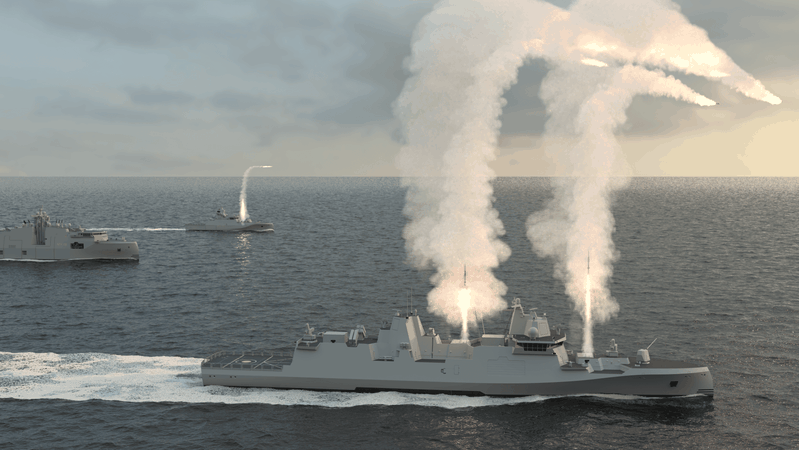
Rheinmetall has presented the GMF140 Guided Missile Frigate, a new surface-combatant concept intended for NATO and allied navies. According to the company, the design is optimised for demanding blue-water operations while retaining the flexibility required for littoral, expeditionary and multinational missions.
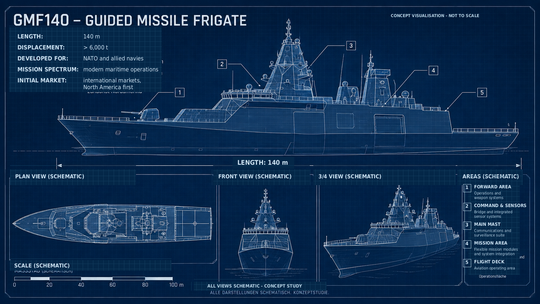
With a length of 140 metres and a displacement of more than 6,000 tonnes, the GMF140 is positioned as a heavily armed multi-mission frigate. Rheinmetall intends to market the platform internationally and plans to offer it first in connection with a procurement campaign in North America.
Air and missile defence at the centre
The ship is designed around integrated air and missile defence. Rheinmetall states that the GMF140 can accommodate US-sourced primary radar systems in several configurations, including options able to support the detection and tracking of ballistic missiles. The sensor architecture is also intended to address conventional aircraft, cruise missiles and emerging hypersonic threats.The company describes the platform as highly digitalised and designed for reduced manning. Its combination of sensors, command systems and long-range effectors is intended to provide battlespace awareness and fire-control performance more commonly associated with larger surface combatants.
AEGIS, CMS330 and 64 strike-length VLS cells
At the core of the proposed combat-system configuration is the AEGIS Combat System. Rheinmetall says AEGIS can be combined with additional command-and-control solutions, including Lockheed Martin Canada’s CMS330 Combat Management System. The open and scalable architecture is intended to support the integration of European sensors, weapons and communications equipment and to simplify operations within multinational naval task groups.
The published configuration includes 64 strike-length Vertical Launch System cells. These are intended to accommodate a broad family of air-defence, ballistic-missile-defence and land-attack missiles. Rheinmetall has not identified a final missile package, which would depend on the customer configuration, national requirements and the relevant export approvals.
The planned weapons and sensor fit also includes anti-ship missiles, torpedo launchers, a 5-inch main gun, secondary armament, a close-in weapon system, electro-optical sensors, electronic-warfare equipment, decoy systems and provision for a laser weapon
Anti-submarine warfare and embarked aviation
Rheinmetall is presenting the GMF140 as a genuine multi-domain combatant rather than a ship focused solely on air defence. The anti-submarine-warfare package is expected to include a low-signature hull, integrated acoustic management, hull-mounted sonar and a towed-array sonar system.
The design is also intended to support embarked maritime helicopters and unmanned air systems of either European or US origin. This aviation component would extend the ship’s surveillance, targeting and anti-submarine reach beyond the detection range of its organic sensors.
North America as the first target market
Schematic GMF140 concept view based on publicly released data. The drawing is AI-assisted, not to scale and not an official construction drawing.
(Source: KI-generiert / Gemini)
Rheinmetall has not named the specific North American procurement programme for which the GMF140 is being prepared. The company nevertheless makes clear that the initial campaign is intended to establish the design in the region before it is offered more widely to allied navies modernising their fleets in Europe, the North Atlantic and the Indo-Pacific.
The selected combination of US radar options, AEGIS, CMS330 and compatibility with European subsystems reflects this export strategy. It is intended to give customers access to established US-led naval combat architectures while retaining scope for national or European equipment.
A capable concept, with major programme details still open
The announcement establishes the intended mission profile and principal combat-system architecture, but it does not yet define a complete shipbuilding programme. Rheinmetall has not disclosed a launch customer, shipyard allocation, construction schedule, propulsion arrangement, range, maximum speed or final crew size.
The GMF140 should therefore be regarded as an export-oriented platform concept and campaign offer at this stage. Its eventual capability, cost and delivery schedule will depend on the customer, the selected radar and missile package, industrial participation and the maturity of the underlying ship design.
Date: 08.12.2025
Naturally, we always handle your personal data responsibly. Any personal data we receive from you is processed in accordance with applicable data protection legislation. For detailed information please see our privacy policy.
Consent to the use of data for promotional purposes
I hereby consent to Vogel Communications Group GmbH & Co. KG, Max-Planck-Str. 7-9, 97082 Würzburg including any affiliated companies according to §§ 15 et seq. AktG (hereafter: Vogel Communications Group) using my e-mail address to send editorial newsletters. A list of all affiliated companies can be found here
Newsletter content may include all products and services of any companies mentioned above, including for example specialist journals and books, events and fairs as well as event-related products and services, print and digital media offers and services such as additional (editorial) newsletters, raffles, lead campaigns, market research both online and offline, specialist webportals and e-learning offers. In case my personal telephone number has also been collected, it may be used for offers of aforementioned products, for services of the companies mentioned above, and market research purposes.
Additionally, my consent also includes the processing of my email address and telephone number for data matching for marketing purposes with select advertising partners such as LinkedIn, Google, and Meta. For this, Vogel Communications Group may transmit said data in hashed form to the advertising partners who then use said data to determine whether I am also a member of the mentioned advertising partner portals. Vogel Communications Group uses this feature for the purposes of re-targeting (up-selling, cross-selling, and customer loyalty), generating so-called look-alike audiences for acquisition of new customers, and as basis for exclusion for on-going advertising campaigns. Further information can be found in section “data matching for marketing purposes”.
In case I access protected data on Internet portals of Vogel Communications Group including any affiliated companies according to §§ 15 et seq. AktG, I need to provide further data in order to register for the access to such content. In return for this free access to editorial content, my data may be used in accordance with this consent for the purposes stated here. This does not apply to data matching for marketing purposes.
Right of revocation
I understand that I can revoke my consent at will. My revocation does not change the lawfulness of data processing that was conducted based on my consent leading up to my revocation. One option to declare my revocation is to use the contact form found at https://contact.vogel.de. In case I no longer wish to receive certain newsletters, I have subscribed to, I can also click on the unsubscribe link included at the end of a newsletter. Further information regarding my right of revocation and the implementation of it as well as the consequences of my revocation can be found in the data protection declaration, section editorial newsletter.
AEGIS Combat System, with CMS330 available as an additional combat-management option
Primary radar
US-sourced air-defence radar options, including configurations with full ballistic-missile tracking capability
Vertical launch system
64 strike-length VLS cells
Weapons and sensors
Anti-ship missiles, torpedo launchers, 5-inch main gun, laser provision, secondary armament, CIWS, EO sensors, EW systems, hull-mounted and towed sonar, and decoys
Missile compatibility
Modern air-defence, ballistic-missile-defence and land-attack missiles
Design philosophy
Open architecture, future growth, NATO interoperability and high survivability
Initial target market
North America, followed by additional allied navies




:quality(80)/p7i.vogel.de/wcms/15/4b/154bca4579386467ff88863808f1b4e8/eda-steering-board-sept-2026-1920x1079v1.jpeg "(Source: European Defence Agency)")
:quality(80)/p7i.vogel.de/wcms/70/16/701618ff59f2c84b1fc27538e9298568/55d4580c-400b-4c10-8e61-2d400e3c6e73-1536x864v1.png "Brussels is pushing for greater industrial cooperation to reduce Europe's defence capability gaps. (Picture: AI generated)")
:quality(80)/p7i.vogel.de/wcms/e2/13/e21382cc2d65da58ff970d44ce4eaf32/fennek-1106x623v1.jpeg "(Source: Bundeswehr/Carl Schulze)")
:quality(80)/p7i.vogel.de/wcms/c2/25/c225b4366a16f4c80ebd4b2a04a75c3a/6-1920x1079v1.png "(Source: COGD)")
:quality(80)/p7i.vogel.de/wcms/4f/3a/4f3a22eb23991207008533412c8dc817/screenshot-2026-09-25-125155-1405x790v1.png "(Source: BINDER GmbH)")
:quality(80)/p7i.vogel.de/wcms/4a/9f/4a9f831c424718e98ef3cf6b10b4dc3e/hot-fire-jarvisv1-900x506v1.jpeg "Developed in record time: A “JARVIS-class” jet engine capable of up to 100 pounds of thrust. It was designed in a four-week sprint using generative AI and established CAD/CAE tools. (Source: MIT)")
:quality(80)/p7i.vogel.de/wcms/13/12/1312059ec82b1ed9e3df080350b29dc4/f46335bf-a581-4786-959f-4a0e9a74aed1-1671x940v1.png "Military radar architecture using distributed RF sensor nodes connected through optical fibre to central processing. (Source: KI-generiert / Gemini)")
:quality(80)/p7i.vogel.de/wcms/0a/14/0a1495d9b570ae32a5a7cc748b9a3c60/st-hannover-035-1920x1079v1-999x562v1.jpeg "Fastening technology you can experience first-hand—visitors to Schraubtec in Bochum (Germany) can see it for themselves at the Ruhr Congress on September 30, 2026. (Source: PHOTOVISION-DH GmbH)")
:quality(80)/p7i.vogel.de/wcms/00/dc/00dcad81b11488711a69893092df7124/thedigitalartist-ai-generated-8314615-1920x1080v1.jpeg "(Source: Pete Linforth on Pixabay)")
:quality(80)/p7i.vogel.de/wcms/f9/37/f93735747249cd50daf2c2fdc4535965/9c7d8875-fc66-4fdd-aa43-5676f10bba45-624x351v1.jpeg "Team of the DLR Mobile Rocket Base (MORABA). (Source: DLR (CC BY-NC-ND 3.0))")
:quality(80)/p7i.vogel.de/wcms/fc/1c/fc1c256ca19020e8f6e398fdb9ba2025/thedigitalartist-ai-generated-8061336-1920x1080v1.jpeg "(Source: Pete Linforth on Pixabay)")
:quality(80)/p7i.vogel.de/wcms/5a/5a/5a5a0a2b51dbe1dd52c884b951db8cc7/aefa03eb-8efe-4b02-b8dd-824db7ae426f-1672x940v1.png "(Source: KI-generiert / Gemini)")
:quality(80)/p7i.vogel.de/wcms/cb/a2/cba2ecda891b2874327a30f69f773bdb/hexaforce-15-1920x1079v1.jpeg "(Source: Thales/Gauthier Chauffrut)")
:quality(80)/p7i.vogel.de/wcms/9d/8a/9d8addea8cc4e6f7a4793563ca397f2a/ai-im-milit-r-1672x940v1.png "(Source: KI-generiert / Gemini)")
:quality(80)/p7i.vogel.de/wcms/7f/5f/7f5fba2c729ec3aa256bf1a18d74529b/ai-chip-1672x940v1.png "(Source: KI-generiert / Gemini)")
:quality(80)/p7i.vogel.de/wcms/64/1b/641b6474b2a614cde7730c89ef2a3015/2026-09-09-rheinmetall-veroeffentlicht-battlesuite-schnittstellen-e8c18194-1225x690v1.jpeg "Rheinmetall’s Battlesuite provides a modular digital platform for connecting and integrating sensors, hardware and software components. (Source: Rheinmetall AG)")
:quality(80)/p7i.vogel.de/wcms/b4/0f/b40f9a9262229f0ad6f652dcff9012d8/ministry-of-defence-uk-1672x940v1.png "(Source: Ministry of Defence UK)")
:quality(80)/p7i.vogel.de/wcms/f1/c8/f1c88c768ba87dd2d71c708945c7df78/s960-applied-intuition04-960x640-960x540v1.jpeg "(Source: UK Government)")
:quality(80)/p7i.vogel.de/wcms/ef/1e/ef1eaddf8243b9c30cbfef17a4151def/aufmacherv1.jpeg "What works against drones—and what should be kept in mind when it comes to chain-based defence strategies? (Source: Mattheck)")
:quality(80)/p7i.vogel.de/wcms/b1/f0/b1f00d146f272acbef15ea82996259de/s960-halo-shield-2-960x540v1.png "Quell’s SkySpyke system in action (Source: UK Government)")
:quality(80)/p7i.vogel.de/wcms/90/a8/90a849f0023f11d1eb642eb4751a0321/bild2-h-c3-a4nel-ict-20truck-20and-20trailer-20parts-4320x2429v1.jpeg "Product information is visible at all times and retrieval of items
is confirmed by employees directly on the display of the Hänel MP 14 N
controller. (Source: René Marks)")
:quality(80)/p7i.vogel.de/wcms/4e/ca/4ecaa39f247490eded591b652c33aee3/thilmann-hcp-web-20kleiner-20ausschnitt-1442x811v1.jpeg "Entering the defence market can be challenging for start-ups, says HCP Sense CEO Ansgar Thilmann. (Picture: HCP Sense)")
:quality(80)/p7i.vogel.de/wcms/7a/51/7a511b80041d3f1335f3a5aa56fe75da/delivery-7022432-1280-1280x720v1.png "(Source: Mohamed_hassan)")
:quality(80)/p7i.vogel.de/wcms/f9/2f/f92f1ef8c739c34c70d99f7b0997621b/stra007-20--20cover-20image-5472x3076v1.jpeg "(Source: Stratasys)")
:quality(80)/p7i.vogel.de/wcms/ec/a9/eca9062ccbe4b042f8515846340410d8/aerospace-and-defence-stairways-platforms-and-much-morev1.jpeg "Modular constructions enable flexible modification. That applies to larger structures such as stairways and platforms, too. And that means aerospace and defence companies can reconfigure their maintenance platforms fast (itemitem)")
:quality(80)/p7i.vogel.de/wcms/30/2a/302a7b5723ad38fbde812fd3a468ad04/safety-on-stairways-in-industry-key-considerationsv1.jpeg "Stairways and platforms are used widely in maintenance and assembly areas in the aerospace and defence sectors. (Source: item)")
:quality(80)/p7i.vogel.de/wcms/f3/4e/f34ed744bb30817d3432c7ad522e6f30/engine-1v1.jpeg "Engineering with aluminium profiles really can be this easy – the item Engineeringtool and its smart functions help you save valuable time. (Source: item)")
:fill(fff,0)/p7i.vogel.de/companies/64/fe/64fec73b1a2fb/logo-master-ggbbytimken-286blue.jpeg "logo-master-ggbbytimken-286blue (GGB)")
:fill(fff,0)/p7i.vogel.de/companies/69/6d/696de2483d115/logo--fastems-rgb-horizontal.jpeg "logo--fastems-rgb-horizontal (Fastems)")
:fill(fff,0)/images.vogel.de/vogelonline/companyimg/84700/84735/65.jpg "logo_item_rgb_neu.jpg ()")
:quality(80)/p7i.vogel.de/wcms/85/f6/85f6aff364a13f9679f7eadc5d9d6ade/bild1-496x279v1.png "bild1-496x279v1 (Source: AI-Generated/ChatGPT)")
:quality(80)/p7i.vogel.de/wcms/be/b3/beb327f47bfcf03b27c1f4f26a4ffdce/thales-1078x606v1.jpeg "HMS Queen Elizabeth, one of the Royal Navy’s two Queen Elizabeth-class aircraft carriers, pictured during carrier strike operations. The Royal Navy’s current deployment is supported by Thales technologies across multiple maritime domains. (Source: © UK MOD - Crown copyright 2020)")