At Space Tech Expo Europe 2026 in Bremen (Germany), the German Aerospace Center (DLR) will showcase innovative technologies and research projects ranging from rocket propulsion and digital development processes to precision atomic clocks and Europe's independent access to space.
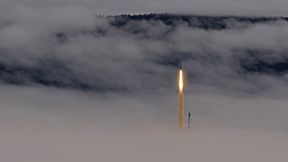
The DLR MAPHEUS-17 sounding rocket was launched on 1 October 2026 from the Esrange Space Center in Sweden. At Space Tech Expo Europe in Bremen, the DLR will provide insights into the research campaign, during which new methods for measuring rocket emissions in the atmosphere were also tested.
(Source: SSC Space)
From 17 to 19 November 2026, the international space industry will gather at Space Tech Expo Europe in Bremen (Germany). The German Aerospace Center (DLR) will once again be represented with an extensive exhibition presence. In Hall 5, Stand J28, the DLR and the German Space Agency at DLR will provide insights into current research projects and developments. The exhibits range from rocket engines and digital development processes to high-precision atomic clocks and issues surrounding European independence in space.
"The demands placed on modern space systems are growing rapidly—they must become increasingly powerful while also being available more quickly," emphasises Dr Anke Pagels-Kerp, DLR Executive Board Member for Space. "With approaches such as digital twins and model-based systems engineering, we are significantly shortening the journey from the initial idea to orbit. Whether in the further development of our LUMEN rocket engine or in key components for satellites, at Space Tech Expo in Bremen we will demonstrate how we are advancing key technologies together with our industry partners and thereby specifically strengthening the competitiveness of the space industry in Germany and Europe."
"Europe's independent access to space is a fundamental prerequisite for ensuring European resilience—not just in the space sector itself, but across all areas of society," adds Dr Walther Pelzer, Member of the DLR Executive Board and Director General of the German Space Agency at DLR. "To meet the increased launch demand in the near future, we need a competitive launcher sector, new ideas and companies capable of driving them forward. With the launch of the SPECTRUM rocket, a privately developed launch vehicle reached orbit from the European continent for the first time. This marks a major catalyst for the German space sector and, at the same time, sends a signal of strength and Europe's growing independence in space, which is being further advanced through the European Launcher Challenge. I hope that the successful ELC model will now also be applied to larger launch systems. After all, a strong European space sector is not an option but a necessity."
Investigating rocket emissions directly in the atmosphere
What impact do rocket launches have on the atmosphere? The DLR is investigating this question using new measurement methods. During the successful flight of the MAPHEUS-17 sounding rocket on 1 October 2026, techniques for the targeted measurement of rocket emissions were tested for the first time. The DLR research aircraft Falcon 20E, equipped with extensive measurement technology, also took part. Following the rocket launch, it conducted measurement flights at altitudes between 2 and 6 km. At the exhibition, the DLR will provide insights into the campaign and present, among other things, a measurement instrument from the Falcon.
From idea to orbit—developing space systems digitally
Space systems are becoming increasingly complex, while at the same time they need to be developed and tested more quickly. The interactive "From-Idea-To-Orbit" demonstrator illustrates how this can be achieved. It combines model-based systems engineering, digital twins and modular avionics with a virtual mission environment. Using a ship detection scenario, visitors can experience how algorithms and hardware are first tested virtually and subsequently with real components. This can shorten development times and improve the adaptability of future space systems.
New developments for rocket engines and satellites
With "LUMEN Optimized", the DLR is working to further develop its demonstrator engine into a flight-ready rocket engine. Four signed letters of intent demonstrate that industry is already showing interest. Following successful commissioning, the engine design is to be licensed to companies for commercial use.
Other exhibits focus on key components for rockets and satellites. These include a fibre-ceramic nozzle throat for a DLR hybrid engine, which is particularly resistant and experiences very little material loss even under high loads. The DLR will also showcase innovative holding and release mechanisms. These enable, for example, the reliable deployment of solar arrays in space.
Another exhibit demonstrates how precise timekeeping can be ensured independently of satellite navigation systems: a compact atomic clock based on laser-cooled atoms. In the long term, it is intended to provide highly stable time references and could be used in navigation, telecommunications and critical infrastructure, among other applications.
Date: 08.12.2025
Naturally, we always handle your personal data responsibly. Any personal data we receive from you is processed in accordance with applicable data protection legislation. For detailed information please see our privacy policy.
Consent to the use of data for promotional purposes
I hereby consent to Vogel Communications Group GmbH & Co. KG, Max-Planck-Str. 7-9, 97082 Würzburg including any affiliated companies according to §§ 15 et seq. AktG (hereafter: Vogel Communications Group) using my e-mail address to send editorial newsletters. A list of all affiliated companies can be found here
Newsletter content may include all products and services of any companies mentioned above, including for example specialist journals and books, events and fairs as well as event-related products and services, print and digital media offers and services such as additional (editorial) newsletters, raffles, lead campaigns, market research both online and offline, specialist webportals and e-learning offers. In case my personal telephone number has also been collected, it may be used for offers of aforementioned products, for services of the companies mentioned above, and market research purposes.
Additionally, my consent also includes the processing of my email address and telephone number for data matching for marketing purposes with select advertising partners such as LinkedIn, Google, and Meta. For this, Vogel Communications Group may transmit said data in hashed form to the advertising partners who then use said data to determine whether I am also a member of the mentioned advertising partner portals. Vogel Communications Group uses this feature for the purposes of re-targeting (up-selling, cross-selling, and customer loyalty), generating so-called look-alike audiences for acquisition of new customers, and as basis for exclusion for on-going advertising campaigns. Further information can be found in section “data matching for marketing purposes”.
In case I access protected data on Internet portals of Vogel Communications Group including any affiliated companies according to §§ 15 et seq. AktG, I need to provide further data in order to register for the access to such content. In return for this free access to editorial content, my data may be used in accordance with this consent for the purposes stated here. This does not apply to data matching for marketing purposes.
Right of revocation
I understand that I can revoke my consent at will. My revocation does not change the lawfulness of data processing that was conducted based on my consent leading up to my revocation. One option to declare my revocation is to use the contact form found at https://contact.vogel.de. In case I no longer wish to receive certain newsletters, I have subscribed to, I can also click on the unsubscribe link included at the end of a newsletter. Further information regarding my right of revocation and the implementation of it as well as the consequences of my revocation can be found in the data protection declaration, section editorial newsletter.
Europe's independent access to space
Independent access to space is an important prerequisite for Europe's ability to act autonomously. This requires a competitive launcher sector, new ideas and innovative companies. At the exhibition, the German Space Agency at DLR will present the "European Launcher Challenge", which is designed to address precisely these requirements. The European competition aims to advance the development of new, high-performance launch vehicles. A presentation will highlight, among other things, the involvement of two German companies.
The importance of a powerful European space infrastructure is also evident in everyday life. Under the themes "Galileo" and "A Day Without Spaceflight", the Space Agency illustrates just how dependent we are on satellite-based services. Videos demonstrate their importance for navigation, communications and numerous other applications.
Virtual spaceflight aboard SPACEBUZZ ONE
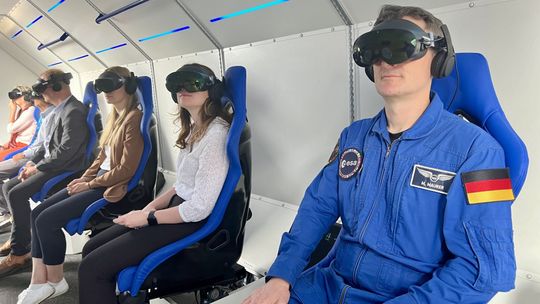
With the SPACEBUZZ ONE operated by the German Space Agency at DLR, visitors to Space Tech Expo Europe 2026 in Bremen can embark on a virtual journey into space, accompanied by avatars of German ESA astronauts Alexander Gerst and Matthias Maurer.
(Source: DLR)
The rocket-shaped SPACEBUZZ ONE operated by the German Space Agency at DLR will also be back at the Messe Bremen exhibition grounds. Visitors take their seats in moving chairs, put on VR headsets and embark on a virtual flight into space. For around 15 minutes, they experience the Earth and the International Space Station (ISS) from the perspective of astronauts. Along the way, they learn more about our home planet and the effects of human-induced climate change. The journey then continues to the Moon before returning to Earth. The flight is accompanied by avatars of German ESA astronauts Alexander Gerst and Matthias Maurer. The experience is free of charge and does not require advance registration.