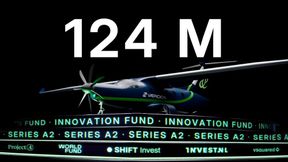
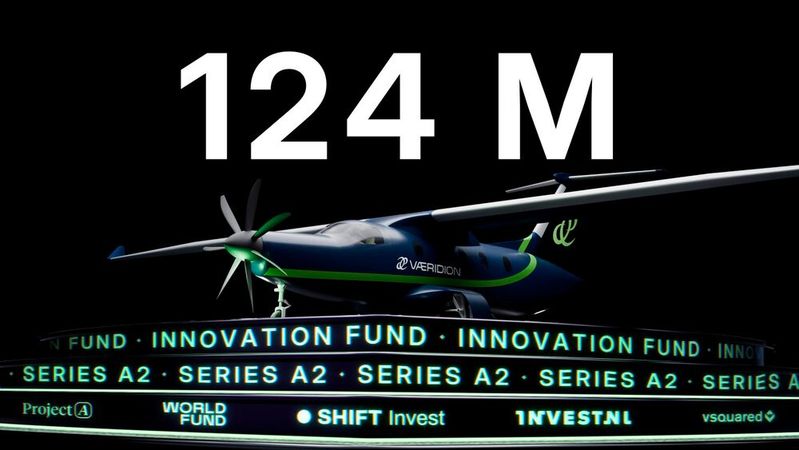
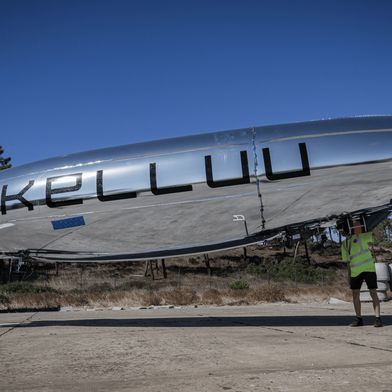
VÆRIDION has closed a €30 million (approx. 33 million USD) Series A2 financing round to build the prototype of its nine-passenger Microliner. At the same time, the company’s Carolus project was selected by the European Commission for a €94,5 million (approx. 105 million USD) grant from the Innovation Fund to support the construction and commissioning of a final assembly facility at Oberpfaffenhofen Airport (Germany).
VÆRIDION has closed a EUR 30 million Series A2 financing round to build the prototype of its nine-passenger Microliner. At the same time, the company’s Carolus project was selected by the European Commission for a EUR 94,5 million grant from the Innovation Fund.
(Source: VÆRIDION)
The financing round was led by Shift Invest and Invest-NL, with participation from existing investors World Fund, Project A and Vsquared Ventures, as well as, among others, Payback founder and deep-tech investor Alexander Rittweger. Including this financing round and earlier public funding, VÆRIDION has raised around 60 million euros (approx. 67 million USD) to date.
The grant comes from the EU Innovation Fund and complements the raised equity capital. Carolus was selected from 358 applications as one of only 12 large-scale projects. The selection is subject to the conclusion of the grant agreement, which is expected to be signed in 2027. “Over the past year, we have moved the Microliner from a validated design into the hardware phase with exceptional capital efficiency,” explains Ivor van Dartel, founder and CEO of VÆRIDION. “Our propulsion and battery technology is currently being tested at our own facility in Oberpfaffenhofen. This funding round enables us to build our first series-compliant aircraft. Carolus’s selection by the Commission supports the next step: building up industrial capacity for Microliner production. With Europe as our starting point, our mission is to make regional air travel economically viable and accessible again—in Europe and for operators worldwide.”
Short-haul routes are currently economically difficult to operate
Regional aviation is particularly vulnerable to shocks in fuel prices. Since the price of aviation gasoline is set to more than double by October 2026 compared to the previous year, and the EU imports 57 percent of its energy, the region remains highly exposed to fluctuations in the energy market.
In addition, more than 21,000 small turboprop aircraft are in service worldwide on regional routes. Their average age is 23 years, and no new aircraft of this size has entered service for 30 years. According to the European Regions Airline Association (ERAA), in the five years prior to June 2026 around 120 regional routes in Europe were discontinued because, due to fuel and rising maintenance costs, it is becoming increasingly difficult to operate short-haul routes economically.
Microliner as a response to economic challenges
VÆRIDION developed the Microliner to change these economic conditions. Target operating costs of under €0.40 (approx. 0.44 USD) per seat-kilometer would enable operators to offer airfares at the level of a first-class train ticket while still running profitable regional routes. In Germany alone, there are more airfields accessible to the Microliner than ICE high-speed rail stations. The Microliner therefore offers an economically viable solution to restore direct connections where none exist today and to enable new connections, including routes operated under public service obligations. The aircraft’s low noise footprint could also allow night flights, subject to airport approval. The opportunities go beyond replacing existing aircraft: McKinsey estimates that the global market for regional air mobility could reach a volume of up to US$115 billion by 2035.
A range of 400 kilometers with nine passengers under IFR
The Microliner, developed entirely from scratch, was designed for regional routes and combines a glider-inspired wing with patented, integrated modular batteries and a multi-motor single-propeller propulsion system. It targets a range of 400 kilometers (approx. 249 miles) with nine passengers under Instrument Flight Rules (IFR) or up to 550 kilometers (approx. 342 miles) with four passengers under Visual Flight Rules (VFR), and is planned in passenger and cargo versions. Developed in accordance with the requirements of EASA CS-23, the aircraft has, over the past 12 months, completed its preliminary design review as well as the second pre-application contract with EASA, thereby reducing the risks of the certification process for its novel technologies.
While the funding round supports the initial tests of the compliant Microliner and the integrated propulsion system, Carolus is focusing on the mass-scale series production and delivery of electric regional aircraft. Customer demand already exists and spans regional airlines, charter companies and lessors, with firm orders for more than 130 aircraft worth over 730 million euros (approx. 809 million USD).
Next steps
In March 2026, VÆRIDION opened its production and test facility at Oberpfaffenhofen Airport, where the company recently put its electric motor into operation for the first time. Next, the battery packs and the propulsion system will be integrated on a ground test rig known as the “Copper Bird.” Together with wind tunnel tests, this will support the development of the first production-ready Microliner as well as preparations for flight tests.
Date: 08.12.2025
Naturally, we always handle your personal data responsibly. Any personal data we receive from you is processed in accordance with applicable data protection legislation. For detailed information please see our privacy policy.
Consent to the use of data for promotional purposes
I hereby consent to Vogel Communications Group GmbH & Co. KG, Max-Planck-Str. 7-9, 97082 Würzburg including any affiliated companies according to §§ 15 et seq. AktG (hereafter: Vogel Communications Group) using my e-mail address to send editorial newsletters. A list of all affiliated companies can be found here
Newsletter content may include all products and services of any companies mentioned above, including for example specialist journals and books, events and fairs as well as event-related products and services, print and digital media offers and services such as additional (editorial) newsletters, raffles, lead campaigns, market research both online and offline, specialist webportals and e-learning offers. In case my personal telephone number has also been collected, it may be used for offers of aforementioned products, for services of the companies mentioned above, and market research purposes.
Additionally, my consent also includes the processing of my email address and telephone number for data matching for marketing purposes with select advertising partners such as LinkedIn, Google, and Meta. For this, Vogel Communications Group may transmit said data in hashed form to the advertising partners who then use said data to determine whether I am also a member of the mentioned advertising partner portals. Vogel Communications Group uses this feature for the purposes of re-targeting (up-selling, cross-selling, and customer loyalty), generating so-called look-alike audiences for acquisition of new customers, and as basis for exclusion for on-going advertising campaigns. Further information can be found in section “data matching for marketing purposes”.
In case I access protected data on Internet portals of Vogel Communications Group including any affiliated companies according to §§ 15 et seq. AktG, I need to provide further data in order to register for the access to such content. In return for this free access to editorial content, my data may be used in accordance with this consent for the purposes stated here. This does not apply to data matching for marketing purposes.
Right of revocation
I understand that I can revoke my consent at will. My revocation does not change the lawfulness of data processing that was conducted based on my consent leading up to my revocation. One option to declare my revocation is to use the contact form found at https://contact.vogel.de. In case I no longer wish to receive certain newsletters, I have subscribed to, I can also click on the unsubscribe link included at the end of a newsletter. Further information regarding my right of revocation and the implementation of it as well as the consequences of my revocation can be found in the data protection declaration, section editorial newsletter.
The Microliner is being developed in Munich and Delft and built in Bavaria. (se)