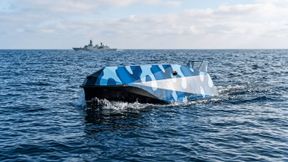
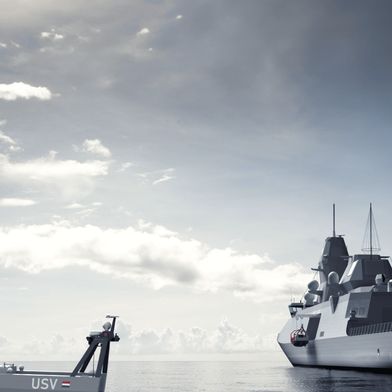
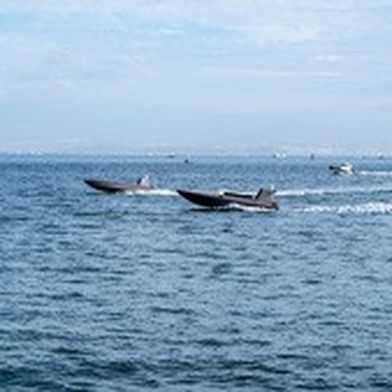
Thales advanced its hybrid fleet vision for anti-submarine warfare with three key innovations at Euronaval 2026.
(Source: Thales)
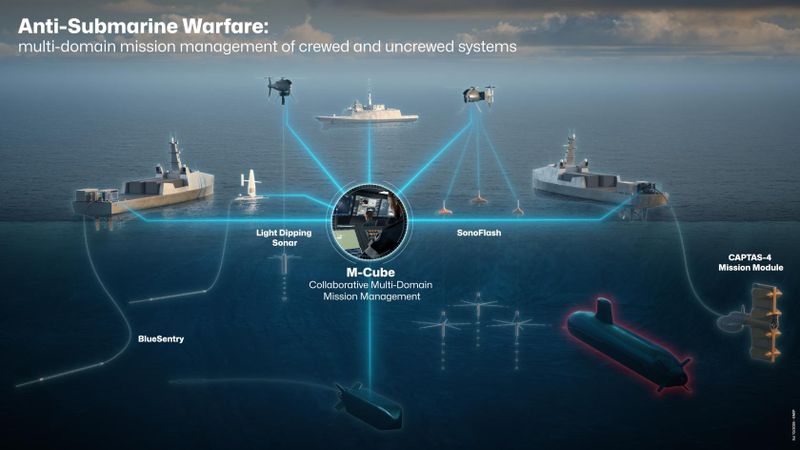
As undersea threats become increasingly complex and naval forces seek to maximise their operational effectiveness, the future of ASW lies in the ability to distribute sensing, extend operational reach and seamlessly orchestrate a growing mix of manned and unmanned assets. Through its Hybrid Fleet vision, Thales is enabling navies to move beyond traditional platform-centric operations towards a connected, scalable and resilient ASW ecosystem.
At Euronaval 2026, Thales highlighted three key innovations that bring this vision to life: M-Cube, the mission management system that enables collaborative operations across distributed assets; the new Lightweight Dipping Sonar (LDS), bringing advanced acoustic detection capabilities to autonomous and lightweight platforms; and the CAPTAS-4 Mission Module (C4MM), delivering world-class variable-depth sonar performance in a flexible, rapidly deployable format.
M-Cube: the mission management backbone of the hybrid fleet
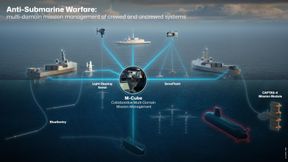
At the heart of Thales' Hybrid Fleet vision, M-Cube provides the mission management and command-and-control framework required to coordinate complex operations involving crewed and uncrewed platforms.
Designed to support collaborative operations across multiple domains, M-Cube enables operators to plan, task and supervise distributed assets from a single mission environment. By orchestrating the deployment of ships, helicopters, unmanned surface vessels and other autonomous systems, it allows navies to conduct coordinated ASW operations over wider areas with increased operational efficiency and responsiveness.
Originally developed and proven in mine warfare missions, M-Cube is now expanding to Anti-Submarine Warfare, ISR and Above Water Warfare applications, providing a scalable and interoperable architecture aligned with NATO operational requirements.
Expanding ASW reach with the Lightweight Dipping Sonar
The Hybrid Fleet vision also relies on multiplying the number of sensors available within the battlespace. To address this challenge, Thales introduced its Lightweight Dipping Sonar (LDS).
Derived from decades of expertise in advanced sonar technologies, LDS extends high-performance acoustic detection capabilities to a new generation of autonomous and lightweight platforms. Compact, modular and highly deployable, the system enables unmanned vessels and other non-traditional platforms to perform sophisticated underwater surveillance and submarine detection missions.
By allowing advanced sonar capabilities to be deployed further forward and for extended periods of time, LDS significantly enhances operational persistence while reducing risks to personnel and high-value assets.
Complementing this distributed architecture is the CAPTAS-4 Mission Module, which brings the proven performance of the world-leading CAPTAS-4 variable-depth sonar to a wider range of naval platforms.
Packaged as a modular, deployable and cross-deckable capability, it offers maximum operational flexibility across heterogeneous fleet. The CAPTAS-4 Mission Module enables navies to rapidly equip vessels with high-end ASW capabilities without requiring dedicated ASW frigates. This unprecedented flexibility allows operators to adapt their force structure to mission requirements while maintaining the level of performance needed to detect and track increasingly silent submarine threats.
By extending advanced underwater warfare capabilities across a broader fleet, CAPTAS-4 Mission Module plays a key role in enabling distributed and scalable ASW operations.
Shaping the future of underwater superiority
These three innovations build on Thales’ growing portfolio of autonomous underwater warfare capabilities, including BlueSentry, a compact towed sonar payload designed for integration on uncrewed maritime platforms to provide persistent underwater surveillance and anti-submarine warfare capabilities.
"The future of Anti-Submarine Warfare is not about a single platform. It is about the ability to connect ships, autonomous systems and advanced sensors into a coordinated operational ecosystem," said Sébastien Guérémy, Vice-President, UnderWater Systems, Thales." Through these technologies, Thales is helping navies maintain decisive advantage in an increasingly contested underwater environment.”
Date: 08.12.2025
Naturally, we always handle your personal data responsibly. Any personal data we receive from you is processed in accordance with applicable data protection legislation. For detailed information please see our privacy policy.
Consent to the use of data for promotional purposes
I hereby consent to Vogel Communications Group GmbH & Co. KG, Max-Planck-Str. 7-9, 97082 Würzburg including any affiliated companies according to §§ 15 et seq. AktG (hereafter: Vogel Communications Group) using my e-mail address to send editorial newsletters. A list of all affiliated companies can be found here
Newsletter content may include all products and services of any companies mentioned above, including for example specialist journals and books, events and fairs as well as event-related products and services, print and digital media offers and services such as additional (editorial) newsletters, raffles, lead campaigns, market research both online and offline, specialist webportals and e-learning offers. In case my personal telephone number has also been collected, it may be used for offers of aforementioned products, for services of the companies mentioned above, and market research purposes.
Additionally, my consent also includes the processing of my email address and telephone number for data matching for marketing purposes with select advertising partners such as LinkedIn, Google, and Meta. For this, Vogel Communications Group may transmit said data in hashed form to the advertising partners who then use said data to determine whether I am also a member of the mentioned advertising partner portals. Vogel Communications Group uses this feature for the purposes of re-targeting (up-selling, cross-selling, and customer loyalty), generating so-called look-alike audiences for acquisition of new customers, and as basis for exclusion for on-going advertising campaigns. Further information can be found in section “data matching for marketing purposes”.
In case I access protected data on Internet portals of Vogel Communications Group including any affiliated companies according to §§ 15 et seq. AktG, I need to provide further data in order to register for the access to such content. In return for this free access to editorial content, my data may be used in accordance with this consent for the purposes stated here. This does not apply to data matching for marketing purposes.
Right of revocation
I understand that I can revoke my consent at will. My revocation does not change the lawfulness of data processing that was conducted based on my consent leading up to my revocation. One option to declare my revocation is to use the contact form found at https://contact.vogel.de. In case I no longer wish to receive certain newsletters, I have subscribed to, I can also click on the unsubscribe link included at the end of a newsletter. Further information regarding my right of revocation and the implementation of it as well as the consequences of my revocation can be found in the data protection declaration, section editorial newsletter.