The EDAG Group has been combining automotive know-how with defense expertise since 2004. Thomas Mailänder and Tobias Reger explain how end-to-end system integration accelerates time-to-field and what software-defined defense means for the next generation of networked systems.
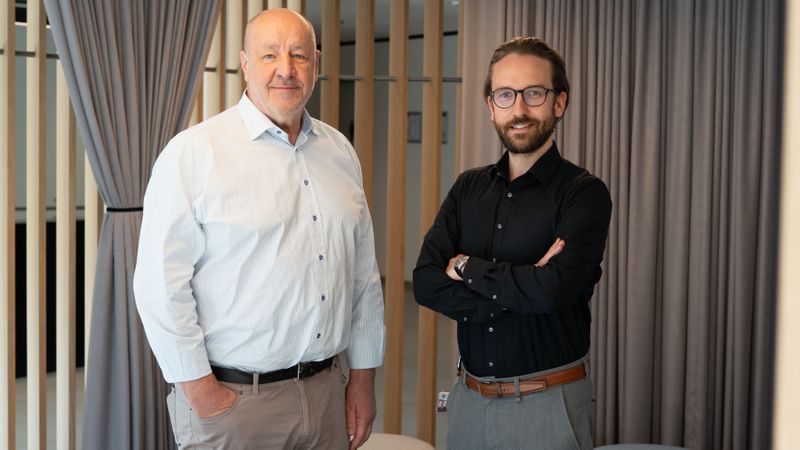
Thomas Mailänder (left) and Tobias Reger (right)
(Source: EDAG)
Mr. Mailänder, Mr. Reger, the turnover of the Defence division at EDAG grew by almost 90 percent in 2025 compared to the previous year. In the future, the division should generate 15 percent of Group turnover. What milestones do you want to achieve this goal with?
Thomas Mailänder: We initially made organizational changes and established a separate Defence profit center. This goes hand in hand with a significant increase in personnel and greater internationalization. We are also expanding our product portfolio considerably: we have a traditional background in special protection, but are now aiming to take on entire system integrations for defense system providers and have larger work packages transferred directly to us.
Tobias Reger: We specifically asked ourselves: How can we strategically position ourselves to meet the needs of the defense industry? We are positioning ourselves as an end-to-end solution provider. This means that we define requirements, develop and integrate systems, validate them in our own EMC laboratories and support the customer right through to production. We can redesign production areas and even provide support as a production service provider for assemblies or entire systems in small batches. This end-to-end expertise sets us apart from the market.
At the recent annual financial press conference, it was said that automotive customers are currently demanding offshore offers because of the low costs. Defense customers absolutely want German engineers because of safety. Is the competitive situation therefore more relaxed for you in the defense sector?
Reger: There are two sides to that. There is competition here too. The part of the competition that uses large workforces in Asia is partially eliminated due to exclusion criteria of the public client. At the same time, the contract award volume in the defense industry is significantly smaller than in the automotive industry, meaning that the entire German EDL market is now focused on this smaller volume.
However, there are also internationalization trends due to so-called offset obligations. When our system houses sell abroad, they often undertake to generate local added value. This is where we at EDAG can provide strong support by providing engineering services in NATO partner countries in Europe.
In which products or divisions can EDAG best contribute its automotive expertise?
Mailänder: Very strongly in the land systems sector, of course. If you look at wheeled vehicles, there is a very high degree of overlap with automotive technology: engines, gearboxes, wheels, steering knuckles and E/E architecture. But there are also starting points in aviation. One keyword is "software-defined defense". The networking and integration of complex, software-driven systems is a huge challenge in defense today - and this is precisely where EDAG is very well positioned.
An automotive lifecycle is fundamentally different. How big is the cultural difference in the projects?
Mailänder: In the automotive sector, we have a cost-driven pull market with very short development cycles. In the defense industry, we have a capability and mission-oriented push market that is politically driven. Here we are talking about life cycles of 20 to 30 years. The foundations for the Boxer wheeled armored vehicle system were laid around the mid-1990s, and the lifecycle goes on for another 15 years.
However, the turnaround and the pressure to be ready for defense by 2030 have given time-to-market a completely different meaning. The defense industry is desperately looking for ways to shorten these times and this is exactly where we can help.
Reger: That's exactly the point. The system houses approach us and say: "Bring us your automotive expertise. How can we get something ready for the market within two to three years?" It's about stimulating the product development process. We are talking a lot about modularization here. The approach from the automotive industry can be transferred very well to the defense sector. This reduces development times and costs enormously.
Thomas Mailänder
has been head of EDAG's Defense division since March 2026. He began his career at Mercedes-Benz in the off-road vehicle sector. He then gained a lot of experience in the defense industry: at Krauss-Maffei/KMW and Rheinmetall.
The automotive industry has invested massively in modern E/E and software architectures in recent years. Does the automotive industry have a technological advantage here?
Reger: The automotive industry is one step ahead when it comes to rolling out these systems and the skills profile. We are contributing our experience and lessons learned from the software-defined vehicle sector so that the learning curve in the defense sector can become more efficient.
However, it should not be transferred one-to-one. The application in the field is often more complex in the defense industry. It's not just about driving, but about reconnaissance and impact. A vehicle moves in highly dynamic terrain without white lines and road signs. The technological basis is the same, but the boundary conditions are much more complex.
How do you handle this in terms of personnel? Is the Defence division an encapsulated unit or do you work with employees from the Automotive division depending on the project?
Reger: We live in the EDAG matrix organization. We use our established automotive competence centers - for example for E/E architecture or software - and use them to form core teams for the defence sector. Due to safety-relevant requirements, screenings and export regulations, these project teams must be kept relatively constant. We therefore draw on the large automotive knowledge pool, but then establish stable, long-term teams that work according to military quality standards.
Cars are an emotionally charged product in Germany. Are there any concerns among EDAG employees if they are now expected to develop technology for military use?
Reger: That has changed considerably. Society's perception of the arms industry has changed; it's about safeguarding our peace and our values. As EDAG, we have also adopted a clear ethics statement: We develop exclusively in a NATO and European context and adhere strictly to export control laws. When we explain this to our employees, we are met with a great deal of openness. Especially as the products are technologically very exciting for engineers.
Tobias Reger
has been Vice President of Sales in the Defense division and Site Manager Ingolstadt for a year now. Reger began working in design at EDAG in 2010 at the same time as studying automotive engineering. He joined the sales department in 2022 via project management.
Mailänder: Unfortunately, you can't do without defence and the arms industry - most people recognize that today. Acceptance has increased significantly. Of course, there are a few colleagues who reject this for themselves, which we absolutely accept. But the majority see it in a positive light. A Leopard tank that brakes from 70 km/h in the shortest possible distance - that brings with it technological challenges that make the heart of every vehicle technician beat faster. In addition, the expansion of the defense sector also secures jobs when there are fluctuations in the automotive industry.
Do you currently also see a transfer of expertise from the defense industry back to the automotive industry when it comes to "resilient supply chains"?
Reger: Yes, this is a classic dual-use effect. The defense industry is currently being forced to establish completely independent and secure supply chains - the keyword here is "China-free" or increasing independence from the USA. If the domestic industry now invests again in European production capacities and core technologies, such as secure connectors or semiconductors, this resilience will also benefit the automotive industry in the medium and long term.
Date: 08.12.2025
Naturally, we always handle your personal data responsibly. Any personal data we receive from you is processed in accordance with applicable data protection legislation. For detailed information please see our privacy policy.
Consent to the use of data for promotional purposes
I hereby consent to Vogel Communications Group GmbH & Co. KG, Max-Planck-Str. 7-9, 97082 Würzburg including any affiliated companies according to §§ 15 et seq. AktG (hereafter: Vogel Communications Group) using my e-mail address to send editorial newsletters. A list of all affiliated companies can be found here
Newsletter content may include all products and services of any companies mentioned above, including for example specialist journals and books, events and fairs as well as event-related products and services, print and digital media offers and services such as additional (editorial) newsletters, raffles, lead campaigns, market research both online and offline, specialist webportals and e-learning offers. In case my personal telephone number has also been collected, it may be used for offers of aforementioned products, for services of the companies mentioned above, and market research purposes.
Additionally, my consent also includes the processing of my email address and telephone number for data matching for marketing purposes with select advertising partners such as LinkedIn, Google, and Meta. For this, Vogel Communications Group may transmit said data in hashed form to the advertising partners who then use said data to determine whether I am also a member of the mentioned advertising partner portals. Vogel Communications Group uses this feature for the purposes of re-targeting (up-selling, cross-selling, and customer loyalty), generating so-called look-alike audiences for acquisition of new customers, and as basis for exclusion for on-going advertising campaigns. Further information can be found in section “data matching for marketing purposes”.
In case I access protected data on Internet portals of Vogel Communications Group including any affiliated companies according to §§ 15 et seq. AktG, I need to provide further data in order to register for the access to such content. In return for this free access to editorial content, my data may be used in accordance with this consent for the purposes stated here. This does not apply to data matching for marketing purposes.
Right of revocation
I understand that I can revoke my consent at will. My revocation does not change the lawfulness of data processing that was conducted based on my consent leading up to my revocation. One option to declare my revocation is to use the contact form found at https://contact.vogel.de. In case I no longer wish to receive certain newsletters, I have subscribed to, I can also click on the unsubscribe link included at the end of a newsletter. Further information regarding my right of revocation and the implementation of it as well as the consequences of my revocation can be found in the data protection declaration, section editorial newsletter.


:quality(80)/p7i.vogel.de/wcms/f6/95/f6954fa7c09ba58863a3730f5e384a62/arek-socha-on-pixabay-1707x960v1.jpeg "A new national space strategy brings together UK’s plans for growth, defence, and national security to help reindustrialise the UK. (Source: Arek Socha on Pixabay)")
:quality(80)/p7i.vogel.de/wcms/63/0f/630f214fa760b8c7f7f7d6279d411fcf/d4ceed8f2f52-2026-08-30-hydef-06--msc4159-1200x675v1.webp "(Source: Diehl Defence)")
:quality(80)/p7i.vogel.de/wcms/4e/7d/4e7d38327c6c928b403249e3c24a2a7c/0132118791v1.jpeg "Porsche Holding SE announces that it is once again turning to rocket technology. Following its investment in Isar Aerospace, the company is now acquiring a stake in a U.S. firm ... (Source: Porsche)")
:quality(80)/p7i.vogel.de/wcms/1c/08/1c082bbd9d05b634168b617aa26fcdcf/safe-bg-lv-ro-v1-991x557v1.png "(Source: European Commission)")
:quality(80)/p7i.vogel.de/wcms/0a/14/0a1495d9b570ae32a5a7cc748b9a3c60/st-hannover-035-1920x1079v1-999x562v1.jpeg "Fastening technology you can experience first-hand—visitors to Schraubtec in Bochum (Germany) can see it for themselves at the Ruhr Congress on September 30, 2026. (Source: PHOTOVISION-DH GmbH)")
:quality(80)/p7i.vogel.de/wcms/cd/a9/cda92b173afa9d0b455d4f11b281c9ea/0094-to-image--capstone-cdr-1440x810v1.png "(Source: Terran Orbital)")
:quality(80)/p7i.vogel.de/wcms/e0/45/e045bc5414d7263fb308bdd501b5fcc1/0133113962v1.jpeg "The HSWL 354 is the transmission used, for example, in the Leopard 2 main battle tank. Renk manufactures this system and is now preparing to significantly increase its cycle time. As a result, Renk is placing greater emphasis on the military sector as a customer ... (Source: Renk)")
:quality(80)/p7i.vogel.de/wcms/a1/5c/a15c2aeba563d5bc3e11fb879b21eb2c/0132989650v1.jpeg "FSS, the flexible clamping system for varying free-form surfaces, is designed for the aerospace industry and other sectors. (Source: Römheld GmbH Friedrichshütte)")
:quality(80)/p7i.vogel.de/wcms/46/8e/468effa87546a2b036dc88ca40e2843e/129fbcac92ce7da872b13af0281b0799-l-png-1920x1079v1.webp "(Source: Arianespace)")
:quality(80)/p7i.vogel.de/wcms/8f/10/8f10697d4bfbd70edf615cca76eaedfd/pete-linforth-on-pixabay-1920x1080v1.jpeg "(Source: Pete Linforth on Pixabay / AI-generated)")
:quality(80)/p7i.vogel.de/wcms/0f/99/0f99561bf51818af92b2960656405aa5/roland-4d-pippes-on-pixabay-1460x820v1.jpeg "(Source: Roland 4D Pippes on Pixabay)")
:quality(80)/p7i.vogel.de/wcms/05/49/054906f874b94ef08b09d5920396e27d/airbus-h160-1920x1079v1.jpeg "Airbus H160 (Source: Airbus)")
:quality(80)/p7i.vogel.de/wcms/9d/8a/9d8addea8cc4e6f7a4793563ca397f2a/ai-im-milit-r-1672x940v1.png "(Source: KI-generiert / Gemini)")
:quality(80)/p7i.vogel.de/wcms/7f/5f/7f5fba2c729ec3aa256bf1a18d74529b/ai-chip-1672x940v1.png "(Source: KI-generiert / Gemini)")
:quality(80)/p7i.vogel.de/wcms/64/1b/641b6474b2a614cde7730c89ef2a3015/2026-09-09-rheinmetall-veroeffentlicht-battlesuite-schnittstellen-e8c18194-1225x690v1.jpeg "Rheinmetall’s Battlesuite provides a modular digital platform for connecting and integrating sensors, hardware and software components. (Source: Rheinmetall AG)")
:quality(80)/p7i.vogel.de/wcms/6f/fe/6ffef325e7f233cc3521943158eb1ebd/0132763535v1.jpeg "Two companies are planning to establish, for the first time in 2027, an optical laser communication link directly between a satellite in low Earth orbit (LEO) and a re-entering spacecraft. (Source: ATMOS Space Cargo)")
:quality(80)/p7i.vogel.de/wcms/8f/f9/8ff91b78b26cb5a2b8a29e39835005b1/2026-09-10-repmus-teaser-images-retouched-dsc01292-1024x683-1024x576v1.jpeg "(Source: Quantum Systems GmbH)")
:quality(80)/p7i.vogel.de/wcms/bf/4a/bf4a237e60d3d4bd1bbdbad918f3c697/airbus-defence-and-space-3-1280x720v1.jpeg "(Source: Airbus Defence and Space)")
:quality(80)/p7i.vogel.de/wcms/e0/d1/e0d112a0d54a4fa9603ec855f7d25b47/t-rex-content-photo-jpg-pc-adaptive-990-medium-988x556v1.jpeg "Swarm of UAVs conducting a fully autonomous collaborative swarm mission. (Source: Lockheed Martin)")
:quality(80)/p7i.vogel.de/wcms/79/fc/79fcaa7ca33e393b11a4740d7d8f3dbe/vilkasss-handshake-9459740-1911x1076v1.jpeg "(Source: Vilius Kukanauskas on Pixabay)")
:quality(80)/p7i.vogel.de/wcms/90/a8/90a849f0023f11d1eb642eb4751a0321/bild2-h-c3-a4nel-ict-20truck-20and-20trailer-20parts-4320x2429v1.jpeg "Product information is visible at all times and retrieval of items
is confirmed by employees directly on the display of the Hänel MP 14 N
controller. (Source: René Marks)")
:quality(80)/p7i.vogel.de/wcms/4e/ca/4ecaa39f247490eded591b652c33aee3/thilmann-hcp-web-20kleiner-20ausschnitt-1442x811v1.jpeg "Entering the defence market can be challenging for start-ups, says HCP Sense CEO Ansgar Thilmann. (Picture: HCP Sense)")
:quality(80)/p7i.vogel.de/wcms/7a/51/7a511b80041d3f1335f3a5aa56fe75da/delivery-7022432-1280-1280x720v1.png "(Source: Mohamed_hassan)")
:quality(80)/p7i.vogel.de/wcms/f9/2f/f92f1ef8c739c34c70d99f7b0997621b/stra007-20--20cover-20image-5472x3076v1.jpeg "(Source: Stratasys)")
:quality(80)/p7i.vogel.de/wcms/ec/a9/eca9062ccbe4b042f8515846340410d8/aerospace-and-defence-stairways-platforms-and-much-morev1.jpeg "Modular constructions enable flexible modification. That applies to larger structures such as stairways and platforms, too. And that means aerospace and defence companies can reconfigure their maintenance platforms fast (itemitem)")
:quality(80)/p7i.vogel.de/wcms/30/2a/302a7b5723ad38fbde812fd3a468ad04/safety-on-stairways-in-industry-key-considerationsv1.jpeg "Stairways and platforms are used widely in maintenance and assembly areas in the aerospace and defence sectors. (Source: item)")
:quality(80)/p7i.vogel.de/wcms/f3/4e/f34ed744bb30817d3432c7ad522e6f30/engine-1v1.jpeg "Engineering with aluminium profiles really can be this easy – the item Engineeringtool and its smart functions help you save valuable time. (Source: item)")
:fill(fff,0)/p7i.vogel.de/companies/6a/16/6a16aac68e36c/edag-300-zugeschnitten-screenshot-2026-05-27-102416.jpeg "edag-300-zugeschnitten-screenshot-2026-05-27-102416 ()")
:quality(80)/p7i.vogel.de/wcms/64/53/645362efd3dc106ed3da74acb371d6be/foto-20knds-20boxer-20fertigung-4480x2519v1.jpeg "Skilled workers wanted: Production of BOXER drive modules at KNDS’ Munich facility. (Picture: KNDS)")
:quality(80)/p7i.vogel.de/wcms/6c/22/6c2214595f175cac0cb8933c26d12cc6/2601-sonplas-vb-enforcetac-pic2-8057x4532v1.jpeg "Sonplas' customised assembly and production systems enable precise, reliable, and flexible serial manufacturing of technical components. (Source: Sonplas GmbH)")