An electrostatic discharge (ESD) can’t usually be seen, but can cause considerable costs at a later stage. Find out about what causes ESDs and what efficient countermeasures can be taken.
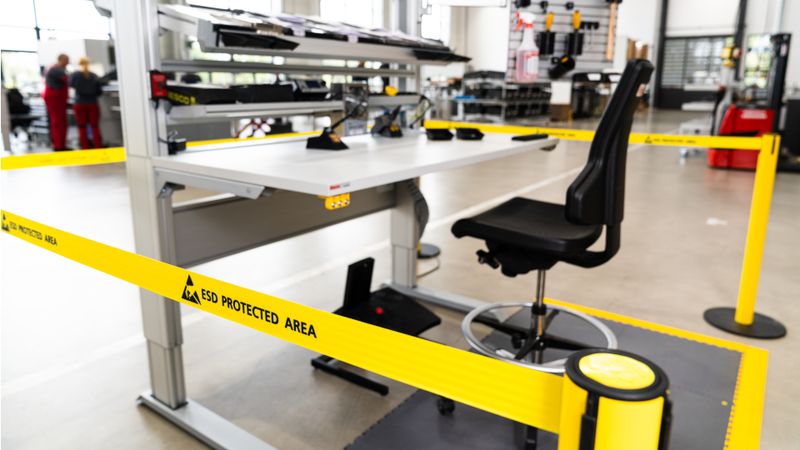
Setting up an Electrostatic Protected Area (EPA) is a basic requirement in ESD safety. Strict access restrictions apply to this clearly marked-out area.
(Source: item)
It is more than likely that at some time or another – perhaps when shaking hands with someone, touching a metal door handle or grabbing a metal handrail on the stairs – you’ll have felt a small electric shock. Electrostatic discharges (ESDs) like these measure around 3500 volts but are harmless to humans.
The situation is different for electronic components. In fact, even just 100 volts is enough to erase information on a magnetic data carrier or destroy an electronic memory chip. Companies and employees often underestimate the risk for ESD-sensitive (ESDS) components. However, when manufacturing or processing components like these, it is essential to both understand and implement the basics of ESD safety. This is where using ESD-safe components and following certain rules of conduct go hand in hand.
Would you like to have one document that sets out the most important rules for ESD safety? That’s exactly what the free white paper from item Industrietechnik is. It is ideal as a quick reference guide or for passing on to colleagues:
ESD stands for electrostatic discharge. It is a sudden equalisation of electrical charge between objects that are charged differently. There does not need to be any direct contact in order for an electrostatic discharge to happen. This poses a major challenge in industry, because electronic components can be damaged by a sudden electrostatic discharge at almost any point in the production chain. Electrostatic charges are being built up almost all the time, due to friction and movement, for example. Even simple activities at a work bench for manual assembly can cause a charge of up to 6000 volts to build up.
Another challenge posed by ESDs is that discharges often go unnoticed. When manufacturing magnetic hard drives, just 5 volts is enough to damage the sensitive read head. Furthermore, ESDs don’t just originate from employees. Without suitable ESD protection, conveyor belts and equipment such as transport trolleys, tools and work surfaces can also become electrostatically charged.
ESD safety – the basics for industrial production
Damaged conducting paths cannot be detected with the naked eye. In fact, you would usually need an electron microscope in order to identify ESD damage. It is only weeks or months later, when the end customer has the product, that this damage causes the affected component to fail. The consequences can be serious for the companies involved – complaints, expensive warranty claims and a loss of trust. ESD is a worst-case scenario for any company. It is also important to remember that ESD damage can occur at your supplier’s factory and go unnoticed in your own.
How can ESD damage be effectively prevented? The key is consistency – be aware of the issues around ESD and put into practice the basics of ESD safety. Approach and establish protection against ESD as an overarching corporate concept. The process of protecting against ESD starts when you decide which suppliers to use and ends when you safely hand over your product to the customer. Practical regulations for fully implementing ESD safety can be found in DIN EN 61340-5-1. This technical standard sets out a detailed monitoring programme, which documents the key components of an ESD safety concept that all employees are required to follow. ESD protection measures include the following aspects and requirements:
Compliance with all important technical standards
Documented safety procedures for the entire process chain, including suppliers and customers
Standard-compliant clothing with electrical conductivity
ESD coordinators and employees with expertise in ESD safety
Electrostatic protected areas that satisfy the applicable technical standards
Daily checks on relevant work steps
Continuous internal audits
The role of employees, humidity and operating equipment in ESD safety
Effective protection against ESD relies on well-trained and well-equipped staff. Employees must understand the necessity of ESD equipment and know how to use it correctly. Special training courses should be provided to teach the basics of ESD safety and the specified rules of conduct. Whether in engineering, in the warehouse or in cleaning – all employees must participate in comprehensive ESD safety measures.
Humidity is also crucial for ESD protection. Electrostatic charges accumulate more easily in conditions of low humidity. That’s why, in everyday life, we tend to experience those small shocks particularly often in the colder months of the year. When handling electronic components, relative humidity in the relevant areas should ideally be at least 30 percent. Another ESD risk is associated with materials that have different electrostatic charges when they arrive from suppliers. Use ionisers to equalise the charges on these materials – before they are placed into your intralogistics system.
You can find even more content on ESD safety in the item ESD Media Center. The topics covered range from general basics to the role of intralogistics and a success story:
Electrostatic protected areas and factory equipment – implementing the basics of ESD safety in practice
The DIN standard centres on using an electrostatic protected area (EPA) to implement the basics of ESD safety. An EPA can also be referred to as an ESD protection zone. Electronic components can only be handled or assembled in one of these areas. Ensure your EPA complies exactly with the technical standard. All the materials used in an EPA must be electrostatically dissipative and earthed to the same potential. This stops electrostatic charges and potential differences from building up. Any electrical charges that do build up must be discharged into the ground. An EPA can consist of a single workstation in production, a defined area or an entire building.
Various components ensure ESD safety within an EPA. An ESD Wristband can be connected to an ESD Earthing Terminal or an ESD Earthing Plug via an ESD Connection Cable. This prevents electrostatic charges from building up on employees. An ESD Table Mat will also protect the components being used. When it comes to moving goods around, an ideal solution is to use item SystemMobiles, for example. These versatile material trolleys use an ESD Drag Chain to ensure they are always in contact with the ESD floor and can safely dissipate electrostatic charges. Having the right components doesn’t make ESD safety any less complex, but does make it relatively straightforward to implement. Considering the much lower failure rates you will experience with your products, the effort is well worthwhile.
Date: 08.12.2025
Naturally, we always handle your personal data responsibly. Any personal data we receive from you is processed in accordance with applicable data protection legislation. For detailed information please see our privacy policy.
Consent to the use of data for promotional purposes
I hereby consent to Vogel Communications Group GmbH & Co. KG, Max-Planck-Str. 7-9, 97082 Würzburg including any affiliated companies according to §§ 15 et seq. AktG (hereafter: Vogel Communications Group) using my e-mail address to send editorial newsletters. A list of all affiliated companies can be found here
Newsletter content may include all products and services of any companies mentioned above, including for example specialist journals and books, events and fairs as well as event-related products and services, print and digital media offers and services such as additional (editorial) newsletters, raffles, lead campaigns, market research both online and offline, specialist webportals and e-learning offers. In case my personal telephone number has also been collected, it may be used for offers of aforementioned products, for services of the companies mentioned above, and market research purposes.
Additionally, my consent also includes the processing of my email address and telephone number for data matching for marketing purposes with select advertising partners such as LinkedIn, Google, and Meta. For this, Vogel Communications Group may transmit said data in hashed form to the advertising partners who then use said data to determine whether I am also a member of the mentioned advertising partner portals. Vogel Communications Group uses this feature for the purposes of re-targeting (up-selling, cross-selling, and customer loyalty), generating so-called look-alike audiences for acquisition of new customers, and as basis for exclusion for on-going advertising campaigns. Further information can be found in section “data matching for marketing purposes”.
In case I access protected data on Internet portals of Vogel Communications Group including any affiliated companies according to §§ 15 et seq. AktG, I need to provide further data in order to register for the access to such content. In return for this free access to editorial content, my data may be used in accordance with this consent for the purposes stated here. This does not apply to data matching for marketing purposes.
Right of revocation
I understand that I can revoke my consent at will. My revocation does not change the lawfulness of data processing that was conducted based on my consent leading up to my revocation. One option to declare my revocation is to use the contact form found at https://contact.vogel.de. In case I no longer wish to receive certain newsletters, I have subscribed to, I can also click on the unsubscribe link included at the end of a newsletter. Further information regarding my right of revocation and the implementation of it as well as the consequences of my revocation can be found in the data protection declaration, section editorial newsletter.




:quality(80)/p7i.vogel.de/wcms/ed/1d/ed1dce9f6b05ddb24060464c0bec717f/0131831927-800x450v1.jpeg "(Source: KNDS)")
:quality(80)/p7i.vogel.de/wcms/2f/d0/2fd03a0d616b3c03fa287bddb62d57ad/airbus-512x288v1.jpeg "Michael Schoellhorn, CEO of Airbus Defence and Space, and Mykola Makovieiev, CEO of SkyFall, sign the Memorandum of Understanding at the ILA Berlin Air Show in the presence of German Federal Minister of Defence Boris Pistorius. (Source: Airbus Defence and Space GmbH 2026)")
:quality(80)/p7i.vogel.de/wcms/9c/66/9c66518f56544ca9ea6035fc6e0a0ecd/0131831927v1.jpeg "What you see here is an interim main battle tank solution for France—known as Capint. It is intended to replace the Leclerc before the main battle tank from the Franco-German MGCS project is actually ready, as France wants and cannot afford to wait long for the tank of the future. (Source: dpa / W. v. Dewitz)")
:quality(80)/p7i.vogel.de/wcms/4e/1f/4e1f4d990967b66741a93d3a77e519cf/0131826760v1.jpeg "With these military trucks, for example, the newly founded company Daimler Truck Defence aims to use increased sales in the defence sector over the next few years to at least partially offset certain shortfalls that have arisen in Daimler Truck’s standard truck business. (Source: Daimler Truck)")
:quality(80)/p7i.vogel.de/wcms/4f/37/4f37e5686a19c0f5029ee6e4b96558a6/rg-4troop-5460x3072v1.jpeg "Renault and Thales will collaborate on building drones. (Source: Renault)")
:quality(80)/p7i.vogel.de/wcms/0b/8e/0b8e89c744254a936e5ab8d4c5ac8ed5/20260610-ohb-ramses-signature-event-ila-scaled-2560x1440v1.jpeg "(Source: OHB SE)")
:quality(80)/p7i.vogel.de/wcms/21/e1/21e1baabcfc9c3fd09c5ced763bdbbb4/annekaiser-hswl-4767-1800x1000-1779x1000v1.webp "(Source: Renk Group AG)")
:quality(80)/p7i.vogel.de/wcms/2d/ba/2dbab47b4f20c66c049feb04af95975a/0113829725v1.jpeg "The integrated DC UPS from Bicker protects the autonomous drone system \"Beehive\" from Sunflower Labs in the event of a power failure, voltage dips or flicker. (Image:Bicker / Sunflower)")
:quality(80)/p7i.vogel.de/wcms/35/21/352179f537683e7fffd0fa61bc91723e/0131827530v1.jpeg "The Spectrum rocket from Isar Aerospace has once again been forced to remain grounded. For the fourth time, the second test flight had to be postponed... (Image:Isar Aerospace)")
:quality(80)/p7i.vogel.de/wcms/09/bd/09bd9e7ad549cec143a9a8fe04603665/tom-20trill-2c-20manfred-20horstmann-gf-dresden-20qualinx-4261x2395v1.jpeg "(Source: GlobalFoundries)")
:quality(80)/p7i.vogel.de/wcms/ec/16/ec1675b83aed8931556f7061efbe3fc4/0130556122-788x443v1.jpeg "(Source: Isar Aerospace)")
:quality(80)/p7i.vogel.de/wcms/0b/05/0b057842e0cb2336ff8065e0172d622c/p19-front-1-1024x571-1016x571v1.png "(Source: Quantum Systems)")
:quality(80)/p7i.vogel.de/wcms/ed/69/ed69fb4fafbccc1e284a074223cd1a11/forschungspreis-fram-piotr-banczerowski-1440x810v1.jpeg "Save energy, compute faster and retain data permanently: the new memory technology meets precisely these requirements. (Source: Fraunhofer / Piotr Banczerowski)")
:quality(80)/p7i.vogel.de/wcms/b2/1d/b21d335e1813d2225c867403503beeca/digital-20transformation-20in-20aerospace-20ptc-3840x2158v1.jpeg "(Source: PTC)")
:quality(80)/p7i.vogel.de/wcms/ec/97/ec97cb796e9319805369826d671ac0af/battle-lab-1280x720v1.png "(Source: Hensoldt AG)")
:quality(80)/p7i.vogel.de/wcms/0e/4f/0e4f3bfac264744ab5b0f78735498d44/mod-noctis-1-20image-202-20starlink-20with-20galaxy-1142x642v1.jpeg "First images from the UK’s Noctis-1 space telescope reveal Starlink satellites orbiting in front of the M101 galaxy as new Borealis space awareness software strengthens protection of critical UK satellite and military space assets. (Source: UK MOD © Crown copyright 2026)")
:quality(80)/p7i.vogel.de/wcms/7e/b7/7eb78c3ea29bd5596af70499a253b033/26dt113-002-6000x3373v1.jpeg "Mercedes-Benz Arocs for the defence sector. (Source: Daimler Truck AG)")
:quality(80)/p7i.vogel.de/wcms/7a/ab/7aab96f172274a092cc8261357c02413/piro4d-satellite-4269348-3840x2158v1.jpeg "Specialised small and mid-sized companies are playing an increasingly important role in modern defence, aerospace and space programmes as governments accelerate investment in advanced capabilities. (Source: PIRO 4D on Pixabay)")
:quality(80)/p7i.vogel.de/wcms/29/b2/29b225d0ba5b9471d3d9600e7c82ac35/0131801240v1.jpeg "In recent months, drones have proven capable of endangering critical infrastructure. That is set to change soon, thanks to the expertise of Deutsche Telekom and Hensoldt. (Source: K. Jüssen)")
:quality(80)/p7i.vogel.de/wcms/1c/fc/1cfce45c43f134c4982772dad53ea534/thoris-lcs-promotional-image-rohde-schwarz-200-202920-1920-1080-1-1920x1079v1.jpeg "Rohde & Schwarz announces the debut of THORIS at ILA Berlin Airshow 2026. (Source: Rohde & Schwarz)")
:quality(80)/p7i.vogel.de/wcms/7a/51/7a511b80041d3f1335f3a5aa56fe75da/delivery-7022432-1280-1280x720v1.png "(Source: Mohamed_hassan)")
:quality(80)/p7i.vogel.de/wcms/f9/2f/f92f1ef8c739c34c70d99f7b0997621b/stra007-20--20cover-20image-5472x3076v1.jpeg "(Source: Stratasys)")
:quality(80)/p7i.vogel.de/wcms/5e/18/5e184e4961f190c86a1ea3227104cab5/26pm03-20kompakte-20l-c3-b6sungen-20f-c3-bcr-20luft--20und-20raumfahrt-202-2362x1329v1.jpeg "(Picture: Keysight)")
:quality(80)/p7i.vogel.de/wcms/67/4c/674c54baa745be497cecb716826af339/stahlwille-hero-1807x1016v1.jpeg "A new modular tool solution designed for safety, precision, and mobility in aviation maintenance. (Source: STAHLWILLE)")
:quality(80)/p7i.vogel.de/wcms/f3/4e/f34ed744bb30817d3432c7ad522e6f30/engine-1v1.jpeg "Engineering with aluminium profiles really can be this easy – the item Engineeringtool and its smart functions help you save valuable time. (Source: item)")
:quality(80)/p7i.vogel.de/wcms/fb/8e/fb8e5ae2aa27bcf3e466815505ca4ff2/alumin-1v1.jpeg "The aluminium profile technology of the item Building Kit System has been used to build a huge variety of structures for decades. (Source: item)")
:quality(80)/p7i.vogel.de/wcms/be/84/be84bbede3e40b1101cd3efa35a6ffa0/overview-of-20work-bench-design-in-productionv1.jpeg "With modular work bench design, you can convert or extend a work bench with ease by changing or adding accessories. This means changes can be implemented quickly and cost-effectively, thus boosting quality and productivity. (Source: item)")
:fill(fff,0)/images.vogel.de/vogelonline/companyimg/84700/84735/65.jpg "logo_item_rgb_neu.jpg ()")
:quality(80)/p7i.vogel.de/wcms/80/3f/803fbef61af95724dd4c64c030568669/item-20industrietechnik-modular-20factory-20equipment-605x340v1.png "Modular factory equipment makes it possible to adopt a flexible and standard-compliant approach when adapting high-tech manufacturing to ever-faster innovation cycles. (Source: item Industrietechnik )")
:quality(80)/p7i.vogel.de/wcms/1c/a5/1ca520d57f3c6108dc6ebb2c77ec34f2/manufa-1v1.jpeg "Operating equipment, fixtures and fittings that can be easily adapted give high-tech manufacturing companies a decisive competitive advantage. The modular building kit principle from item Industrietechnik makes it much easier to design and build solutions such as stairways and platforms. (Source: item)")