



:quality(80)/p7i.vogel.de/wcms/5f/be/5fbef750642afb67f9335a173ca4efbd/chatgpt-image-22--sept--2026-11-25-43-1536x864v1.png "SMEs could play a bigger role in defence supply chains in the future. (Picture: AI generated)")
:quality(80)/p7i.vogel.de/wcms/2e/0e/2e0e8c8fb01d6e14cd0efadbc118cb4e/rsi-europe-photo-credit-delfi-josvydo-elinsko-1920x1079v1.jpeg "(Source: Delfi Josvydo Elinsko)")
:quality(80)/p7i.vogel.de/wcms/cb/bf/cbbfe6049e2e264bc58b30b05a36f755/enjoytheworld-dubai-4051672-1920x1079v1.jpeg "(Source: Dirk on Pixabay)")
:quality(80)/p7i.vogel.de/wcms/d9/a3/d9a3c241961e6c2aa668d0147292bc49/screenshot-2026-09-17-113517-931x524v1.png "Dr. Elisabeth Hauschild will take over as Chief Executive of the BDSV in November 2026. (Source: BDSV)")
:quality(80)/p7i.vogel.de/wcms/13/12/1312059ec82b1ed9e3df080350b29dc4/f46335bf-a581-4786-959f-4a0e9a74aed1-1671x940v1.png "Military radar architecture using distributed RF sensor nodes connected through optical fibre to central processing. (Source: KI-generiert / Gemini)")
:quality(80)/p7i.vogel.de/wcms/0a/14/0a1495d9b570ae32a5a7cc748b9a3c60/st-hannover-035-1920x1079v1-999x562v1.jpeg "Fastening technology you can experience first-hand—visitors to Schraubtec in Bochum (Germany) can see it for themselves at the Ruhr Congress on September 30, 2026. (Source: PHOTOVISION-DH GmbH)")
:quality(80)/p7i.vogel.de/wcms/cd/a9/cda92b173afa9d0b455d4f11b281c9ea/0094-to-image--capstone-cdr-1440x810v1.png "(Source: Terran Orbital)")
:quality(80)/p7i.vogel.de/wcms/e0/45/e045bc5414d7263fb308bdd501b5fcc1/0133113962v1.jpeg "The HSWL 354 is the transmission used, for example, in the Leopard 2 main battle tank. Renk manufactures this system and is now preparing to significantly increase its cycle time. As a result, Renk is placing greater emphasis on the military sector as a customer ... (Source: Renk)")
:quality(80)/p7i.vogel.de/wcms/1f/c2/1fc25ec2bd47a47b4617766e40033de2/image-2000-74f03b8e935a22580e24d2b05fe5ca3c-1920x1079v1.jpeg "The Airbus A310 ZERO-G stands ready for the 47th DLR parabolic flight campaign. It took place in Bordeaux from 7 to 18 September 2026. A total of twelve experiments from the fields of biology, physics, technology and materials science were on board. (Source: DLR (CC BY-NC-ND 3.0))")
:quality(80)/p7i.vogel.de/wcms/22/81/22812f686fd6ec1235f02392a3df56b9/34370ad9-163a-5941-9825-9c87a0e50000-1920x1079v1.png "Ariane 6 A64 flight VA267 with 32 satellites for Amazon LEO constellation, ready for launch at Europe's Spaceport in Kourou, French Guiana on 12 February 2026. (Source: ESA—M. Pédoussaut)")
:quality(80)/p7i.vogel.de/wcms/04/6b/046bda5de33193b13ebda873c3372868/iris2-1ceuropean-commission-1-1680x944v1.jpeg "(Source: European Commission)")
:quality(80)/p7i.vogel.de/wcms/d9/3c/d93c89ab8ed08d673065e1eac2e85aea/8cc82e51-a188-4e50-9432-ee715ab25586-1672x940v1.png "At Mach 10, Aerodynamics Becomes Materials Science (Source: )")
:quality(80)/p7i.vogel.de/wcms/cb/a2/cba2ecda891b2874327a30f69f773bdb/hexaforce-15-1920x1079v1.jpeg "(Source: Thales/Gauthier Chauffrut)")
:quality(80)/p7i.vogel.de/wcms/9d/8a/9d8addea8cc4e6f7a4793563ca397f2a/ai-im-milit-r-1672x940v1.png "(Source: KI-generiert / Gemini)")
:quality(80)/p7i.vogel.de/wcms/7f/5f/7f5fba2c729ec3aa256bf1a18d74529b/ai-chip-1672x940v1.png "(Source: KI-generiert / Gemini)")
:quality(80)/p7i.vogel.de/wcms/64/1b/641b6474b2a614cde7730c89ef2a3015/2026-09-09-rheinmetall-veroeffentlicht-battlesuite-schnittstellen-e8c18194-1225x690v1.jpeg "Rheinmetall’s Battlesuite provides a modular digital platform for connecting and integrating sensors, hardware and software components. (Source: Rheinmetall AG)")
:quality(80)/p7i.vogel.de/wcms/2b/3d/2b3d42b7dc255aaaf5cadf57dab47d3b/43907b28dda9-sky-striker-demo-2-1600x899v1.webp "Diehl Defence and Elbit Systems demonstrate the capabilities of the SkyStriker loitering munition during a live demonstration. (Source: Diehl Defence)")
:quality(80)/p7i.vogel.de/wcms/73/b3/73b310d878207253f20d1725e76bc1e3/leopard-2-bundeswehr-picture-1920x1079v1.jpeg "(Source: European Defence Agency)")
:quality(80)/p7i.vogel.de/wcms/61/fd/61fde39a2c5744cc1bcc522965692c21/0133364253v1.jpeg "U.S. Secretary of Defence Pete Hegseth wants to make greater use of German industry for NATO defence. (Image: ©Sergey Ryzhov—stock.adobe.com)")
:quality(80)/p7i.vogel.de/wcms/61/a4/61a4c9e3578477c2dbf511f986c7a5fb/tiger-2500x1406v1.webp "A Bundeswehr Tiger combat helicopter. The Optarion mission support system forms the link between these helicopters and the command and control information system. (Source: Hensoldt AG)")
:quality(80)/p7i.vogel.de/wcms/90/a8/90a849f0023f11d1eb642eb4751a0321/bild2-h-c3-a4nel-ict-20truck-20and-20trailer-20parts-4320x2429v1.jpeg "Product information is visible at all times and retrieval of items
is confirmed by employees directly on the display of the Hänel MP 14 N
controller. (Source: René Marks)")
:quality(80)/p7i.vogel.de/wcms/4e/ca/4ecaa39f247490eded591b652c33aee3/thilmann-hcp-web-20kleiner-20ausschnitt-1442x811v1.jpeg "Entering the defence market can be challenging for start-ups, says HCP Sense CEO Ansgar Thilmann. (Picture: HCP Sense)")
:quality(80)/p7i.vogel.de/wcms/7a/51/7a511b80041d3f1335f3a5aa56fe75da/delivery-7022432-1280-1280x720v1.png "(Source: Mohamed_hassan)")
:quality(80)/p7i.vogel.de/wcms/f9/2f/f92f1ef8c739c34c70d99f7b0997621b/stra007-20--20cover-20image-5472x3076v1.jpeg "(Source: Stratasys)")
:quality(80)/p7i.vogel.de/wcms/ec/a9/eca9062ccbe4b042f8515846340410d8/aerospace-and-defence-stairways-platforms-and-much-morev1.jpeg "Modular constructions enable flexible modification. That applies to larger structures such as stairways and platforms, too. And that means aerospace and defence companies can reconfigure their maintenance platforms fast (itemitem)")
:quality(80)/p7i.vogel.de/wcms/30/2a/302a7b5723ad38fbde812fd3a468ad04/safety-on-stairways-in-industry-key-considerationsv1.jpeg "Stairways and platforms are used widely in maintenance and assembly areas in the aerospace and defence sectors. (Source: item)")
:quality(80)/p7i.vogel.de/wcms/f3/4e/f34ed744bb30817d3432c7ad522e6f30/engine-1v1.jpeg "Engineering with aluminium profiles really can be this easy – the item Engineeringtool and its smart functions help you save valuable time. (Source: item)")
Radar & sensor technology Light Instead of Copper: The Rise of Photonic Radar
Related Vendors
:fill(fff,0)/p7i.vogel.de/companies/69/6d/696de2483d115/logo--fastems-rgb-horizontal.jpeg "logo--fastems-rgb-horizontal (Fastems)")
:fill(fff,0)/images.vogel.de/vogelonline/companyimg/84700/84735/65.jpg "logo_item_rgb_neu.jpg ()")
Radar has traditionally been an electronic technology. Antennas collect radio-frequency signals, coaxial cables move them, analogue front ends condition them and processors turn echoes into tracks. Silicon photonics is beginning to change that architecture. By moving part of the signal transport into the optical domain, radar designers can separate antennas from central electronics, distribute apertures across a platform and reduce the penalties of long RF cable runs. The result is not “optical radar” in the lidar sense. It is microwave radar whose internal nervous system increasingly uses light.
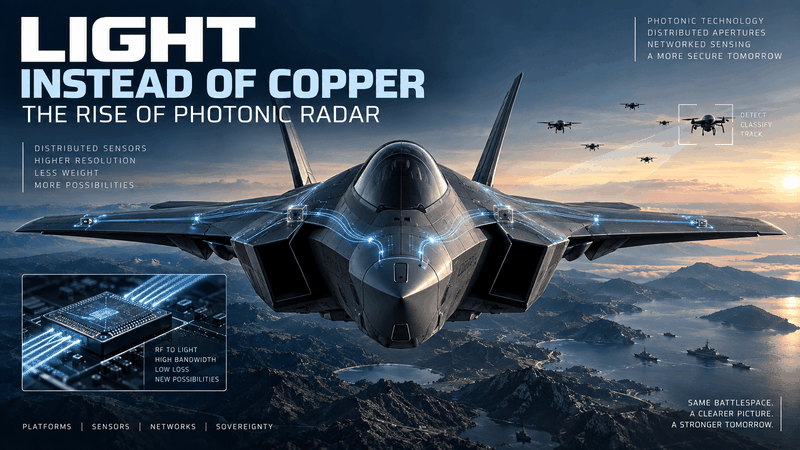
Photonic radar architectures combine conventional microwave sensing with optical signal transport. Fibre links can connect distributed RF sensor nodes to central processing, opening new possibilities for conformal and distributed military radar systems.
Sign in or register and read on
Please log in or register and read this article. To be able to read this article in full, you must be registered. Free registration gives you access to exclusive specialist information.
Already registered? Log in here
:quality(80)/p7i.vogel.de/wcms/50/98/50988123a8f0142ac07bd294d33c7144/xavveo-logo-1280x719v1.jpeg "xavveo-logo-1280x719v1 (Source: Xavveo)")
:quality(80)/p7i.vogel.de/wcms/5f/69/5f69c2c76e58ee6e9a59f605035927d9/astrolight-20solution-20scheme-3840x2158v1.png "Visualisation of the Astrolight solution (Source: Astrolight)")