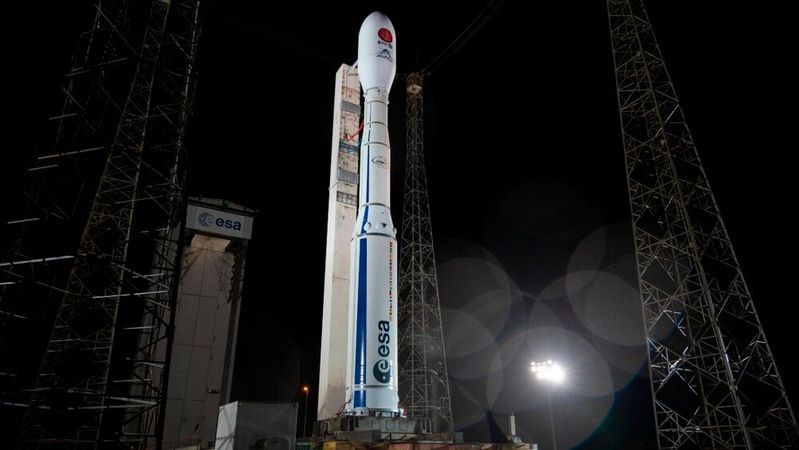
On May 19, 2026, the Smile space probe launched with a Vega-C rocket from the European Spaceport in French Guiana. Smile, a joint project of ESA and the Chinese Academy of Sciences, aims to demonstrate how Earth responds to particle streams and radiation bursts from the Sun.
The Smile space probe was launched on May 19, 2026, at 5:52 AM CEST with a Vega-C rocket from the European Spaceport in French Guiana.
(Source: ESA)
Solar Wind Magnetosphere Ionosphere Link Explorer, or Smile, will utilise four scientific instruments to investigate how the Earth responds to the solar wind. In this way, Smile will enhance the understanding of solar storms, geomagnetic storms, and the science of space weather. The ESA is responsible for providing Smile's payload module, one of the spacecraft's four scientific instruments, namely the Soft X-ray Imager (SXI), the launch vehicle, as well as the facilities and services for assembly, integration, and testing. The ESA also contributes to a second scientific instrument, the Ultraviolet Imager (UVI), as well as to mission operations once Smile is in orbit.
The Chinese Academy of Sciences (CAS) provides the other three scientific instruments as well as the spacecraft platform and is responsible for operating the spacecraft in orbit.
"We are on the verge of witnessing something we have never seen before—the Earth's invisible protective shield in action," explains ESA Director General Josef Aschbacher. "With Smile, we are pushing the boundaries of science to answer big questions that have remained a mystery since our discovery over seventy years ago that the Earth is safely enclosed within a giant magnetic bubble." David Agnolon, Smile Project Manager at ESA, adds: "Smile will shed light on the mysteries of Earth's magnetic field. The mission is made possible through seamless collaboration between ESA and CAS, with contributions from partners across Europe. It is the first time that ESA and China have jointly selected, designed, implemented, launched, and operated a mission, and we are all very excited about the significant scientific discoveries we expect from Smile over the next three years."
How does the defence against the solar wind work?
For nearly four billion years, the Earth has maintained a massive shield against the relentless onslaught of charged particles from the Sun. This solar wind can damage everything in its path, especially when it intensifies into solar storms. The solar wind would turn the green and blue Earth into a rocky, brown wasteland—if not for the magnetic field generated deep within our planet. This magnetic field forms a giant protective bubble around the Earth, the magnetosphere.
For the first time in history, humanity has reached a point where scientific instruments and technologies have advanced enough to clarify how this defence against the solar wind works. Smile is equipped with a set of instruments designed to provide a comprehensive insight into how Earth's magnetic field responds to the relentless assaults of the Sun.
The Earth's magnetic field is being observed with X-ray vision to reveal where and how it is struck by the solar wind. This interaction triggers disturbances—from small substorms to major geomagnetic storms—that spread through the magnetosphere toward the North and South Poles. There, the magnetic storms create a light spectacle, the aurora. Smile will record the northern lights using ultraviolet radiation for 45 continuous hours, making it the first mission to observe them for such a duration and the first since 2008 to observe the entire auroral oval around the North Pole in ultraviolet light.
By comparing the X-ray and ultraviolet images, it is possible to track in real-time how the Earth reacts to the onslaught of the solar wind.
Data collection begins in July
Over the course of the next month, Smile will slowly gain altitude through eleven engine ignitions and eventually settle into an extremely elliptical orbit, taking it 121,000 km (approx. 75185 miles) over the North Pole to collect data before descending to 5,000 km (approx. 3107 miles) over the South Pole to efficiently transmit this data to the eagerly awaiting scientists on Earth.
Data collection will begin in earnest in July after the team has deployed the booms, opened the camera covers, and confirmed that everything is functioning as expected.
Date: 08.12.2025
Naturally, we always handle your personal data responsibly. Any personal data we receive from you is processed in accordance with applicable data protection legislation. For detailed information please see our privacy policy.
Consent to the use of data for promotional purposes
I hereby consent to Vogel Communications Group GmbH & Co. KG, Max-Planck-Str. 7-9, 97082 Würzburg including any affiliated companies according to §§ 15 et seq. AktG (hereafter: Vogel Communications Group) using my e-mail address to send editorial newsletters. A list of all affiliated companies can be found here
Newsletter content may include all products and services of any companies mentioned above, including for example specialist journals and books, events and fairs as well as event-related products and services, print and digital media offers and services such as additional (editorial) newsletters, raffles, lead campaigns, market research both online and offline, specialist webportals and e-learning offers. In case my personal telephone number has also been collected, it may be used for offers of aforementioned products, for services of the companies mentioned above, and market research purposes.
Additionally, my consent also includes the processing of my email address and telephone number for data matching for marketing purposes with select advertising partners such as LinkedIn, Google, and Meta. For this, Vogel Communications Group may transmit said data in hashed form to the advertising partners who then use said data to determine whether I am also a member of the mentioned advertising partner portals. Vogel Communications Group uses this feature for the purposes of re-targeting (up-selling, cross-selling, and customer loyalty), generating so-called look-alike audiences for acquisition of new customers, and as basis for exclusion for on-going advertising campaigns. Further information can be found in section “data matching for marketing purposes”.
In case I access protected data on Internet portals of Vogel Communications Group including any affiliated companies according to §§ 15 et seq. AktG, I need to provide further data in order to register for the access to such content. In return for this free access to editorial content, my data may be used in accordance with this consent for the purposes stated here. This does not apply to data matching for marketing purposes.
Right of revocation
I understand that I can revoke my consent at will. My revocation does not change the lawfulness of data processing that was conducted based on my consent leading up to my revocation. One option to declare my revocation is to use the contact form found at https://contact.vogel.de. In case I no longer wish to receive certain newsletters, I have subscribed to, I can also click on the unsubscribe link included at the end of a newsletter. Further information regarding my right of revocation and the implementation of it as well as the consequences of my revocation can be found in the data protection declaration, section editorial newsletter.
Collaboration made in Europe
Smile is an international project with significant European contributions. On behalf of the ESA, Airbus Defence and Space in Spain has built the payload module of Smile. This crucial part of the spacecraft houses three of the mission's four scientific instruments—including the X-ray and ultraviolet cameras, as well as the control unit for the instruments and the communication channel through which all valuable scientific data is transmitted back to Earth.
Europe was also responsible for the X-ray camera, Smile's largest instrument. On behalf of ESA, this camera was developed and built in the UK by the University of Leicester in collaboration with the Mullard Space Science Laboratory, the Open University, and several other institutions across Europe.
A total of institutes and companies from 14 European countries were involved in the development of the payload module and the X-ray camera, with the United Kingdom and Spain making the largest contributions.
The ESA's financial contribution to the mission amounts to 130 million euros (approx. 150 million USD) and includes over 25 procurement contracts with more than 40 companies and institutes. All ESA member states make an indirect contribution through the agency's science program, with the average contribution to Smile being around 28 cents per European resident. (se)




:quality(80)/p7i.vogel.de/wcms/f6/95/f6954fa7c09ba58863a3730f5e384a62/arek-socha-on-pixabay-1707x960v1.jpeg "A new national space strategy brings together UK’s plans for growth, defence, and national security to help reindustrialise the UK. (Source: Arek Socha on Pixabay)")
:quality(80)/p7i.vogel.de/wcms/63/0f/630f214fa760b8c7f7f7d6279d411fcf/d4ceed8f2f52-2026-08-30-hydef-06--msc4159-1200x675v1.webp "(Source: Diehl Defence)")
:quality(80)/p7i.vogel.de/wcms/4e/7d/4e7d38327c6c928b403249e3c24a2a7c/0132118791v1.jpeg "Porsche Holding SE announces that it is once again turning to rocket technology. Following its investment in Isar Aerospace, the company is now acquiring a stake in a U.S. firm ... (Source: Porsche)")
:quality(80)/p7i.vogel.de/wcms/1c/08/1c082bbd9d05b634168b617aa26fcdcf/safe-bg-lv-ro-v1-991x557v1.png "(Source: European Commission)")
:quality(80)/p7i.vogel.de/wcms/0a/14/0a1495d9b570ae32a5a7cc748b9a3c60/st-hannover-035-1920x1079v1-999x562v1.jpeg "Fastening technology you can experience first-hand—visitors to Schraubtec in Bochum (Germany) can see it for themselves at the Ruhr Congress on September 30, 2026. (Source: PHOTOVISION-DH GmbH)")
:quality(80)/p7i.vogel.de/wcms/cd/a9/cda92b173afa9d0b455d4f11b281c9ea/0094-to-image--capstone-cdr-1440x810v1.png "(Source: Terran Orbital)")
:quality(80)/p7i.vogel.de/wcms/e0/45/e045bc5414d7263fb308bdd501b5fcc1/0133113962v1.jpeg "The HSWL 354 is the transmission used, for example, in the Leopard 2 main battle tank. Renk manufactures this system and is now preparing to significantly increase its cycle time. As a result, Renk is placing greater emphasis on the military sector as a customer ... (Source: Renk)")
:quality(80)/p7i.vogel.de/wcms/a1/5c/a15c2aeba563d5bc3e11fb879b21eb2c/0132989650v1.jpeg "FSS, the flexible clamping system for varying free-form surfaces, is designed for the aerospace industry and other sectors. (Source: Römheld GmbH Friedrichshütte)")
:quality(80)/p7i.vogel.de/wcms/46/8e/468effa87546a2b036dc88ca40e2843e/129fbcac92ce7da872b13af0281b0799-l-png-1920x1079v1.webp "(Source: Arianespace)")
:quality(80)/p7i.vogel.de/wcms/8f/10/8f10697d4bfbd70edf615cca76eaedfd/pete-linforth-on-pixabay-1920x1080v1.jpeg "(Source: Pete Linforth on Pixabay / AI-generated)")
:quality(80)/p7i.vogel.de/wcms/0f/99/0f99561bf51818af92b2960656405aa5/roland-4d-pippes-on-pixabay-1460x820v1.jpeg "(Source: Roland 4D Pippes on Pixabay)")
:quality(80)/p7i.vogel.de/wcms/05/49/054906f874b94ef08b09d5920396e27d/airbus-h160-1920x1079v1.jpeg "Airbus H160 (Source: Airbus)")
:quality(80)/p7i.vogel.de/wcms/9d/8a/9d8addea8cc4e6f7a4793563ca397f2a/ai-im-milit-r-1672x940v1.png "(Source: KI-generiert / Gemini)")
:quality(80)/p7i.vogel.de/wcms/7f/5f/7f5fba2c729ec3aa256bf1a18d74529b/ai-chip-1672x940v1.png "(Source: KI-generiert / Gemini)")
:quality(80)/p7i.vogel.de/wcms/64/1b/641b6474b2a614cde7730c89ef2a3015/2026-09-09-rheinmetall-veroeffentlicht-battlesuite-schnittstellen-e8c18194-1225x690v1.jpeg "Rheinmetall’s Battlesuite provides a modular digital platform for connecting and integrating sensors, hardware and software components. (Source: Rheinmetall AG)")
:quality(80)/p7i.vogel.de/wcms/6f/fe/6ffef325e7f233cc3521943158eb1ebd/0132763535v1.jpeg "Two companies are planning to establish, for the first time in 2027, an optical laser communication link directly between a satellite in low Earth orbit (LEO) and a re-entering spacecraft. (Source: ATMOS Space Cargo)")
:quality(80)/p7i.vogel.de/wcms/8f/f9/8ff91b78b26cb5a2b8a29e39835005b1/2026-09-10-repmus-teaser-images-retouched-dsc01292-1024x683-1024x576v1.jpeg "(Source: Quantum Systems GmbH)")
:quality(80)/p7i.vogel.de/wcms/bf/4a/bf4a237e60d3d4bd1bbdbad918f3c697/airbus-defence-and-space-3-1280x720v1.jpeg "(Source: Airbus Defence and Space)")
:quality(80)/p7i.vogel.de/wcms/e0/d1/e0d112a0d54a4fa9603ec855f7d25b47/t-rex-content-photo-jpg-pc-adaptive-990-medium-988x556v1.jpeg "Swarm of UAVs conducting a fully autonomous collaborative swarm mission. (Source: Lockheed Martin)")
:quality(80)/p7i.vogel.de/wcms/79/fc/79fcaa7ca33e393b11a4740d7d8f3dbe/vilkasss-handshake-9459740-1911x1076v1.jpeg "(Source: Vilius Kukanauskas on Pixabay)")
:quality(80)/p7i.vogel.de/wcms/90/a8/90a849f0023f11d1eb642eb4751a0321/bild2-h-c3-a4nel-ict-20truck-20and-20trailer-20parts-4320x2429v1.jpeg "Product information is visible at all times and retrieval of items
is confirmed by employees directly on the display of the Hänel MP 14 N
controller. (Source: René Marks)")
:quality(80)/p7i.vogel.de/wcms/4e/ca/4ecaa39f247490eded591b652c33aee3/thilmann-hcp-web-20kleiner-20ausschnitt-1442x811v1.jpeg "Entering the defence market can be challenging for start-ups, says HCP Sense CEO Ansgar Thilmann. (Picture: HCP Sense)")
:quality(80)/p7i.vogel.de/wcms/7a/51/7a511b80041d3f1335f3a5aa56fe75da/delivery-7022432-1280-1280x720v1.png "(Source: Mohamed_hassan)")
:quality(80)/p7i.vogel.de/wcms/f9/2f/f92f1ef8c739c34c70d99f7b0997621b/stra007-20--20cover-20image-5472x3076v1.jpeg "(Source: Stratasys)")
:quality(80)/p7i.vogel.de/wcms/ec/a9/eca9062ccbe4b042f8515846340410d8/aerospace-and-defence-stairways-platforms-and-much-morev1.jpeg "Modular constructions enable flexible modification. That applies to larger structures such as stairways and platforms, too. And that means aerospace and defence companies can reconfigure their maintenance platforms fast (itemitem)")
:quality(80)/p7i.vogel.de/wcms/30/2a/302a7b5723ad38fbde812fd3a468ad04/safety-on-stairways-in-industry-key-considerationsv1.jpeg "Stairways and platforms are used widely in maintenance and assembly areas in the aerospace and defence sectors. (Source: item)")
:quality(80)/p7i.vogel.de/wcms/f3/4e/f34ed744bb30817d3432c7ad522e6f30/engine-1v1.jpeg "Engineering with aluminium profiles really can be this easy – the item Engineeringtool and its smart functions help you save valuable time. (Source: item)")
:fill(fff,0)/images.vogel.de/vogelonline/companyimg/84700/84735/65.jpg "logo_item_rgb_neu.jpg ()")
:quality(80)/p7i.vogel.de/wcms/c6/dc/c6dccef07c2e281718e7a41a49ebf9df/esa-20solarflare-1563x879v1.jpeg "Extreme-ultraviolet imagery from 11 November 2025 shows the solar eruption sequence that preceded the geomagnetic storm, captured by ESA and partner observatories. (Source: European Space Agency)")
:quality(80)/p7i.vogel.de/wcms/8a/ff/8aff1bcdc7292d2f7f6c366455cb64d6/54963580015-cdcb4657c5-kv1.jpeg "The Nancy Grace Roman Space Telescope was completed in the largest cleanroom of NASA's Goddard Space Flight Center. It is scheduled to launch into space in September 2026. (Source: NASA/Sydney Rohde)")