Reusable flight research is returning to hypersonics. Its industrial value lies in how quickly a measured flight can become a corrected model, a revised component and another test—not simply in reaching a high Mach number.
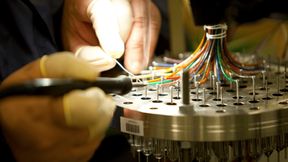
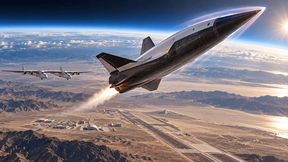
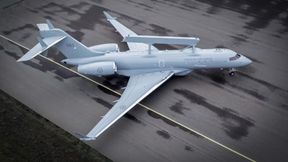
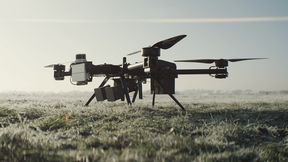
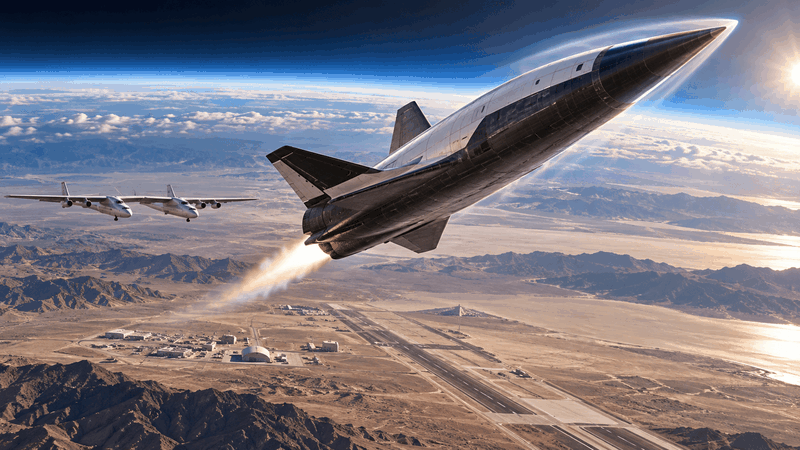
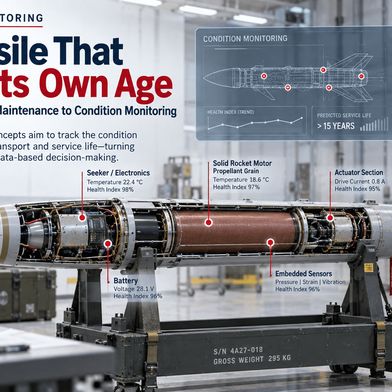
Reusable research vehicles make the flight-to-redesign loop possible. Conceptual illustration; no actual X-15 or Talon-A vehicle is depicted.
(Source: KI-generiert / Imagen)
A flight is useful only when the next design learns from it
A hypersonic vehicle can exist simultaneously as a convincing simulation, a promising wind-tunnel model and an unresolved flight problem. The gap between those descriptions matters. An inlet may behave differently during manoeuvres; a sensor may drift as its mounting heats; a control response may change as the vehicle crosses an atmospheric layer. Resolving such questions requires data from a moving, integrated vehicle. When opportunities to obtain that data are scarce, even a well-funded development programme can spend months improving assumptions it cannot yet validate.
Flight-test throughput is therefore becoming a constraint on the rate of learning. That does not make aerodynamics, propulsion or materials solved problems, nor does it establish flight availability as the dominant bottleneck in every programme. It changes the industrial question: how many useful, comparable experiments can a team complete before its design, supplier configuration or operational requirement changes? A reusable test vehicle can improve that answer if recovery is followed by prompt inspection, data reduction and another flight.
The comparison between NASA's X-15 and Stratolaunch's Talon-A is useful at precisely this level. They are different aircraft from different technical and institutional settings. Talon-A is not a direct continuation of the X-15 design. Both nevertheless make the research vehicle an asset that carries experiments repeatedly, rather than treating every flight as the final demonstration of a disposable article.
What the X-15 actually demonstrated
NASA records 199 X-15 research flights between 1959 and 1968, using three rocket-powered aircraft. The programme reached Mach 6.7 in October 1967. Those figures describe the complete research programme: they are not 199 flights at its maximum speed, or even a count of exclusively hypersonic sorties. The historical lesson is the accumulated experimental record, not a headline speed divided by a programme budget.
Air launch from a B-52 moved part of the ascent task to a carrier aircraft. Rocket propulsion then allowed the research vehicle to explore high-speed conditions without first solving an air-breathing hypersonic engine. Pilots, ground teams and instrumentation brought back observations about heating, stability and control. The aircraft could be examined after landing, so flight records could be compared with the physical condition of the vehicle.
Recovery made it possible to distinguish an instrument's response from damage in its installation, or a modelling error from a manufacturing problem. That distinction remains valuable. A telemetry trace can show that a temperature rose unexpectedly; the recovered hardware may show whether a joint opened, a coating changed or a sensor detached. Neither record alone necessarily explains the event. Together, they can narrow the next experiment.
The X-15 also cautions against romanticising reuse. A vehicle exposed to an extreme flight envelope may require extensive work before another sortie, and damage can remove it from service. Reusable does not mean that every flight is cheap, immediately repeatable or free of risk. The relevant advantage is access to successive experiments and to the hardware that generated their results.
Ground tests remain indispensable
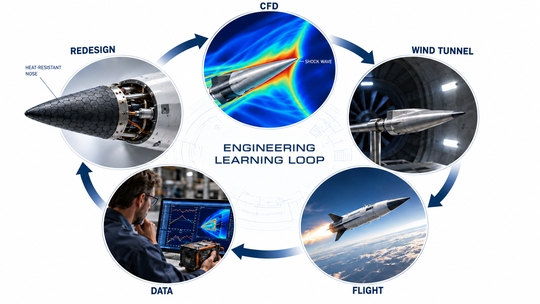
Computational fluid dynamics helps engineers explore alternatives before committing hardware. Wind tunnels test selected conditions and provide measurements against which calculations can be checked. Flight tests then expose the integrated vehicle to a changing environment. These methods form a loop: CFD, tunnel experiment, flight, data interpretation and redesign. Removing any one of them weakens the others.
would be wrong to describe every ground facility as unable to reproduce realistic hypersonic conditions. NASA's Hypersonic Tunnel Facility, for example, provides high-enthalpy, non-vitiated airflow for air-breathing propulsion research. Such facilities can answer difficult questions under controlled conditions. Their value comes partly from separating variables that are entangled in flight.
Date: 08.12.2025
Naturally, we always handle your personal data responsibly. Any personal data we receive from you is processed in accordance with applicable data protection legislation. For detailed information please see our privacy policy.
Consent to the use of data for promotional purposes
I hereby consent to Vogel Communications Group GmbH & Co. KG, Max-Planck-Str. 7-9, 97082 Würzburg including any affiliated companies according to §§ 15 et seq. AktG (hereafter: Vogel Communications Group) using my e-mail address to send editorial newsletters. A list of all affiliated companies can be found here
Newsletter content may include all products and services of any companies mentioned above, including for example specialist journals and books, events and fairs as well as event-related products and services, print and digital media offers and services such as additional (editorial) newsletters, raffles, lead campaigns, market research both online and offline, specialist webportals and e-learning offers. In case my personal telephone number has also been collected, it may be used for offers of aforementioned products, for services of the companies mentioned above, and market research purposes.
Additionally, my consent also includes the processing of my email address and telephone number for data matching for marketing purposes with select advertising partners such as LinkedIn, Google, and Meta. For this, Vogel Communications Group may transmit said data in hashed form to the advertising partners who then use said data to determine whether I am also a member of the mentioned advertising partner portals. Vogel Communications Group uses this feature for the purposes of re-targeting (up-selling, cross-selling, and customer loyalty), generating so-called look-alike audiences for acquisition of new customers, and as basis for exclusion for on-going advertising campaigns. Further information can be found in section “data matching for marketing purposes”.
In case I access protected data on Internet portals of Vogel Communications Group including any affiliated companies according to §§ 15 et seq. AktG, I need to provide further data in order to register for the access to such content. In return for this free access to editorial content, my data may be used in accordance with this consent for the purposes stated here. This does not apply to data matching for marketing purposes.
Right of revocation
I understand that I can revoke my consent at will. My revocation does not change the lawfulness of data processing that was conducted based on my consent leading up to my revocation. One option to declare my revocation is to use the contact form found at https://contact.vogel.de. In case I no longer wish to receive certain newsletters, I have subscribed to, I can also click on the unsubscribe link included at the end of a newsletter. Further information regarding my right of revocation and the implementation of it as well as the consequences of my revocation can be found in the data protection declaration, section editorial newsletter.
The limitation is the combination of conditions that a particular experiment can reproduce. Scale, Reynolds number, flow chemistry, wall effects, model supports and useful test duration require attention. A tunnel measurement that is excellent for one purpose may need corrections before it supports another. A full flight adds acceleration, vibration, changing attitude, atmospheric variation and the interaction of subsystems over a trajectory.
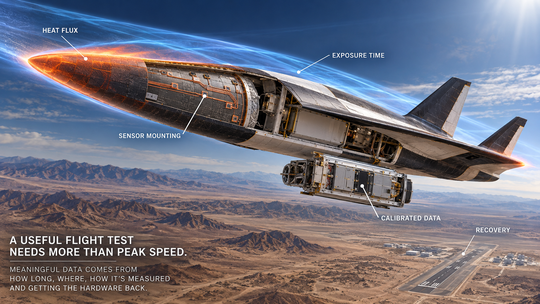
Mach number alone does not define the experiment. Dynamic pressure, heat flux, exposure time and the preceding thermal history can be equally consequential. A brief excursion through a high-speed point is not interchangeable with a sustained exposure at a different altitude. Test planners must specify the phenomenon they want to reproduce before choosing a platform or celebrating its speed.
That is why flight should be designed to discriminate between competing explanations. If two models predict different temperature histories at a joint, instrumentation and trajectory should make the difference measurable. Flying a large payload of sensors without an explicit decision to be made can produce impressive volumes of data and little reduction in design uncertainty.
Talon-A changes the available test architecture
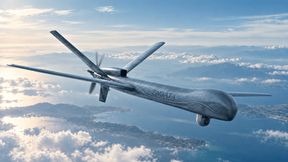
In July 2026, Stratolaunch reported more than ten successful hypersonic flights across its Talon-A platform, including repeat flights of the same vehicle. These are company-reported milestones, not an independently published measure of annual throughput or cost per experiment. They nonetheless support the central distinction: reuse has moved beyond a proposed operating concept to repeated hypersonic flight activity.
Talon-A is a rocket-powered, autonomous test platform. An experiment carried on it does not thereby become a demonstrated hypersonic air-breathing propulsion system. Air launch provides access to a test trajectory; it does not eliminate payload qualification, range coordination, carrier operations or recovery requirements. The architecture is attractive because these services can be shared across successive experiments.
The carrier fleet is also developing. A May 2026 company announcement described a Missile Defense Agency test conducted on 6 March using Talon-A3 and the Spirit of Mojave 747. Separately, on 30 September, Stratolaunch announced acquisition of a Boeing 777-200ER, with modification expected in 2027. The stated 35 per cent capacity increase is a forecast associated with that expansion, not additional capacity already delivered by the announcement date.
The distinction matters for customers buying development time. A successful vehicle flight, an available payload slot and a predictable service schedule are three different deliverables. Programme managers need to know which one is being offered, what conditions can be flown and how a cancelled sortie affects the next opportunity. Fleet expansion can help, but test availability also depends on qualified crews, instrumentation, maintenance and access to an appropriate range.
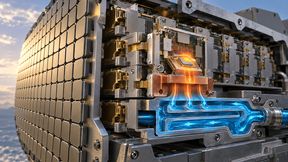
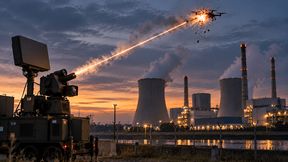
CFD, tunnel measurements and flight data answer different questions. The loop closes only when analysis changes the next experiment.
(Source: KI-generiert / Imagen)
The economics depend on completed learning cycles
A launch price is only one component of the cost of an experiment. Payload integration, calibration, qualification, ground equipment, analysts and post-flight inspection may dominate a small supplier's budget. Recovery can preserve expensive hardware and allow it to be modified, but refurbishment and requalification can consume that saving. Without published, comparable cost data, claims that a particular platform makes testing cheaper by a fixed percentage are premature.
A more useful measure is the cost and elapsed time required to close a technical question. Consider a sensor developer trying to establish whether an installation error explains a flight discrepancy. A recovered package can be recalibrated, its mounting inspected and the same configuration flown again with one controlled change. An expendable experiment may instead require a new assembly, introducing fresh manufacturing variation before the original question is resolved.
Data reduction can become the next bottleneck as flight access improves. An organisation capable of flying more often may still wait weeks to reconcile sensor timing, reject faulty channels and update its model. Increasing sortie capacity without expanding this analytical work produces a queue after flight instead of before it. The effective cadence is the slower of the test service and the engineering team that turns its results into a decision.
What changes for suppliers and sensor developers
For component suppliers, a recurring flight service could make smaller, focused experiments practical before a complete missile or aircraft configuration is ready. A supplier could qualify a sensor mounting or compare two interface designs without waiting for the prime contractor's next integrated demonstration. That prospect depends on interfaces, export permissions and data rights being settled early enough for the result to influence production.
Instrumentation suppliers face a particular opportunity. The relevant product is not just a sensor capable of surviving a peak temperature. It is a measurement chain with known response time, uncertainty, drift and installation effects under the intended flight conditions. A recovered assembly allows those properties to be checked after exposure. Calibration laboratories and specialists in data synchronisation become part of the development service.
Manufacturers also need to decide what a flight result qualifies. Success for one specimen does not establish the repeatability of a production process. If a thermal joint performs well, the next question concerns tolerances, inspection methods and the distribution of behaviour across batches. Flight evidence is most valuable when it is tied to a traceable material lot and a documented manufacturing route.
The industrial risk is mistaking access to an impressive platform for a qualification strategy. Suppliers should agree the evidence required for acceptance before integrating a payload: which loads must be reproduced, which measurements resolve the uncertainty and which ground tests connect a limited flight sample to production variability? Otherwise, a successful sortie may still leave the customer unable to approve the component.
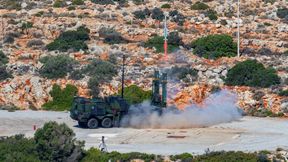
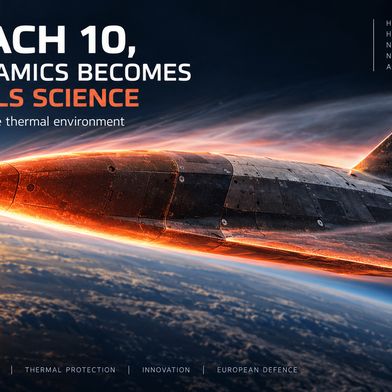
Peak Mach number is not a complete test specification. Duration, dynamic pressure, heat flux and payload conditions determine useful evidence.
(Source: KI-generiert / Imagen)
Throughput must become a measurable service
The decisive comparison with the X-15 is not whether Talon-A can match a historical flight count. It is whether today's test architecture can maintain a useful feedback loop across several customers, vehicle configurations and development schedules. Recoverable hardware, standard interfaces and additional carriers support that loop; reliable measurements and disciplined analysis complete it.
For hypersonic developers, the purchasing decision should therefore include demonstrated envelope, payload integration lead time, recovery and inspection arrangements, data quality and the interval between a result and a follow-up experiment. Peak speed remains a necessary capability for many tests. The scarce industrial resource is increasingly the opportunity to learn what went wrong, change it and fly again while the answer still matters.