Quality assurance through production integrated leak and flow testing: CETA exhibits at EUDEX.
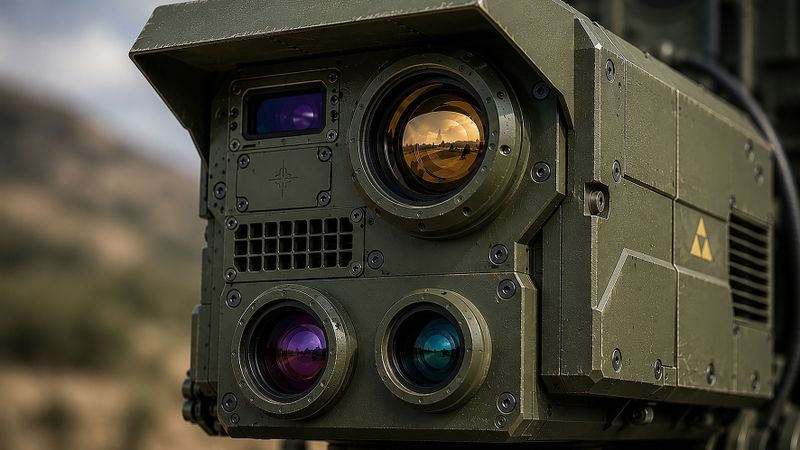
Electro optical sensor systems must be watertight.
(Source: CETA Testsysteme GmbH / Canva / AI generated)
The expansion of the European defence industry requires not only additional manufacturing capacity, but above all stable, reproducible production processes. Automated leak and flow testing makes a decisive contribution to this: it ensures the quality of safety critical components, reduces scrap and rework, and enables comprehensive quality documentation. At Euro Defence Expo (EUDEX) 2026 (22—25 September 2026, Essen (Germany)), CETA Testsysteme GmbH will present solutions for production integrated leak and flow testing.
Rising volumes require industrial series production
The European security and defence industry is undergoing profound change. As defence spending increases, production capacities are being expanded, supply chains diversified and manufacturing processes designed for higher volumes. Production that has traditionally been largely project based is increasingly developing into industrial series production.
This transformation is accompanied by rising requirements for process reliability, traceability and reproducible quality. Thousands of identical components must be manufactured reliably, and product quality must be documented.
Quality is created during the production process
Safety critical electronic products used outdoors must function reliably under a range of environmental conditions. Even the smallest manufacturing deviations can allow moisture or dust to penetrate encapsulated systems. This can cause malfunctions or lead to failure of the entire system.
For this reason, quality assurance is increasingly shifting from conventional final inspection into the manufacturing process. The aim is to detect deviations at an early stage and prevent defective components from entering downstream production steps in the first place.
Leak and flow testing as a key technology in the manufacturing process
Automated and objective testing methods are becoming significantly more important, particularly in high volume production. They provide measurement data for every individual component and enable continuous monitoring of manufacturing quality. Changes in the production process can therefore be detected and corrected at an early stage.
Industrial leak and flow testing plays a central role in this context. Numerous components of modern defence systems must be protected against environmental influences or must reliably ensure defined media flows.
Typical components include electronic control units, sensors, actuators, radio and communication systems, monitoring systems, energy storage systems, battery housings, optoelectronic systems, hermetically sealed units, connectors, valves, cooling circuits, as well as hydraulic and pneumatic components.
Depending on the component and testing requirements, differential pressure, pressure decay, flow or mass flow methods are used. The aim is to reliably detect even the smallest leaks or to measure flow quantitatively, for example in valves and cooling channels.
The measurement data enable continuous monitoring of process stability and provide reliable quality records for every individual component.
Europe’s security landscape is changing rapidly
(Source: VCG)
As defence budgets rise and EU programmes expand, civil technology providers are becoming vital contributors to Europe’s strategic autonomy. The event will act as a neutral platform for dialogue between technology suppliers, integrators, and decision-makers shaping the next generation of European defence capabilities and aims to open doors between civil industry and defence procurement, providing practical insights.
Successful testing technology starts with the right concept
The performance of a testing device alone does not determine the success of a testing solution. An application specific testing concept, the selection of suitable measurement methods and optimal integration into the production line are equally important.
Component geometry, material properties, leak rates, testing times and environmental conditions must already be taken into account during the project planning phase. Only the combination of measurement technology, application expertise and process understanding makes it possible to achieve stable and reproducible test results.
CETA Testsysteme GmbH—experience creates process reliability
Experienced technology partners who support their customers throughout all project phases play a particularly important role when establishing new production capacities.
For more than 35 years, CETA Testsysteme GmbH has been developing measurement and testing systems for industrial leak and flow testing. CETA supports customers from feasibility studies and the development of individual testing concepts through to integration into automated production lines.
Date: 08.12.2025
Naturally, we always handle your personal data responsibly. Any personal data we receive from you is processed in accordance with applicable data protection legislation. For detailed information please see our privacy policy.
Consent to the use of data for promotional purposes
I hereby consent to Vogel Communications Group GmbH & Co. KG, Max-Planck-Str. 7-9, 97082 Würzburg including any affiliated companies according to §§ 15 et seq. AktG (hereafter: Vogel Communications Group) using my e-mail address to send editorial newsletters. A list of all affiliated companies can be found here
Newsletter content may include all products and services of any companies mentioned above, including for example specialist journals and books, events and fairs as well as event-related products and services, print and digital media offers and services such as additional (editorial) newsletters, raffles, lead campaigns, market research both online and offline, specialist webportals and e-learning offers. In case my personal telephone number has also been collected, it may be used for offers of aforementioned products, for services of the companies mentioned above, and market research purposes.
Additionally, my consent also includes the processing of my email address and telephone number for data matching for marketing purposes with select advertising partners such as LinkedIn, Google, and Meta. For this, Vogel Communications Group may transmit said data in hashed form to the advertising partners who then use said data to determine whether I am also a member of the mentioned advertising partner portals. Vogel Communications Group uses this feature for the purposes of re-targeting (up-selling, cross-selling, and customer loyalty), generating so-called look-alike audiences for acquisition of new customers, and as basis for exclusion for on-going advertising campaigns. Further information can be found in section “data matching for marketing purposes”.
In case I access protected data on Internet portals of Vogel Communications Group including any affiliated companies according to §§ 15 et seq. AktG, I need to provide further data in order to register for the access to such content. In return for this free access to editorial content, my data may be used in accordance with this consent for the purposes stated here. This does not apply to data matching for marketing purposes.
Right of revocation
I understand that I can revoke my consent at will. My revocation does not change the lawfulness of data processing that was conducted based on my consent leading up to my revocation. One option to declare my revocation is to use the contact form found at https://contact.vogel.de. In case I no longer wish to receive certain newsletters, I have subscribed to, I can also click on the unsubscribe link included at the end of a newsletter. Further information regarding my right of revocation and the implementation of it as well as the consequences of my revocation can be found in the data protection declaration, section editorial newsletter.
The “Made in Germany” testing devices use compressed air as the test medium. Typical test pressures range from 1 bar to 10 bar. Compressed air can be used to detect leak rates down to 10-3 mbar*l/s, depending on the size of the test volume. The flow testing devices can measure gas flows from 3 ml/min to 200 l/min.
The testing methods used are based on standards described in DIN EN 1779 (criteria for the selection of leak testing methods) and DIN EN 13184 (pressure change methods).
The testing methods that have proven successful in the automotive, electronics, energy technology, medical technology and electric mobility sectors can be transferred to numerous applications in the security and defence industry—particularly wherever high production volumes coincide with safety critical quality requirements. CETA is characterised by its own development and manufacturing capabilities, a calibration laboratory accredited to DIN EN ISO/IEC 17025 (D-K-19566), and a quality management system in accordance with ISO 9001. Several thousand CETA testing devices are in use worldwide in production lines for quality control.
EUDEX as a platform for cooperation
The international leading trade fair for the defence industry, Euro Defence Expo (EUDEX), is being held in parallel with security essen, the international leading trade fair for civilian security, from 22—25 September 2026 at the exhibition grounds in Essen.
With its first participation in Euro Defence Expo, CETA is highlighting the expansion of its activities in the security and defence industry. The company is seeking dialogue with manufacturers, system integrators, research institutions and public sector customers in order to jointly develop solutions for future testing tasks in industrial defence production.
At the trade fair, CETA will present leak testing using compressed air as the test medium on an electronic control unit with the CETATEST 820 leak tester. The pressure loss caused by leakage is quantitatively determined using the differential pressure method.
CETA at EUDEX | 22—25 September 2026 | Essen (Germany) Joint stand of the state of North Rhine Westphalia, Hall 3, Stand 3B17


:quality(80)/p7i.vogel.de/wcms/97/29/97293bc01fcd40ac9f5d5b4f4b1c1227/995ffab6-abca-4366-b067-078aee746368-1536x864v1.png "Symbolic image of a Leopard 2 main battle tank: Production and maintenance starts in Lithuania. (Picture: AI generated)")
:quality(80)/p7i.vogel.de/wcms/a6/5a/a65a0979453bbbd1812271415d3c5496/aws-constellation-pink-201220-1800x200-1024x683-1-1024x576v1.png "(Source: OHB Sweden)")
:quality(80)/p7i.vogel.de/wcms/b1/29/b12963beb937c53200edb41ab98f0ad7/battleverse-v1-990x557v1.png "(Source: European Commission)")
:quality(80)/p7i.vogel.de/wcms/ce/77/ce77408fa51d0b60ea2e0f209c763681/rr-invests-pound-300-million-in-uk-ct-img-480x270v1.jpeg "(Source: Rolls-Royce)")
:quality(80)/p7i.vogel.de/wcms/33/a7/33a7f8ac37b143e73964dad10c8aafbc/0133560493v1.jpeg "Benedikt Gundling and Tobias Hannen in front of a tank component of the Ariane 6. (Source: Grob Works)")
:quality(80)/p7i.vogel.de/wcms/4f/3a/4f3a22eb23991207008533412c8dc817/screenshot-2026-09-25-125155-1405x790v1.png "(Source: BINDER GmbH)")
:quality(80)/p7i.vogel.de/wcms/4a/9f/4a9f831c424718e98ef3cf6b10b4dc3e/hot-fire-jarvisv1-900x506v1.jpeg "Developed in record time: A “JARVIS-class” jet engine capable of up to 100 pounds of thrust. It was designed in a four-week sprint using generative AI and established CAD/CAE tools. (Source: MIT)")
:quality(80)/p7i.vogel.de/wcms/13/12/1312059ec82b1ed9e3df080350b29dc4/f46335bf-a581-4786-959f-4a0e9a74aed1-1671x940v1.png "Military radar architecture using distributed RF sensor nodes connected through optical fibre to central processing. (Source: KI-generiert / Gemini)")
:quality(80)/p7i.vogel.de/wcms/00/dc/00dcad81b11488711a69893092df7124/thedigitalartist-ai-generated-8314615-1920x1080v1.jpeg "(Source: Pete Linforth on Pixabay)")
:quality(80)/p7i.vogel.de/wcms/f9/37/f93735747249cd50daf2c2fdc4535965/9c7d8875-fc66-4fdd-aa43-5676f10bba45-624x351v1.jpeg "Team of the DLR Mobile Rocket Base (MORABA). (Source: DLR (CC BY-NC-ND 3.0))")
:quality(80)/p7i.vogel.de/wcms/fc/1c/fc1c256ca19020e8f6e398fdb9ba2025/thedigitalartist-ai-generated-8061336-1920x1080v1.jpeg "(Source: Pete Linforth on Pixabay)")
:quality(80)/p7i.vogel.de/wcms/5a/5a/5a5a0a2b51dbe1dd52c884b951db8cc7/aefa03eb-8efe-4b02-b8dd-824db7ae426f-1672x940v1.png "(Source: KI-generiert / Gemini)")
:quality(80)/p7i.vogel.de/wcms/cb/a2/cba2ecda891b2874327a30f69f773bdb/hexaforce-15-1920x1079v1.jpeg "(Source: Thales/Gauthier Chauffrut)")
:quality(80)/p7i.vogel.de/wcms/9d/8a/9d8addea8cc4e6f7a4793563ca397f2a/ai-im-milit-r-1672x940v1.png "(Source: KI-generiert / Gemini)")
:quality(80)/p7i.vogel.de/wcms/7f/5f/7f5fba2c729ec3aa256bf1a18d74529b/ai-chip-1672x940v1.png "(Source: KI-generiert / Gemini)")
:quality(80)/p7i.vogel.de/wcms/64/1b/641b6474b2a614cde7730c89ef2a3015/2026-09-09-rheinmetall-veroeffentlicht-battlesuite-schnittstellen-e8c18194-1225x690v1.jpeg "Rheinmetall’s Battlesuite provides a modular digital platform for connecting and integrating sensors, hardware and software components. (Source: Rheinmetall AG)")
:quality(80)/p7i.vogel.de/wcms/fe/11/fe1187f54b38f08ec4e244b50edf3201/toulouse-si-ge-airbus-853x480v1.jpeg "Airbus is expanding its European cybersecurity activities through a series of acquisitions (Picture: Nemausensis Asinus / Public Domain)")
:quality(80)/p7i.vogel.de/wcms/b4/0f/b40f9a9262229f0ad6f652dcff9012d8/ministry-of-defence-uk-1672x940v1.png "(Source: Ministry of Defence UK)")
:quality(80)/p7i.vogel.de/wcms/f1/c8/f1c88c768ba87dd2d71c708945c7df78/s960-applied-intuition04-960x640-960x540v1.jpeg "(Source: UK Government)")
:quality(80)/p7i.vogel.de/wcms/ef/1e/ef1eaddf8243b9c30cbfef17a4151def/aufmacherv1.jpeg "What works against drones—and what should be kept in mind when it comes to chain-based defence strategies? (Source: Mattheck)")
:quality(80)/p7i.vogel.de/wcms/90/a8/90a849f0023f11d1eb642eb4751a0321/bild2-h-c3-a4nel-ict-20truck-20and-20trailer-20parts-4320x2429v1.jpeg "Product information is visible at all times and retrieval of items
is confirmed by employees directly on the display of the Hänel MP 14 N
controller. (Source: René Marks)")
:quality(80)/p7i.vogel.de/wcms/4e/ca/4ecaa39f247490eded591b652c33aee3/thilmann-hcp-web-20kleiner-20ausschnitt-1442x811v1.jpeg "Entering the defence market can be challenging for start-ups, says HCP Sense CEO Ansgar Thilmann. (Picture: HCP Sense)")
:quality(80)/p7i.vogel.de/wcms/7a/51/7a511b80041d3f1335f3a5aa56fe75da/delivery-7022432-1280-1280x720v1.png "(Source: Mohamed_hassan)")
:quality(80)/p7i.vogel.de/wcms/f9/2f/f92f1ef8c739c34c70d99f7b0997621b/stra007-20--20cover-20image-5472x3076v1.jpeg "(Source: Stratasys)")
:quality(80)/p7i.vogel.de/wcms/ec/a9/eca9062ccbe4b042f8515846340410d8/aerospace-and-defence-stairways-platforms-and-much-morev1.jpeg "Modular constructions enable flexible modification. That applies to larger structures such as stairways and platforms, too. And that means aerospace and defence companies can reconfigure their maintenance platforms fast (itemitem)")
:quality(80)/p7i.vogel.de/wcms/30/2a/302a7b5723ad38fbde812fd3a468ad04/safety-on-stairways-in-industry-key-considerationsv1.jpeg "Stairways and platforms are used widely in maintenance and assembly areas in the aerospace and defence sectors. (Source: item)")
:quality(80)/p7i.vogel.de/wcms/f3/4e/f34ed744bb30817d3432c7ad522e6f30/engine-1v1.jpeg "Engineering with aluminium profiles really can be this easy – the item Engineeringtool and its smart functions help you save valuable time. (Source: item)")
:fill(fff,0)/p7i.vogel.de/companies/69/6d/696de2483d115/logo--fastems-rgb-horizontal.jpeg "logo--fastems-rgb-horizontal (Fastems)")
:fill(fff,0)/images.vogel.de/vogelonline/companyimg/84700/84735/65.jpg "logo_item_rgb_neu.jpg ()")

:quality(80)/p7i.vogel.de/wcms/4f/3a/4f3a22eb23991207008533412c8dc817/screenshot-2026-09-25-125155-1405x790v1.png "screenshot-2026-09-25-125155-1405x790v1 (Source: BINDER GmbH)")
:quality(80)/p7i.vogel.de/wcms/19/fe/19fec946bf72c94493e9286fb7b694d0/0132176619v1.jpeg "Vision Engineering will be showcasing its products at the Euro Defence Expo in Hall 3 / 3A79 from September 22 to 25, 2026, among other events. (Source: Vision Engineering)")