UKDI, on behalf of Army Innovation, funded the first passive counter-drone detection systems deployed at a British Army base - delivered in under six months.
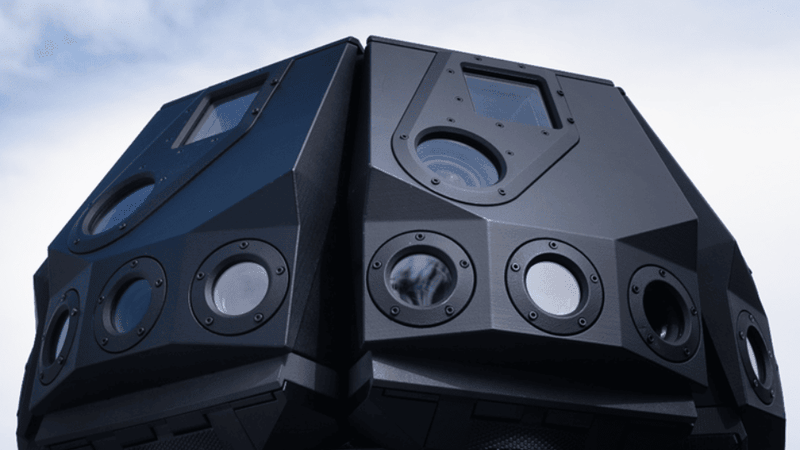
Quell’s SkySpyke system in action
(Source: UK Government)
Drones are getting smaller, cheaper, and harder to detect. An unauthorised drone can loiter above a military site, gathering visual and signal intelligence, and remain hidden from sight, unless you have the right detection capability in place.
Now, that capability exists at a UK Army base. A rapid, partnering model, Initiated and led by the ETG, and funded by UK Defence Innovation (UKDI), Project Halo Shield delivered a passive C-UAS detection system at the Warminster garrison, moving from concept to operational deployment at genuine pace, delivering a UK first for Army base protection.
In the first 17 days of live monitoring, the system recorded 29 drone position alerts with detections up to 5km away - none of which presented a threat to the base. The system was also tested by Army flown drones seeking to expose any weaknesses. The impressive results are already helping inform how defence thinks about drone detection, building a clear foundation for wider adoption across UK military sites.
Two companies. One layered solution.
UKDI funding backed two suppliers to deliver a layered detection capability to give end users a clearer, more reliable picture of the airspace around the base.
That decision was built on solid groundwork. ETG had already worked alongside both suppliers through field demonstrations and C-UAS exercises, including Project Vanaheim and Project Flytrap, where the technology was tested against live drone activity. That familiarity — with the suppliers, with defence networks, and with integration standards — is what made the transition from demonstration to deployment so rapid.
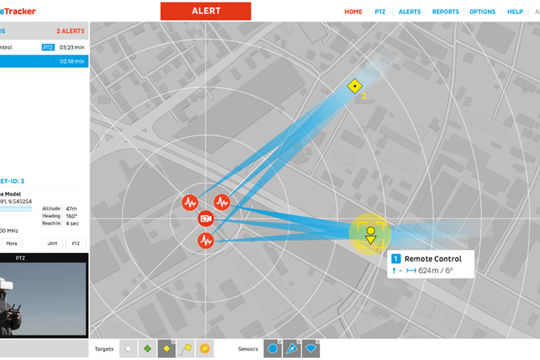
One of those suppliers, Dedrone, now part of Axon, is a global leader in counter-drone technology, protecting over 1,130+ sites across 35 countries, from airports to critical national infrastructure. Their C2 software solution, which brings together multiple sensor types — including Dedrone’s own radio frequency (RF) sensors — into a single integrated operational picture, can detect the signal between a drone and its operator, identifying both the aircraft and the pilot and displaying that information in real time.
Dedrone’s system in action
(Source: UK Government)
For Nick McRobb, Dedrone’s UK defence lead and a former Army Colonel, the speed of the project stood out even by commercial standards. “We moved quickly. The demonstration event took place in November 2025, and we did our on-site recce in January 2026. We were installed and operational a few months later by March 2026.”
The system uses three RF sensors to triangulate the drone position across the garrison site. Meanwhile, a fourth RF sensor handles recognition and identification of both the drone and its controller. But RF detection is just one part of the capability.
This is where Quell comes in. A British company designing and building passive, AI-enabled surveillance and C-UAS systems, Quell delivered SkySpyke as the second layer of the Warminster deployment. The system operates autonomously, providing complete hemispheric sky coverage, detecting, tracking, and identifying all airborne objects. AI is also used to filter and deliver alerts and visual confirmation of objects of interest, reducing operator burden and making it easy to use.
Bobby Hamilton, Quell’s Chief Operating Officer, explains: “We’ve worked hard to build a system that is both simple and effective for the end-user. The drone threat is evolving, with a migration away from traditional RF-emitting capabilities. That’s where we can really add value. If a drone is present we will be able to see it and identify it, regardless of how it is communicating.”
Quell’s journey to Warminster can be traced back to earlier UKDI funding, which helped the company enhance the SkySpyke system, by building out their software platform, Deep Truth, improving the detection range and redesigning the hardware to deliver a modular solution. That funding didn’t just improve the product, but it also helped build the track record that got Quell through the door at Warminster.
Date: 08.12.2025
Naturally, we always handle your personal data responsibly. Any personal data we receive from you is processed in accordance with applicable data protection legislation. For detailed information please see our privacy policy.
Consent to the use of data for promotional purposes
I hereby consent to Vogel Communications Group GmbH & Co. KG, Max-Planck-Str. 7-9, 97082 Würzburg including any affiliated companies according to §§ 15 et seq. AktG (hereafter: Vogel Communications Group) using my e-mail address to send editorial newsletters. A list of all affiliated companies can be found here
Newsletter content may include all products and services of any companies mentioned above, including for example specialist journals and books, events and fairs as well as event-related products and services, print and digital media offers and services such as additional (editorial) newsletters, raffles, lead campaigns, market research both online and offline, specialist webportals and e-learning offers. In case my personal telephone number has also been collected, it may be used for offers of aforementioned products, for services of the companies mentioned above, and market research purposes.
Additionally, my consent also includes the processing of my email address and telephone number for data matching for marketing purposes with select advertising partners such as LinkedIn, Google, and Meta. For this, Vogel Communications Group may transmit said data in hashed form to the advertising partners who then use said data to determine whether I am also a member of the mentioned advertising partner portals. Vogel Communications Group uses this feature for the purposes of re-targeting (up-selling, cross-selling, and customer loyalty), generating so-called look-alike audiences for acquisition of new customers, and as basis for exclusion for on-going advertising campaigns. Further information can be found in section “data matching for marketing purposes”.
In case I access protected data on Internet portals of Vogel Communications Group including any affiliated companies according to §§ 15 et seq. AktG, I need to provide further data in order to register for the access to such content. In return for this free access to editorial content, my data may be used in accordance with this consent for the purposes stated here. This does not apply to data matching for marketing purposes.
Right of revocation
I understand that I can revoke my consent at will. My revocation does not change the lawfulness of data processing that was conducted based on my consent leading up to my revocation. One option to declare my revocation is to use the contact form found at https://contact.vogel.de. In case I no longer wish to receive certain newsletters, I have subscribed to, I can also click on the unsubscribe link included at the end of a newsletter. Further information regarding my right of revocation and the implementation of it as well as the consequences of my revocation can be found in the data protection declaration, section editorial newsletter.
Europe’s security landscape is changing rapidly
(Source: VCG)
As defence budgets rise and EU programmes expand, civil technology providers are becoming vital contributors to Europe’s strategic autonomy. The event will act as a neutral platform for dialogue between technology suppliers, integrators, and decision-makers shaping the next generation of European defence capabilities and aims to open doors between civil industry and defence procurement, providing practical insights.
Hamilton notes, “The UKDI funding allowed us to implement a lot of the learnings we took from the British Army’s Army Warfighting Experiment and pushed us forward into operational testing with Taskforce RAPSTONE on their C-UAS Exercises, Project Vanaheim and Project Flytrap. Having systems deployed with the UK MOD has allowed us to prove the capability in real operational environment, and demonstrate how it could perform across the wider defence estate.”
What comes next
ETG’s technical input throughout Halo Shield has created a solid foundation for expansion. Future phases may see more C-UAS solutions adopted across UK garrison sites, with radar capabilities and acoustic sensors added alongside existing RF and optical sensors to create a truly layered detection architecture.
Col James Howard, Experimentation & Trials Group said: “Working with UKDI and industry on this kind of dual use capability has been beneficial to all parties, making the British Army more safe from real, modern, threats while in its barracks as well as allowing the Experimentation and Trials Group to further develop the British Army’s counter drone capabilities.”
Nick McRobb notes: ”I want them to really bend it, break it, test it hard. Because only by doing that will they get the confidence to say, this is something we need more broadly across the estate. What this project proves is that sensor fusion is the answer. Each technology brings something the others don’t — and when you bring them together into a single picture, you get a level of confidence and clarity that no single system can match on its own.”
UKDI exists to get cutting-edge capability from concept to frontline at pace. Project Halo Shield is exactly that in action, a real threat, a rapid response, and two innovative companies given the space and funding to prove what’s possible.




:quality(80)/p7i.vogel.de/wcms/08/e7/08e7c441560d9a9662adf2aec7b564f3/0133497578v1.jpeg "A Virtus drone from Stark Defence is being deployed in the war in Ukraine. Now the Berlin-based company reports that it has secured a major contract from the German Armed Forces. (Image:S. Sorjevsky)")
:quality(80)/p7i.vogel.de/wcms/5f/be/5fbef750642afb67f9335a173ca4efbd/chatgpt-image-22--sept--2026-11-25-43-1536x864v1.png "SMEs could play a bigger role in defence supply chains in the future. (Picture: AI generated)")
:quality(80)/p7i.vogel.de/wcms/2e/0e/2e0e8c8fb01d6e14cd0efadbc118cb4e/rsi-europe-photo-credit-delfi-josvydo-elinsko-1920x1079v1.jpeg "(Source: Delfi Josvydo Elinsko)")
:quality(80)/p7i.vogel.de/wcms/cb/bf/cbbfe6049e2e264bc58b30b05a36f755/enjoytheworld-dubai-4051672-1920x1079v1.jpeg "(Source: Dirk on Pixabay)")
:quality(80)/p7i.vogel.de/wcms/13/12/1312059ec82b1ed9e3df080350b29dc4/f46335bf-a581-4786-959f-4a0e9a74aed1-1671x940v1.png "Military radar architecture using distributed RF sensor nodes connected through optical fibre to central processing. (Source: KI-generiert / Gemini)")
:quality(80)/p7i.vogel.de/wcms/0a/14/0a1495d9b570ae32a5a7cc748b9a3c60/st-hannover-035-1920x1079v1-999x562v1.jpeg "Fastening technology you can experience first-hand—visitors to Schraubtec in Bochum (Germany) can see it for themselves at the Ruhr Congress on September 30, 2026. (Source: PHOTOVISION-DH GmbH)")
:quality(80)/p7i.vogel.de/wcms/cd/a9/cda92b173afa9d0b455d4f11b281c9ea/0094-to-image--capstone-cdr-1440x810v1.png "(Source: Terran Orbital)")
:quality(80)/p7i.vogel.de/wcms/e0/45/e045bc5414d7263fb308bdd501b5fcc1/0133113962v1.jpeg "The HSWL 354 is the transmission used, for example, in the Leopard 2 main battle tank. Renk manufactures this system and is now preparing to significantly increase its cycle time. As a result, Renk is placing greater emphasis on the military sector as a customer ... (Source: Renk)")
:quality(80)/p7i.vogel.de/wcms/1f/c2/1fc25ec2bd47a47b4617766e40033de2/image-2000-74f03b8e935a22580e24d2b05fe5ca3c-1920x1079v1.jpeg "The Airbus A310 ZERO-G stands ready for the 47th DLR parabolic flight campaign. It took place in Bordeaux from 7 to 18 September 2026. A total of twelve experiments from the fields of biology, physics, technology and materials science were on board. (Source: DLR (CC BY-NC-ND 3.0))")
:quality(80)/p7i.vogel.de/wcms/22/81/22812f686fd6ec1235f02392a3df56b9/34370ad9-163a-5941-9825-9c87a0e50000-1920x1079v1.png "Ariane 6 A64 flight VA267 with 32 satellites for Amazon LEO constellation, ready for launch at Europe's Spaceport in Kourou, French Guiana on 12 February 2026. (Source: ESA—M. Pédoussaut)")
:quality(80)/p7i.vogel.de/wcms/04/6b/046bda5de33193b13ebda873c3372868/iris2-1ceuropean-commission-1-1680x944v1.jpeg "(Source: European Commission)")
:quality(80)/p7i.vogel.de/wcms/d9/3c/d93c89ab8ed08d673065e1eac2e85aea/8cc82e51-a188-4e50-9432-ee715ab25586-1672x940v1.png "At Mach 10, Aerodynamics Becomes Materials Science (Source: )")
:quality(80)/p7i.vogel.de/wcms/cb/a2/cba2ecda891b2874327a30f69f773bdb/hexaforce-15-1920x1079v1.jpeg "(Source: Thales/Gauthier Chauffrut)")
:quality(80)/p7i.vogel.de/wcms/9d/8a/9d8addea8cc4e6f7a4793563ca397f2a/ai-im-milit-r-1672x940v1.png "(Source: KI-generiert / Gemini)")
:quality(80)/p7i.vogel.de/wcms/7f/5f/7f5fba2c729ec3aa256bf1a18d74529b/ai-chip-1672x940v1.png "(Source: KI-generiert / Gemini)")
:quality(80)/p7i.vogel.de/wcms/64/1b/641b6474b2a614cde7730c89ef2a3015/2026-09-09-rheinmetall-veroeffentlicht-battlesuite-schnittstellen-e8c18194-1225x690v1.jpeg "Rheinmetall’s Battlesuite provides a modular digital platform for connecting and integrating sensors, hardware and software components. (Source: Rheinmetall AG)")
:quality(80)/p7i.vogel.de/wcms/b1/f0/b1f00d146f272acbef15ea82996259de/s960-halo-shield-2-960x540v1.png "Quell’s SkySpyke system in action (Source: UK Government)")
:quality(80)/p7i.vogel.de/wcms/2b/3d/2b3d42b7dc255aaaf5cadf57dab47d3b/43907b28dda9-sky-striker-demo-2-1600x899v1.webp "Diehl Defence and Elbit Systems demonstrate the capabilities of the SkyStriker loitering munition during a live demonstration. (Source: Diehl Defence)")
:quality(80)/p7i.vogel.de/wcms/73/b3/73b310d878207253f20d1725e76bc1e3/leopard-2-bundeswehr-picture-1920x1079v1.jpeg "(Source: European Defence Agency)")
:quality(80)/p7i.vogel.de/wcms/61/fd/61fde39a2c5744cc1bcc522965692c21/0133364253v1.jpeg "U.S. Secretary of Defence Pete Hegseth wants to make greater use of German industry for NATO defence. (Image: ©Sergey Ryzhov—stock.adobe.com)")
:quality(80)/p7i.vogel.de/wcms/90/a8/90a849f0023f11d1eb642eb4751a0321/bild2-h-c3-a4nel-ict-20truck-20and-20trailer-20parts-4320x2429v1.jpeg "Product information is visible at all times and retrieval of items
is confirmed by employees directly on the display of the Hänel MP 14 N
controller. (Source: René Marks)")
:quality(80)/p7i.vogel.de/wcms/4e/ca/4ecaa39f247490eded591b652c33aee3/thilmann-hcp-web-20kleiner-20ausschnitt-1442x811v1.jpeg "Entering the defence market can be challenging for start-ups, says HCP Sense CEO Ansgar Thilmann. (Picture: HCP Sense)")
:quality(80)/p7i.vogel.de/wcms/7a/51/7a511b80041d3f1335f3a5aa56fe75da/delivery-7022432-1280-1280x720v1.png "(Source: Mohamed_hassan)")
:quality(80)/p7i.vogel.de/wcms/f9/2f/f92f1ef8c739c34c70d99f7b0997621b/stra007-20--20cover-20image-5472x3076v1.jpeg "(Source: Stratasys)")
:quality(80)/p7i.vogel.de/wcms/ec/a9/eca9062ccbe4b042f8515846340410d8/aerospace-and-defence-stairways-platforms-and-much-morev1.jpeg "Modular constructions enable flexible modification. That applies to larger structures such as stairways and platforms, too. And that means aerospace and defence companies can reconfigure their maintenance platforms fast (itemitem)")
:quality(80)/p7i.vogel.de/wcms/30/2a/302a7b5723ad38fbde812fd3a468ad04/safety-on-stairways-in-industry-key-considerationsv1.jpeg "Stairways and platforms are used widely in maintenance and assembly areas in the aerospace and defence sectors. (Source: item)")
:quality(80)/p7i.vogel.de/wcms/f3/4e/f34ed744bb30817d3432c7ad522e6f30/engine-1v1.jpeg "Engineering with aluminium profiles really can be this easy – the item Engineeringtool and its smart functions help you save valuable time. (Source: item)")
:fill(fff,0)/p7i.vogel.de/companies/69/6d/696de2483d115/logo--fastems-rgb-horizontal.jpeg "logo--fastems-rgb-horizontal (Fastems)")
:fill(fff,0)/images.vogel.de/vogelonline/companyimg/84700/84735/65.jpg "logo_item_rgb_neu.jpg ()")

:quality(80)/p7i.vogel.de/wcms/86/bb/86bb77517bba1aa32ffdd827d3e86934/s960-vizgard-960-x-640px-2-960x540v1.png "Vizgard’s FortifAI in action (Source: GOV.UK)")
:quality(80)/p7i.vogel.de/wcms/d2/a9/d2a93832b5593fb89e110d893b347a13/199682-1920x1079v1.jpeg "Rheinmetall’s Skyspotter system provides electro-optical detection and tracking for comprehensive drone surveillance at civilian airfields. (Source: Rheinmetall AG)")