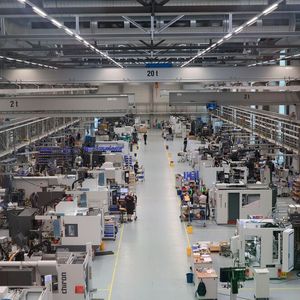
What was long characterised by small batch sizes, individual parts, and a lot of manual work must now increasingly be handled on an industrial scale. Chiron offers solutions that meet the new requirements of this industry in transition efficiently, effectively, and safely.
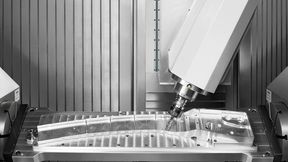
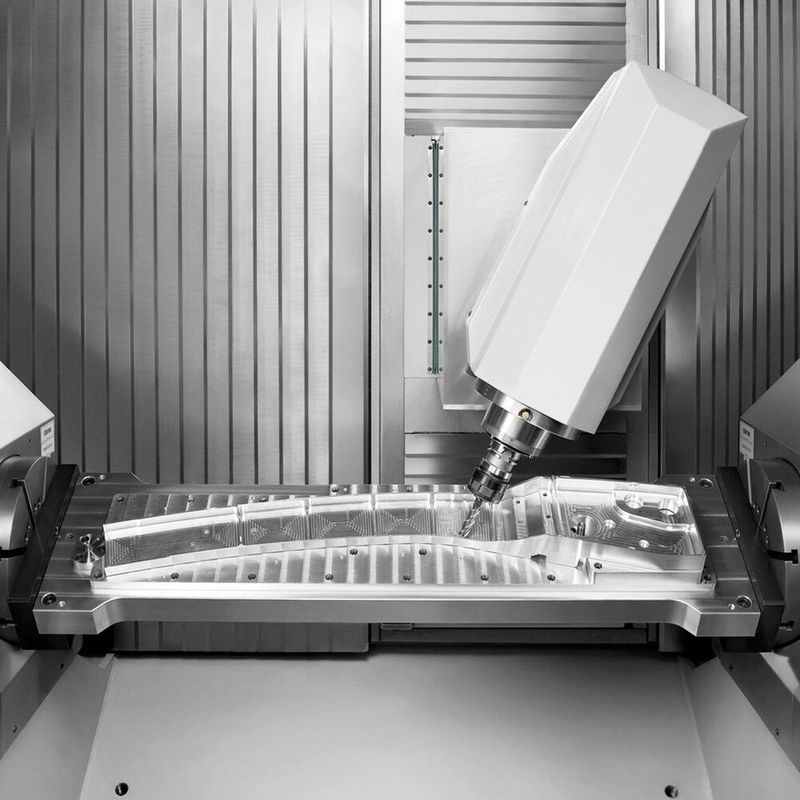
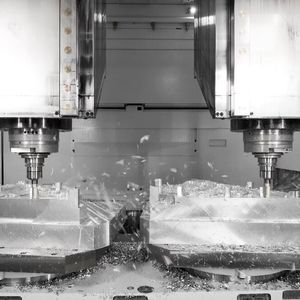
Machining allowances of 95 percent and more—for stability reasons, in the aerospace industry structurally relevant, load-bearing components are often milled from solid stock. This, too, is now often done in unmanned machining.
(Source: Chiron)
Structures and processes in aerospace manufacturing are currently undergoing fundamental change: batch sizes in the aerospace industry are increasing. Not necessarily to the extremely large unit numbers that were still common in the automotive industry a few years ago. But they are reaching volumes at which manufacturing that treats every part like a one-off quickly reaches its limits. Aircraft manufacturers are increasing their production rates. In the first half of 2026, Airbus already delivered 351 commercial aircraft and reported an order backlog of 9,222 commercial aircraft. For the A320 family, the company is sticking to a production rate of 70 to 75 aircraft per month through the end of 2027; after that, the figure is to be stabilised at 75. Other manufacturers are in a similar situation.
Requirements in transition
Such figures dramatically change the requirements in the production chain. Suppliers have to deliver. Continuously. Precisely and with high quality. And reliably. They need capacity. They need short throughput times. They must be able to handle variants. They must ensure reproducible quality assurance. And in order to remain marketable and competitive, they must utilise their machines optimally so that they can manufacture on attractive terms.
In machining, the question therefore is no longer simply whether a machining center can manufacture a complex aerospace component. The more interesting question is: How many such components can it produce in what period of time—and what happens in between?
The number of units comes in through the back door
Manufacturing in the aerospace industry is not the automotive industry. Nor will it become one. An aircraft consists of a great many parts. Some of them are needed only in small quantities. Others recur throughout a program. And from a few dozen or a few hundred parts, over the lifetime of an aircraft program, a quite respectable production run can emerge.
That is why the change does not come as a big leap. It comes piece by piece. A component that used to be regarded as an individual part gets a recurring call-off. A small series becomes a medium series. Several variants become a family. And suddenly the question becomes interesting as to whether the machine can also take care of the parts at night or on the weekend.
From artisanal to industrial production
This is the point at which, in manufacturing production that has so far been strongly characterised by manual craftsmanship, automation increasingly comes into play not only against the backdrop of the shortage of skilled workers, but especially also in the interest of manufacturing quality and efficiency. And it is the point at which the machine tool is changing as well. It does not necessarily have to become (only) faster. Above all, it needs to be utilised better.
The Tuttlingen machine tool manufacturer Chiron offers a broadly positioned machine range that covers a wide spectrum of very different applications. The current program extends from the Micro5 and Micro5 XL for small and very small precision components, through the compact 08, 12 and 15 series, to the 16, 18 and 19 series, and on to the 22 and 25 series for larger parts as well as the even larger 28 series. In addition, there is the MILL series for long workpieces and the 715 for mill-turn tasks. The program is complemented by automation and digital solutions.
Small and safety-relevant
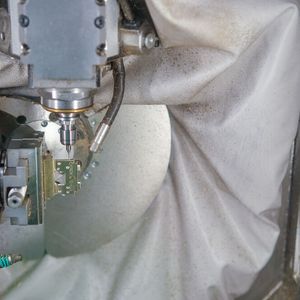
“Small” by no means means “insignificant” in the aerospace industry. For example, Chiron has the ultracompact Micro5 5-axis machining center, a machine designed for highly precise 5-axis machining of small workpieces. It is about parts down to sizes such as those used in Swiss luxury watches or, as safety-relevant components, for instance in the sensor technology and control systems of aerospace vehicles. The maximum workpiece dimensions on this machine fit into a cube with a side length of 50 millimeters (approx. 2 iches). The machine is compact and dynamic and can be equipped with a magazine for up to 60 tools as well as with palletisation. For automatic loading, the Feed5 handling system is available, whose 6-axis robot can supply up to two Micro5 machines.
Date: 08.12.2025
Naturally, we always handle your personal data responsibly. Any personal data we receive from you is processed in accordance with applicable data protection legislation. For detailed information please see our privacy policy.
Consent to the use of data for promotional purposes
I hereby consent to Vogel Communications Group GmbH & Co. KG, Max-Planck-Str. 7-9, 97082 Würzburg including any affiliated companies according to §§ 15 et seq. AktG (hereafter: Vogel Communications Group) using my e-mail address to send editorial newsletters. A list of all affiliated companies can be found here
Newsletter content may include all products and services of any companies mentioned above, including for example specialist journals and books, events and fairs as well as event-related products and services, print and digital media offers and services such as additional (editorial) newsletters, raffles, lead campaigns, market research both online and offline, specialist webportals and e-learning offers. In case my personal telephone number has also been collected, it may be used for offers of aforementioned products, for services of the companies mentioned above, and market research purposes.
Additionally, my consent also includes the processing of my email address and telephone number for data matching for marketing purposes with select advertising partners such as LinkedIn, Google, and Meta. For this, Vogel Communications Group may transmit said data in hashed form to the advertising partners who then use said data to determine whether I am also a member of the mentioned advertising partner portals. Vogel Communications Group uses this feature for the purposes of re-targeting (up-selling, cross-selling, and customer loyalty), generating so-called look-alike audiences for acquisition of new customers, and as basis for exclusion for on-going advertising campaigns. Further information can be found in section “data matching for marketing purposes”.
In case I access protected data on Internet portals of Vogel Communications Group including any affiliated companies according to §§ 15 et seq. AktG, I need to provide further data in order to register for the access to such content. In return for this free access to editorial content, my data may be used in accordance with this consent for the purposes stated here. This does not apply to data matching for marketing purposes.
Right of revocation
I understand that I can revoke my consent at will. My revocation does not change the lawfulness of data processing that was conducted based on my consent leading up to my revocation. One option to declare my revocation is to use the contact form found at https://contact.vogel.de. In case I no longer wish to receive certain newsletters, I have subscribed to, I can also click on the unsubscribe link included at the end of a newsletter. Further information regarding my right of revocation and the implementation of it as well as the consequences of my revocation can be found in the data protection declaration, section editorial newsletter.
Especially with small parts, non-productive times can carry disproportionately more weight. If the workpiece spends only a few minutes in the machine, manual loading quickly becomes the limiting factor. How automation can help optimise this was demonstrated by Chiron, for example, at various trade fairs with the production of aerospace connectors on a Micro5. And with the Micro5 XL, the concept has since been extended to larger workpieces up to 120 millimeters (approx. 5 inches). The principle remains the same: the machine should be busy with the part—not the operator.
If it can be one size bigger
In the 08, 12 and 15 series, the principle evolves into a fully fledged production concept: The 08 series is designed for compact, dynamic machining. It is available with one or two spindles, as a 5-axis machine, with in-cycle workpiece changeover, and also as a mill-turn variant. This allows the machine to be tailored very precisely to the respective task. And that makes it, like the entire machine family, ideally suited for a wide range of aerospace components.
In series 12, the dual spindle also comes into play. And series 15 takes the concept further. With two spindles, an automated workpiece changeover, and the inherently short travel paths of the design, the machine’s idle time can be significantly reduced. That sounds unspectacular. But it isn’t.
When seconds add up
Because in serial production, the seconds add up. A few seconds during tool changes. A few during loading. A few during unloading. A few minutes because the operator is currently busy at another machine. In the end, that turns into hours, days, and weeks that are ultimately missing from parts production.
The companies in the aerospace industry need a new manufacturing logic.
Therefore, companies in the aerospace industry need a new manufacturing logic: In the past, the operator stood next to the machine, eyes on the cutting edge of the tool, hand often on the potentiometer. Today, a machine operator tends several machines. Better still: he loads an automation system that covers several machines and possibly a wide variety of processes, prepares tools, monitors ongoing machining operations, and takes care of what actually requires the attention of a skilled worker.
Tailor-made manufacturing concepts
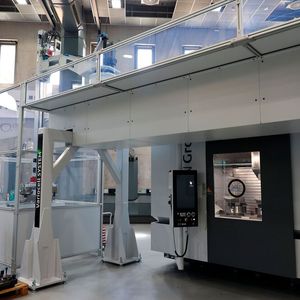
Chiron offers different concepts for this. Variocell Move brings a robot to the machine. Variocell Pallet works with pallets and is therefore also interesting for changing workpieces and smaller batch sizes. Variocell System links machining centers with material handling and other stations to create an automated production system. In addition, there is Feed5 for the compact automation of the Micro5.
Chiron
Chiron offers an unusually broad modular range for machining tasks in the aerospace industry, from the compact 5-axis center to the large long-bed machine. So there is no single “aerospace machine.” There are a wide variety of machines that are optimally designed for a wide range of manufacturing tasks from a broad spectrum of applications. In addition, there are twin-spindle concepts, complete machining, pallet and robot automation, as well as digital solutions for process monitoring. The current portfolio is therefore to be understood less as a collection of individual machines, but rather as the opportunity to build a manufacturing operation from a holistic perspective along its specific task. Link here
The decisive factor in automation is not the robot or the pallet system. Those are only the visible elements. What matters is the concept and the way of working behind it. If, for example, an FZ 16 S is equipped with a Variocell Pallet and 26 pallets, the machining center becomes a manufacturing unit that can take on many different jobs. This exact combination is ideal for flexible, highly automated variant production. This is particularly interesting for aerospace, because there flexibility means being able to manufacture different jobs economically one after another.
Machining titanium requires know-how and machine power
Machining in the aerospace industry also means a wide spectrum of materials—from plastics and a wide variety of aluminum alloys to titanium and Inconel; just about everything is included. And quite a few of them are a real challenge in machining.
Titanium, for example, is a material that can withstand great forces. Lightweight. Temperature-resistant. For many applications in aviation, virtually ideal. However, when milling, titanium does not make life easy for the machinist. A considerable portion of the heat remains in the tool and the workpiece. The cutting forces are high. The tools are stressed accordingly. And when, with the often typical high machining volumes in the aerospace industry, a lot of material has to be worked out of solid stock, the user in series production also needs a machine that not only manages this “somehow,” but delivers good parts reproducibly and with stable processes.
Solid machines for complex tasks
Chiron, for example, presented the FZ 16 S five axis in a version with an HSK-A100 interface. The spindle achieves up to 400 newton meters of torque and up to 80 kilowatts of power. The machine’s robust moving-gantry design ensures high static and dynamic rigidity. Typical applications for this machine include turbine components and titanium structural parts.
The classic aerospace task often starts with a large billet, a complex geometry, and a high degree of machining.
The classic aerospace task often starts with a large blank, a complex geometry, and a high machining ratio. In the end, it usually results in a part that has to meet demanding requirements. 5-axis machining helps to combine as many operations as possible in a single setup. This not only saves time, but also reduces clamping operations. And every clamping operation that is eliminated means one less potential source of error.
Five axes are not an end in themselves
5-axis machining is particularly interesting because it changes how the tool is applied to the workpiece. The tool can follow the surface much better. Geometries can be machined from different directions. Deeper cavities become accessible. And the component needs to be re-clamped less frequently. With a complex aerospace component, that can make a significant difference.
The FZ 19 S five axis combines flexibility, precision and performance. With its work envelope of 850 x 960 x 700 mm (approx. 33.5 × 37.8 × 27.6 inches), the Chiron machine is designed for larger, complex workpieces. It features a moving-gantry design and can be equipped with large tool magazines. A current example is the production of a strut for a landing-gear assembly made from titanium Grade 5. Other aerospace applications include engine mounts and brackets, as well as window frames and airfoils, for example. The broad spectrum makes it clear that “aerospace” encompasses an extensive range of very different manufacturing tasks.
From the research component to series production
At the Center for Hybrid Electric Systems Cottbus, chesco, there are three identically configured FZ 19 S five-axis machines. The focus there is on components for electric and hybrid aircraft propulsion systems. This is not serial production at first; it is primarily about development. About prototypes. About new components. But especially there, manufacturing has to become reproducible. Because at some point, prototype production is ultimately meant to become a robust process. And from the process, perhaps a pre-series.
When manufacturing and development move closer together, a machine must also be ready quickly enough for the next trial.
This trend of manufacturing and development moving closer together is becoming increasingly important in the aerospace industry. In such an environment, a machine should therefore not only be capable of series production. It must also be ready quickly enough for the next trial.
Two spindles, one component
For larger structural components with a corresponding machining volume, things get interesting when two spindles can work simultaneously. The Chiron Series 25 relies on a spindle spacing of 800 millimeters (approx. 31 inches). The machine is available as the DZ 25 S five axis and as the DZ 25 P five axis with a pallet changer. Typical workpieces from the aerospace sector include track ribs, window frames, and wing slots.
The Series 28 takes this principle to even larger dimensions. With a spindle spacing of 1,200 millimeters (approx. 47 inches), travels of up to 1200 x 1100 x 800 millimeters (approx. 47.2 × 43.3 × 31.5 inches), and two independently moving spindles, the machines are ideally equipped for large machining volumes. And in the version with a pallet changer, it is predestined for high quantities and short cycle times.
Productivity that fits the task
Even if worlds lie between this system and the Micro5, the basic idea behind it is the same. The machine is not supposed to be as large as possible. Rather, productivity should match the task. If two spindles can be used effectively, a large component becomes a task in which the machining time can be significantly reduced.
Intelligent manufacturing strategy—it is about making optimal use of machine time.
However, even the largest double-spindle machine does not always help. Some structural parts are simply long. For that, Chiron offers the Mill series. It starts with the Mill 800 five axis and extends to the Mill 8000. On the largest machine, up to 8,000 millimeters (approx. 315 inches) of travel in X are available. The series thus covers both complete 5-axis machining and long-bed production of large workpieces. Particularly interesting is the option, from the Mill 2000 onward, to divide the work area. In practice, this means: while work is being carried out on one side, setup or loading and unloading can be done on the other side. Once again, the aim is to make optimal use of machine time.
Bringing milling and turning together
Another risk of wasting time lies in resetting and reclamping. Milling on one machine. Turning on the next. Then perhaps milling again. Yes, it works. But it takes time. And it puts a strain on logistics resources. With the 715 series, Chiron therefore takes a different approach. This machine combines 5-axis machining with mill-turn operations. Workpieces can be completely machined on six sides. Depending on the version, workpieces up to 400 millimeters (approx. 16 inches) in diameter and 1,400 millimeters (approx. 55 inches) in length are possible. The integrated workpiece handling supports automated operation.
For aerospace, this is interesting wherever a component needs both milling and turning operations. The calculation is simple: one fewer setup, one fewer handover, one fewer transport. And thus one less step in the manufacturing process where something can go wrong.
Quality is not created only at the inspection station
In this context, the issue of quality is at least as important as speed. Because aerospace forgives little. A part cannot simply be considered good just because it was manufactured quickly. It has to be dimensionally accurate. It has to be reproducible. The process must be under control. And all of that must be documentable. That’s why quality is increasingly being integrated into the process.
Chiron offers digital solutions for monitoring and safeguarding production with SmartLine. ConditionLine monitors the condition of relevant machine components. ProcessLine supports process monitoring. ProtectLine serves, among other things, to protect against collisions.
Up-to-date data ensures that during processing it can be reliably detected if something is getting out of hand.
This is increasingly changing the role and significance of the recorded data. They are no longer just something that ends up in a database after processing. They are intended to ensure that, during processing, it is reliably detected if something is getting out of hand. This is particularly important when the machine operates autonomously. Because the less the operator is directly on hand, the more important the machine’s ability becomes to monitor its own condition and the process.
A different way of handling machines
This also changes the planning of a manufacturing process. Let’s take a component that has so far been machined on two machines. The sequence of operations could look like this: milling—reclamping—turning—inspection—transport. Perhaps some rework as well. With a suitable 5-axis or mill-turn machine, this can be turned into a much more compact process flow.
If ten different components have to be machined, up to now each part is prepared individually, the machine is loaded, the part is machined, the machine is cleared out—and then everything starts all over again with the next workpiece. With pallet automation, this can become a job pool: the machine receives a list of the machining orders and all data. The automation is loaded with the corresponding raw parts. And the operator takes care of the process.
The potential lies dormant among the shavings
Exactly such combinations of machine, automation and digital process control are increasingly becoming the focus at Chiron. At AMB 2026, for example, the company showcased the combination of the FZ 16 S five axis and the Variocell Pallet, as well as an FZ 19 S five axis with a new pallet changer. The advantage of such systems is long autonomous spindle running times.
This is exactly where one of the decisive differences from manufacturing in the past lies. Back then, the main question was: How fast can the machine mill? Today a second question is added: How long can it mill without anyone having to intervene? That entails a major difference in the approach.
Because a machine that runs ten hours a day with an operator is something different from a machine that runs ten hours while sharing an operator’s attention with several machines. A machine with pallet automation is something different from a machine that waits for the next job after each part. And a machine that monitors its process is something different from a machine whose condition is assessed exclusively by the operator. Today’s machine tool thus becomes part of a system. Not isolated, but integrated into a coordinated production concept.
Paradigm shift
The ramp-up of aviation programs is accelerating this development. In 2025, Airbus delivered a total of 793 commercial aircraft and recorded 1,000 gross orders. The order backlog stood at 8,754 aircraft at year-end. In the first half of 2026, the backlog continued to grow to 9,222 commercial aircraft. This increases the pressure on aircraft manufacturers to deliver more aircraft in a shorter time. At the same time, the supply chain remains under strain. Because more aircraft mean more components. More components mean more machining. However, that does not necessarily mean more people at the machines—the resources available on the labor market are limited. The more sensible approach is to deploy the existing workforce more productively. People set up, plan, monitor and—only when needed—intervene. Intelligent automation takes over handling. And the machine uses spindle time optimally for production. Link here
Whereas in the past it was about manufacturing a single part, today it is about producing entire series—each and every part with the same quality, in the same time, and with as much the same effort as possible. That is the real step from manufacturing-based production to industrial production: not the quantity alone, but repeatability.
The production run that loses the least time wins
The decisive question is then no longer: Which machine can manufacture this component? But rather: What does the process need to look like so that a finished aerospace component can be produced from every blank reliably, quickly, and economically? That is what matters. Because if the aviation industry continues to increase its production rates, it won’t be the single fastest machine that wins. It will be the manufacturing operation that loses the least time overall.