A growing number of companies that have previously operated exclusively or predominantly in civilian markets are turning to military applications. The expansion of production capacity is also playing a role. This was evident at this year’s Storytelling Days in Nierstein on the Rhine.
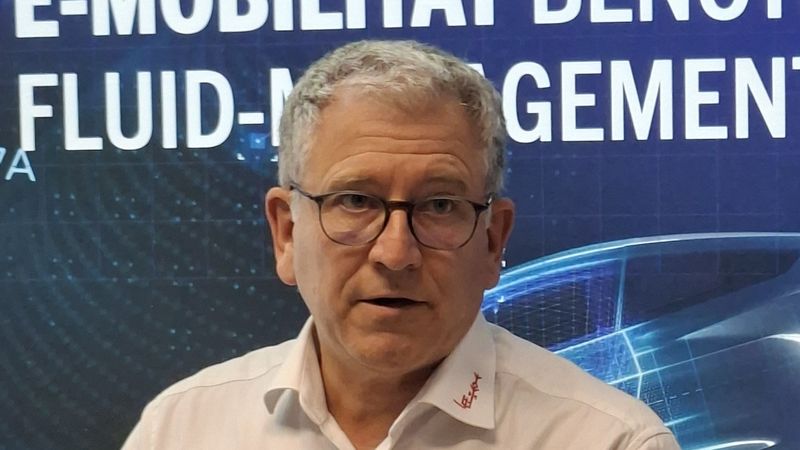
For miniature components manufacturer Lee, Managing Director Jürgen Prochno sees new opportunities in Europe arising from future satellite and space programmes.
(Photo: Detlev Karg)
Lee Hydraulische Miniaturkomponenten GmbH has particularly concrete plans. The German company is part of US-based The Lee Company, which specialises in miniature fluid-control components such as valves, pumps, filters and nozzles. The company has supplied the aviation industry for decades and also offers components for defence and space applications. In the space sector, solenoid valves are used, among other things, to control fluid flows in rockets, spacecraft and satellites. The US family-owned company is now considering establishing its first manufacturing operation in Europe. One major reason is the growing European space market, says Jürgen Prochno, Managing Director of Lee Hydraulische Miniaturkomponenten GmbH. “The successful launch of Isar Aerospace’s Spectrum rocket was a clear signal for us. And there are other German companies building satellites, for example. This is where we can contribute our hydraulic control components.” The company has also recently acquired new production facilities in the US states of Connecticut and South Carolina.
Satellite market offers opportunity for expansion
Prochno sees potential, for example, in satellite propulsion control: “Control nozzles on satellites are usually opened pyrotechnically after launch. But that always involves a certain degree of risk. We can replace these pyrotechnic elements with our solenoid valves.” Lee is also active in damping systems for military land vehicles. According to Prochno, European production would offer another advantage: “If we establish manufacturing in Europe, we can avoid US export restrictions because the individual parts of our systems are not subject to restrictions.” At the same time, lead times have increased as a result of strong demand from the defence and space sectors. “We could offset that by manufacturing in Europe”, Prochno expects.
STW to actively target the defence market
An even clearer strategic shift is emerging at Sensor-Technik Wiedemann (STW). The family-owned company based in Kaufbeuren develops electronics, sensors, control systems and software for the digitalisation and automation of mobile machinery. Its technology extends to highly automated and autonomous functions as well as AI-based object recognition – capabilities that can in principle also be transferred to unmanned military ground vehicles. “Until now, we have been a civilian-focused company, but very soon we will also actively offer our solutions for military systems such as UGVs (Unmanned Ground Vehicles),” says Strategy Director Stefan Lang. The company has already worked on initial projects. “In previous cases, customers approached us. In future, we will specifically market our solutions in the defence sector and actively approach companies ourselves.”
Europe’s security challenges prompt a rethink
The change in direction is part of a broader development, he said. “There is currently a fundamental rethink within our company when it comes to defence. This rethink is taking place across the German corporate landscape,” Lang says. “We see applications for our products in the UGV sector, and optical detection is one of our strengths. Our compact systems can cover a wide range of applications. They provide UGVs with information that enables them to initiate the appropriate response”, he adds. STW develops solutions for autonomous mobile machinery in which sensor and control technology can be combined with AI and object recognition.
Camera technology for military vehicles
The situation is similar at Motec. The company, which belongs to US technology group AMETEK, develops rugged camera and assistance systems for mobile machinery and commercial vehicles. The systems are designed for operation in demanding environments and now also include digital image processing and AI-based person detection. Motec already lists military vehicles as a dedicated application area. “We have already implemented defence projects using our camera systems, which are designed for heavy land vehicles and construction machinery,” says Marketing Manager Andreas Schroeter. One possible application is monitoring the area around a vehicle: “In certain operational scenarios, it is important for the vehicle crew to know whether people are in the immediate vicinity.” Motec illustrates how small the technological gap between civilian and military applications can sometimes be. Cameras originally developed for construction machinery or other commercial vehicles are already designed to withstand vibration, dirt and extreme temperatures.
Date: 08.12.2025
Naturally, we always handle your personal data responsibly. Any personal data we receive from you is processed in accordance with applicable data protection legislation. For detailed information please see our privacy policy.
Consent to the use of data for promotional purposes
I hereby consent to Vogel Communications Group GmbH & Co. KG, Max-Planck-Str. 7-9, 97082 Würzburg including any affiliated companies according to §§ 15 et seq. AktG (hereafter: Vogel Communications Group) using my e-mail address to send editorial newsletters. A list of all affiliated companies can be found here
Newsletter content may include all products and services of any companies mentioned above, including for example specialist journals and books, events and fairs as well as event-related products and services, print and digital media offers and services such as additional (editorial) newsletters, raffles, lead campaigns, market research both online and offline, specialist webportals and e-learning offers. In case my personal telephone number has also been collected, it may be used for offers of aforementioned products, for services of the companies mentioned above, and market research purposes.
Additionally, my consent also includes the processing of my email address and telephone number for data matching for marketing purposes with select advertising partners such as LinkedIn, Google, and Meta. For this, Vogel Communications Group may transmit said data in hashed form to the advertising partners who then use said data to determine whether I am also a member of the mentioned advertising partner portals. Vogel Communications Group uses this feature for the purposes of re-targeting (up-selling, cross-selling, and customer loyalty), generating so-called look-alike audiences for acquisition of new customers, and as basis for exclusion for on-going advertising campaigns. Further information can be found in section “data matching for marketing purposes”.
In case I access protected data on Internet portals of Vogel Communications Group including any affiliated companies according to §§ 15 et seq. AktG, I need to provide further data in order to register for the access to such content. In return for this free access to editorial content, my data may be used in accordance with this consent for the purposes stated here. This does not apply to data matching for marketing purposes.
Right of revocation
I understand that I can revoke my consent at will. My revocation does not change the lawfulness of data processing that was conducted based on my consent leading up to my revocation. One option to declare my revocation is to use the contact form found at https://contact.vogel.de. In case I no longer wish to receive certain newsletters, I have subscribed to, I can also click on the unsubscribe link included at the end of a newsletter. Further information regarding my right of revocation and the implementation of it as well as the consequences of my revocation can be found in the data protection declaration, section editorial newsletter.
Europe’s security landscape is changing rapidly
(Source: VCG)
As defence budgets rise and EU programmes expand, civil technology providers are becoming vital contributors to Europe’s strategic autonomy. The event will act as a neutral platform for dialogue between technology suppliers, integrators, and decision-makers shaping the next generation of European defence capabilities and aims to open doors between civil industry and defence procurement, providing practical insights.
The trend is also becoming apparent in products that at first glance have little to do with defence technology. Ulm-based Hermann Bantleon GmbH develops lubricants, cleaning agents and corrosion-protection products, among other things. “We are receiving a growing number of orders from the military sector and are developing oils and lubricants that will receive NATO certification in future,” says Ralf Schrempp, Team Leader Heavy Machinery at Bantleon. According to Schrempp, demand is not coming only from traditional defence companies: “There are also construction-equipment manufacturers that are increasingly asking us for NATO and MIL certification.”




:quality(80)/p7i.vogel.de/wcms/69/11/6911d8eae109755ebaabd914db4b1c20/0133126677v1.jpeg "(Image:AI-generated)")
:quality(80)/p7i.vogel.de/wcms/4c/d5/4cd56185da64b17a838269392691c21e/20260915-171830-1440x810v1.jpeg "For miniature components manufacturer Lee, Managing Director Jürgen Prochno sees new opportunities in Europe arising from future satellite and space programmes. (Photo: Detlev Karg)")
:quality(80)/p7i.vogel.de/wcms/f6/95/f6954fa7c09ba58863a3730f5e384a62/arek-socha-on-pixabay-1707x960v1.jpeg "A new national space strategy brings together UK’s plans for growth, defence, and national security to help reindustrialise the UK. (Source: Arek Socha on Pixabay)")
:quality(80)/p7i.vogel.de/wcms/63/0f/630f214fa760b8c7f7f7d6279d411fcf/d4ceed8f2f52-2026-08-30-hydef-06--msc4159-1200x675v1.webp "(Source: Diehl Defence)")
:quality(80)/p7i.vogel.de/wcms/0a/14/0a1495d9b570ae32a5a7cc748b9a3c60/st-hannover-035-1920x1079v1-999x562v1.jpeg "Fastening technology you can experience first-hand—visitors to Schraubtec in Bochum (Germany) can see it for themselves at the Ruhr Congress on September 30, 2026. (Source: PHOTOVISION-DH GmbH)")
:quality(80)/p7i.vogel.de/wcms/cd/a9/cda92b173afa9d0b455d4f11b281c9ea/0094-to-image--capstone-cdr-1440x810v1.png "(Source: Terran Orbital)")
:quality(80)/p7i.vogel.de/wcms/e0/45/e045bc5414d7263fb308bdd501b5fcc1/0133113962v1.jpeg "The HSWL 354 is the transmission used, for example, in the Leopard 2 main battle tank. Renk manufactures this system and is now preparing to significantly increase its cycle time. As a result, Renk is placing greater emphasis on the military sector as a customer ... (Source: Renk)")
:quality(80)/p7i.vogel.de/wcms/a1/5c/a15c2aeba563d5bc3e11fb879b21eb2c/0132989650v1.jpeg "FSS, the flexible clamping system for varying free-form surfaces, is designed for the aerospace industry and other sectors. (Source: Römheld GmbH Friedrichshütte)")
:quality(80)/p7i.vogel.de/wcms/46/8e/468effa87546a2b036dc88ca40e2843e/129fbcac92ce7da872b13af0281b0799-l-png-1920x1079v1.webp "(Source: Arianespace)")
:quality(80)/p7i.vogel.de/wcms/8f/10/8f10697d4bfbd70edf615cca76eaedfd/pete-linforth-on-pixabay-1920x1080v1.jpeg "(Source: Pete Linforth on Pixabay / AI-generated)")
:quality(80)/p7i.vogel.de/wcms/0f/99/0f99561bf51818af92b2960656405aa5/roland-4d-pippes-on-pixabay-1460x820v1.jpeg "(Source: Roland 4D Pippes on Pixabay)")
:quality(80)/p7i.vogel.de/wcms/05/49/054906f874b94ef08b09d5920396e27d/airbus-h160-1920x1079v1.jpeg "Airbus H160 (Source: Airbus)")
:quality(80)/p7i.vogel.de/wcms/9d/8a/9d8addea8cc4e6f7a4793563ca397f2a/ai-im-milit-r-1672x940v1.png "(Source: KI-generiert / Gemini)")
:quality(80)/p7i.vogel.de/wcms/7f/5f/7f5fba2c729ec3aa256bf1a18d74529b/ai-chip-1672x940v1.png "(Source: KI-generiert / Gemini)")
:quality(80)/p7i.vogel.de/wcms/64/1b/641b6474b2a614cde7730c89ef2a3015/2026-09-09-rheinmetall-veroeffentlicht-battlesuite-schnittstellen-e8c18194-1225x690v1.jpeg "Rheinmetall’s Battlesuite provides a modular digital platform for connecting and integrating sensors, hardware and software components. (Source: Rheinmetall AG)")
:quality(80)/p7i.vogel.de/wcms/6f/fe/6ffef325e7f233cc3521943158eb1ebd/0132763535v1.jpeg "Two companies are planning to establish, for the first time in 2027, an optical laser communication link directly between a satellite in low Earth orbit (LEO) and a re-entering spacecraft. (Source: ATMOS Space Cargo)")
:quality(80)/p7i.vogel.de/wcms/8f/f9/8ff91b78b26cb5a2b8a29e39835005b1/2026-09-10-repmus-teaser-images-retouched-dsc01292-1024x683-1024x576v1.jpeg "(Source: Quantum Systems GmbH)")
:quality(80)/p7i.vogel.de/wcms/bf/4a/bf4a237e60d3d4bd1bbdbad918f3c697/airbus-defence-and-space-3-1280x720v1.jpeg "(Source: Airbus Defence and Space)")
:quality(80)/p7i.vogel.de/wcms/e0/d1/e0d112a0d54a4fa9603ec855f7d25b47/t-rex-content-photo-jpg-pc-adaptive-990-medium-988x556v1.jpeg "Swarm of UAVs conducting a fully autonomous collaborative swarm mission. (Source: Lockheed Martin)")
:quality(80)/p7i.vogel.de/wcms/79/fc/79fcaa7ca33e393b11a4740d7d8f3dbe/vilkasss-handshake-9459740-1911x1076v1.jpeg "(Source: Vilius Kukanauskas on Pixabay)")
:quality(80)/p7i.vogel.de/wcms/90/a8/90a849f0023f11d1eb642eb4751a0321/bild2-h-c3-a4nel-ict-20truck-20and-20trailer-20parts-4320x2429v1.jpeg "Product information is visible at all times and retrieval of items
is confirmed by employees directly on the display of the Hänel MP 14 N
controller. (Source: René Marks)")
:quality(80)/p7i.vogel.de/wcms/4e/ca/4ecaa39f247490eded591b652c33aee3/thilmann-hcp-web-20kleiner-20ausschnitt-1442x811v1.jpeg "Entering the defence market can be challenging for start-ups, says HCP Sense CEO Ansgar Thilmann. (Picture: HCP Sense)")
:quality(80)/p7i.vogel.de/wcms/7a/51/7a511b80041d3f1335f3a5aa56fe75da/delivery-7022432-1280-1280x720v1.png "(Source: Mohamed_hassan)")
:quality(80)/p7i.vogel.de/wcms/f9/2f/f92f1ef8c739c34c70d99f7b0997621b/stra007-20--20cover-20image-5472x3076v1.jpeg "(Source: Stratasys)")
:quality(80)/p7i.vogel.de/wcms/ec/a9/eca9062ccbe4b042f8515846340410d8/aerospace-and-defence-stairways-platforms-and-much-morev1.jpeg "Modular constructions enable flexible modification. That applies to larger structures such as stairways and platforms, too. And that means aerospace and defence companies can reconfigure their maintenance platforms fast (itemitem)")
:quality(80)/p7i.vogel.de/wcms/30/2a/302a7b5723ad38fbde812fd3a468ad04/safety-on-stairways-in-industry-key-considerationsv1.jpeg "Stairways and platforms are used widely in maintenance and assembly areas in the aerospace and defence sectors. (Source: item)")
:quality(80)/p7i.vogel.de/wcms/f3/4e/f34ed744bb30817d3432c7ad522e6f30/engine-1v1.jpeg "Engineering with aluminium profiles really can be this easy – the item Engineeringtool and its smart functions help you save valuable time. (Source: item)")
:fill(fff,0)/p7i.vogel.de/companies/69/6d/696de2483d115/logo--fastems-rgb-horizontal.jpeg "logo--fastems-rgb-horizontal (Fastems)")
:fill(fff,0)/images.vogel.de/vogelonline/companyimg/84700/84735/65.jpg "logo_item_rgb_neu.jpg ()")

:quality(80)/p7i.vogel.de/wcms/f6/5e/f65e6f4b74ea62348db67acc8321fc16/pilotarcm2-1672x940v1.png "The Pilotarc M2 Desktop Plasma Cutting System enables on-site production of metal parts. (Picture: Pilotarc UG)")
:quality(80)/p7i.vogel.de/wcms/4e/30/4e30dfffc4a19c22f1131538778658f8/04-aus-einer-hand--f-c3-bchrende-20stahl--und-schmiedel-c3-b6sungen-f-c3-bcr-die-r-c3-bcstungsindustriev1.jpeg "Dillinger is the only supplier in Germany to be comprehensively approved in accordance with TL 2350-0000, and its Difender armor steels cover almost all of the Bundeswehr's requirements. The picture shows the Fuchs armored transport vehicle. (Source: Rheinmetall)")