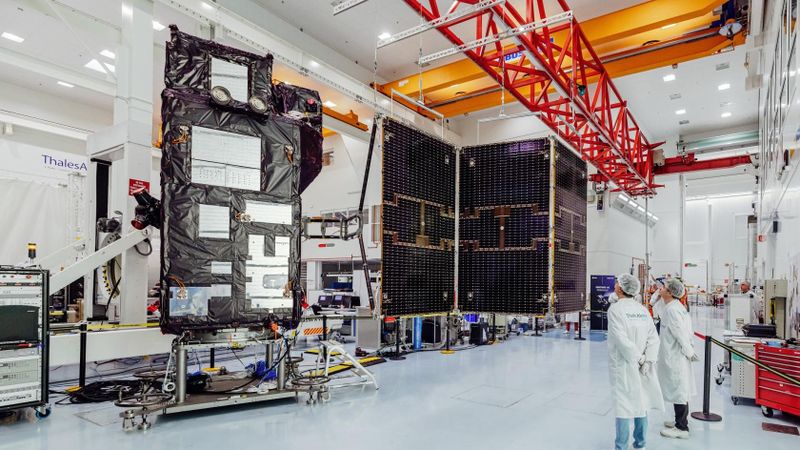
The Copernicus Sentinel-3C and Earth Explorer FLEX satellites, for which Thales Alenia Space – the joint company between Thales (67%) and Leonardo (33%) – is prime contractor, were successfully launched aboard a Vega C launcher from Europe’s Spaceport in French Guiana.
(Source: Thales Alenia Space, A. Pichon)
Sentinel-3C is an integral part of Copernicus, the world’s most advanced environmental monitoring program. This program is managed by the European Commission, funded by the EU and partially by the European Space Agency (ESA). It is jointly operated by ESA and EUMETSAT.
Sentinel-3C is the third satellite in the Copernicus Sentinel-3 mission, dedicated to monitoring the oceans and land surfaces. The Sentinel-3 satellites feature four state-of-the-art instruments which provide essential measurements on surface temperature, color and height of the oceans. The mission also supplies data on land surfaces, including vegetation, soil temperature, inland water quality (lakes, rivers), and fire detection.
With a launch mass of approximately 1,140 kg, Sentinel-3C will operate in low Earth orbit at an altitude of 814 km, with an operational lifespan of 7.5 years. It will join the Sentinel-3B satellite in orbit and continue the vital mission of providing images essential to understanding ocean currents, climate phenomena and the health of ecosystems.
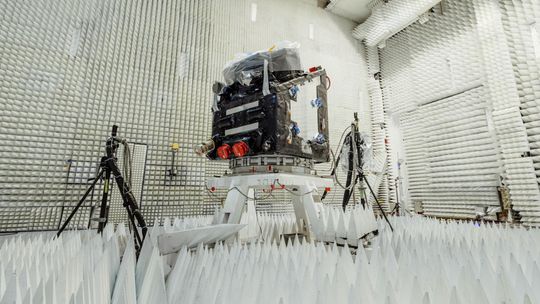
(Source: Thales Alenia Space, A. Pichon)
FLEX (FLuorescence EXplorer) is a satellite in ESA’s series of innovative Earth Explorer missions. It will be the first to measure plant fluorescence from space with such a high degree of precision over vast territories. Data collected by FLEX and its instrument FLORIS, built by Leonardo, will further our understanding of how carbon moves between plants and the atmosphere, and of how photosynthesis affects the carbon and water cycles. With global warming and extreme climatic events – heatwaves, droughts, wildfires, winds, etc. – becoming ever more intense, the FLEX mission will help us to assess how climate change is impacting photosynthesis and, therefore, plant health and productivity. FLEX’s observations will help tooptimize climate models, agriculture, and biodiversity monitoring.
Weighing approximately 400 kg, FLEX will operate in an 814-kilometre orbit, flying in tandem with one of the Sentinel-3 satellites. The mission’s operational lifespan in orbit is 3.5 years.
FLEX observations will be combined with those from Sentinel-3’s imaging spectrometer to correct for atmospheric bias and precisely quantify the level of fluorescence on the ground. Sentinel-3’s optical and thermal sensors will provide FLEX with complementary data on the plant’s environment. Data from both satellites will improve measurement accuracy, increase the temporal coverage of vegetation, and allow for a better interpretation of fluorescence within its environment.
Europe’s security landscape is changing rapidly
(Source: VCG)
As defence budgets rise and EU programmes expand, civil technology providers are becoming vital contributors to Europe’s strategic autonomy. The event will act as a neutral platform for dialogue between technology suppliers, integrators, and decision-makers shaping the next generation of European defence capabilities and aims to open doors between civil industry and defence procurement, providing practical insights.
The Sentinel-3 mission illustrates the solid partnership between ESA, the European Commission, the European Organization for the Exploitation of Meteorological Satellites (EUMETSAT), industry, service providers and data users.
Thales Alenia Space in France, prime contractor for the satellites, is also responsible for developing two key instruments – the imaging spectrometer (OLCI) and the radar altimeter (SRAL) – as well as the platform. Thales Alenia Space entities in Spain, Belgium, and Italy are also involved. A consortium of more than 100 European companies contributed to the design and construction of the satellites, including Leonardo for the imaging radiometer (SLSTR) and Airbus Defence & Space for the microwave radiometer (MWR).
The FLEX mission illustrates the collaboration between ESA and the European space industry. Thales Alenia Space in France, prime contractor for the satellite, is also in charge of developing the platform, which also involves its Harwell and Belfast sites (United Kingdom) for the propulsion module and platform integration, Charleroi (Belgium) for on-board power management, Gorgonzola and L’Aquila (Italy) for the central computer’s processor board, and Madrid (Spain) for S- and X-band communications. A consortium of almost 40 European companies contributed to the construction of this satellite, including Leonardo, responsible for the high-resolution FLORIS imaging spectrometer that will map plant fluorescence, and Beyond Gravity, notably in charge of supplying the structures and thermal control for the platform and associated satellite engineering.
Date: 08.12.2025
Naturally, we always handle your personal data responsibly. Any personal data we receive from you is processed in accordance with applicable data protection legislation. For detailed information please see our privacy policy.
Consent to the use of data for promotional purposes
I hereby consent to Vogel Communications Group GmbH & Co. KG, Max-Planck-Str. 7-9, 97082 Würzburg including any affiliated companies according to §§ 15 et seq. AktG (hereafter: Vogel Communications Group) using my e-mail address to send editorial newsletters. A list of all affiliated companies can be found here
Newsletter content may include all products and services of any companies mentioned above, including for example specialist journals and books, events and fairs as well as event-related products and services, print and digital media offers and services such as additional (editorial) newsletters, raffles, lead campaigns, market research both online and offline, specialist webportals and e-learning offers. In case my personal telephone number has also been collected, it may be used for offers of aforementioned products, for services of the companies mentioned above, and market research purposes.
Additionally, my consent also includes the processing of my email address and telephone number for data matching for marketing purposes with select advertising partners such as LinkedIn, Google, and Meta. For this, Vogel Communications Group may transmit said data in hashed form to the advertising partners who then use said data to determine whether I am also a member of the mentioned advertising partner portals. Vogel Communications Group uses this feature for the purposes of re-targeting (up-selling, cross-selling, and customer loyalty), generating so-called look-alike audiences for acquisition of new customers, and as basis for exclusion for on-going advertising campaigns. Further information can be found in section “data matching for marketing purposes”.
In case I access protected data on Internet portals of Vogel Communications Group including any affiliated companies according to §§ 15 et seq. AktG, I need to provide further data in order to register for the access to such content. In return for this free access to editorial content, my data may be used in accordance with this consent for the purposes stated here. This does not apply to data matching for marketing purposes.
Right of revocation
I understand that I can revoke my consent at will. My revocation does not change the lawfulness of data processing that was conducted based on my consent leading up to my revocation. One option to declare my revocation is to use the contact form found at https://contact.vogel.de. In case I no longer wish to receive certain newsletters, I have subscribed to, I can also click on the unsubscribe link included at the end of a newsletter. Further information regarding my right of revocation and the implementation of it as well as the consequences of my revocation can be found in the data protection declaration, section editorial newsletter.




:quality(80)/p7i.vogel.de/wcms/b2/db/b2db599d38480ee76cb0632c3c5ac968/sentinel3c-sadeploymentthalesaleniaspace-alban-pichon-3-1680x944v1.jpeg "(Source: Thales Alenia Space, A. Pichon)")
:quality(80)/p7i.vogel.de/wcms/82/79/8279289d94e17b34c49f305ef1421161/flight-2-liftoff-wide-c-isar-aerospace-1920x1079v1.jpeg "(Source: Isar Aerospace)")
:quality(80)/p7i.vogel.de/wcms/0b/46/0b46eaee6945014e71a15a3fa7340000/nigcomsat-2acthales-alenia-space-briot-0-1680x944v1.jpeg "(Source: Thales Alenia Space, E. Briot)")
:quality(80)/p7i.vogel.de/wcms/08/e7/08e7c441560d9a9662adf2aec7b564f3/0133497578v1.jpeg "A Virtus drone from Stark Defence is being deployed in the war in Ukraine. Now the Berlin-based company reports that it has secured a major contract from the German Armed Forces. (Image:S. Sorjevsky)")
:quality(80)/p7i.vogel.de/wcms/13/12/1312059ec82b1ed9e3df080350b29dc4/f46335bf-a581-4786-959f-4a0e9a74aed1-1671x940v1.png "Military radar architecture using distributed RF sensor nodes connected through optical fibre to central processing. (Source: KI-generiert / Gemini)")
:quality(80)/p7i.vogel.de/wcms/0a/14/0a1495d9b570ae32a5a7cc748b9a3c60/st-hannover-035-1920x1079v1-999x562v1.jpeg "Fastening technology you can experience first-hand—visitors to Schraubtec in Bochum (Germany) can see it for themselves at the Ruhr Congress on September 30, 2026. (Source: PHOTOVISION-DH GmbH)")
:quality(80)/p7i.vogel.de/wcms/cd/a9/cda92b173afa9d0b455d4f11b281c9ea/0094-to-image--capstone-cdr-1440x810v1.png "(Source: Terran Orbital)")
:quality(80)/p7i.vogel.de/wcms/e0/45/e045bc5414d7263fb308bdd501b5fcc1/0133113962v1.jpeg "The HSWL 354 is the transmission used, for example, in the Leopard 2 main battle tank. Renk manufactures this system and is now preparing to significantly increase its cycle time. As a result, Renk is placing greater emphasis on the military sector as a customer ... (Source: Renk)")
:quality(80)/p7i.vogel.de/wcms/1f/c2/1fc25ec2bd47a47b4617766e40033de2/image-2000-74f03b8e935a22580e24d2b05fe5ca3c-1920x1079v1.jpeg "The Airbus A310 ZERO-G stands ready for the 47th DLR parabolic flight campaign. It took place in Bordeaux from 7 to 18 September 2026. A total of twelve experiments from the fields of biology, physics, technology and materials science were on board. (Source: DLR (CC BY-NC-ND 3.0))")
:quality(80)/p7i.vogel.de/wcms/22/81/22812f686fd6ec1235f02392a3df56b9/34370ad9-163a-5941-9825-9c87a0e50000-1920x1079v1.png "Ariane 6 A64 flight VA267 with 32 satellites for Amazon LEO constellation, ready for launch at Europe's Spaceport in Kourou, French Guiana on 12 February 2026. (Source: ESA—M. Pédoussaut)")
:quality(80)/p7i.vogel.de/wcms/04/6b/046bda5de33193b13ebda873c3372868/iris2-1ceuropean-commission-1-1680x944v1.jpeg "(Source: European Commission)")
:quality(80)/p7i.vogel.de/wcms/d9/3c/d93c89ab8ed08d673065e1eac2e85aea/8cc82e51-a188-4e50-9432-ee715ab25586-1672x940v1.png "At Mach 10, Aerodynamics Becomes Materials Science (Source: )")
:quality(80)/p7i.vogel.de/wcms/cb/a2/cba2ecda891b2874327a30f69f773bdb/hexaforce-15-1920x1079v1.jpeg "(Source: Thales/Gauthier Chauffrut)")
:quality(80)/p7i.vogel.de/wcms/9d/8a/9d8addea8cc4e6f7a4793563ca397f2a/ai-im-milit-r-1672x940v1.png "(Source: KI-generiert / Gemini)")
:quality(80)/p7i.vogel.de/wcms/7f/5f/7f5fba2c729ec3aa256bf1a18d74529b/ai-chip-1672x940v1.png "(Source: KI-generiert / Gemini)")
:quality(80)/p7i.vogel.de/wcms/64/1b/641b6474b2a614cde7730c89ef2a3015/2026-09-09-rheinmetall-veroeffentlicht-battlesuite-schnittstellen-e8c18194-1225x690v1.jpeg "Rheinmetall’s Battlesuite provides a modular digital platform for connecting and integrating sensors, hardware and software components. (Source: Rheinmetall AG)")
:quality(80)/p7i.vogel.de/wcms/f1/c8/f1c88c768ba87dd2d71c708945c7df78/s960-applied-intuition04-960x640-960x540v1.jpeg "(Source: UK Government)")
:quality(80)/p7i.vogel.de/wcms/ef/1e/ef1eaddf8243b9c30cbfef17a4151def/aufmacherv1.jpeg "What works against drones—and what should be kept in mind when it comes to chain-based defence strategies? (Source: Mattheck)")
:quality(80)/p7i.vogel.de/wcms/b1/f0/b1f00d146f272acbef15ea82996259de/s960-halo-shield-2-960x540v1.png "Quell’s SkySpyke system in action (Source: UK Government)")
:quality(80)/p7i.vogel.de/wcms/2b/3d/2b3d42b7dc255aaaf5cadf57dab47d3b/43907b28dda9-sky-striker-demo-2-1600x899v1.webp "Diehl Defence and Elbit Systems demonstrate the capabilities of the SkyStriker loitering munition during a live demonstration. (Source: Diehl Defence)")
:quality(80)/p7i.vogel.de/wcms/90/a8/90a849f0023f11d1eb642eb4751a0321/bild2-h-c3-a4nel-ict-20truck-20and-20trailer-20parts-4320x2429v1.jpeg "Product information is visible at all times and retrieval of items
is confirmed by employees directly on the display of the Hänel MP 14 N
controller. (Source: René Marks)")
:quality(80)/p7i.vogel.de/wcms/4e/ca/4ecaa39f247490eded591b652c33aee3/thilmann-hcp-web-20kleiner-20ausschnitt-1442x811v1.jpeg "Entering the defence market can be challenging for start-ups, says HCP Sense CEO Ansgar Thilmann. (Picture: HCP Sense)")
:quality(80)/p7i.vogel.de/wcms/7a/51/7a511b80041d3f1335f3a5aa56fe75da/delivery-7022432-1280-1280x720v1.png "(Source: Mohamed_hassan)")
:quality(80)/p7i.vogel.de/wcms/f9/2f/f92f1ef8c739c34c70d99f7b0997621b/stra007-20--20cover-20image-5472x3076v1.jpeg "(Source: Stratasys)")
:quality(80)/p7i.vogel.de/wcms/ec/a9/eca9062ccbe4b042f8515846340410d8/aerospace-and-defence-stairways-platforms-and-much-morev1.jpeg "Modular constructions enable flexible modification. That applies to larger structures such as stairways and platforms, too. And that means aerospace and defence companies can reconfigure their maintenance platforms fast (itemitem)")
:quality(80)/p7i.vogel.de/wcms/30/2a/302a7b5723ad38fbde812fd3a468ad04/safety-on-stairways-in-industry-key-considerationsv1.jpeg "Stairways and platforms are used widely in maintenance and assembly areas in the aerospace and defence sectors. (Source: item)")
:quality(80)/p7i.vogel.de/wcms/f3/4e/f34ed744bb30817d3432c7ad522e6f30/engine-1v1.jpeg "Engineering with aluminium profiles really can be this easy – the item Engineeringtool and its smart functions help you save valuable time. (Source: item)")
:fill(fff,0)/images.vogel.de/vogelonline/companyimg/84700/84735/65.jpg "logo_item_rgb_neu.jpg ()")

:quality(80)/p7i.vogel.de/wcms/7b/35/7b351947b314400d23a07a25493ee6b3/encapsulation-mtg-i2-1-1294x728v1.jpeg "MTG-I2 being encapsulated. (Source: 2026 ESA-CNES-ARIANESPACE-ArianeGroup / Optique Vidéo de CSG—S MARTIN)")
:quality(80)/p7i.vogel.de/wcms/3c/17/3c17157497a23e05cc3c0dde03597615/lisa-mission-c-ohb-0-38-1294x728v1.jpeg "lisa-mission-c-ohb-0-38-1294x728v1 (Source: OHB)")