A European constellation at the forefront of weather forecasting.
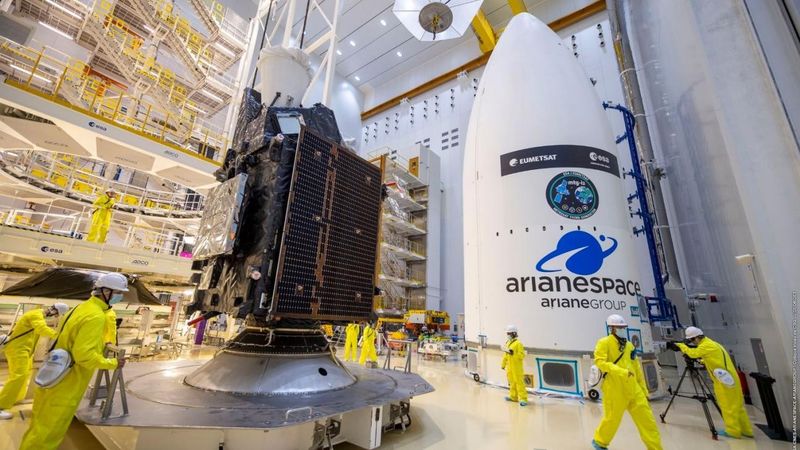
MTG-I2 being encapsulated.
(Source: 2026 ESA-CNES-ARIANESPACE-ArianeGroup / Optique Vidéo de CSG—S MARTIN)
The MTG-I2 weather satellite, built by prime contractor Thales Alenia Space, the joint company between Thales (67%) and Leonardo (33%), was successfully launched today by Arianespace aboard an Ariane 62 launcher from Europe’s Spaceport in French Guiana.
MTG-I2 is the second imaging satellite in the Meteosat Third Generation (MTG) program, designed to improve weather forecasting in Europe and Africa. The MTG program is a collaborative venture between the European Space Agency (ESA) and EUMETSAT* to ensure the continuity of high-resolution weather monitoring beyond 2040. Built by Thales Alenia Space in cooperation with OHB, the MTG satellites will operate in geostationary orbit, 36,000 km (approx. 22,370 miles) above the Earth, and have a nominal lifespan of 8.5 years.
The MTG-I2 satellite will join the Meteosat-12 (MTG-I1) imaging satellite and the MTG-S1 atmospheric sounding satellite in orbit, launched in December 2022 and July 2025, respectively. MTG-I2 will operate in tandem with Meteosat-12. While Meteosat-12 provides images over Europe and Africa every 10 minutes, MTG-I2 will capture images over Europe every 2.5 minutes, thereby delivering weather imagery of unmatched accuracy at an unprecedented rate.
“I’m delighted with the successful launch of the third satellite in the Meteosat Third Generation fleet, which will contribute to improved immediate weather forecasts and unprecedented anticipation of extreme weather events.” said Hervé Derrey, Chief Executive Officer of Thales Alenia Space. “Once the MTG-I2 satellite is operational in orbit, Europe will benefit from the world’s most sophisticated meteorological services from a geostationary orbit.”
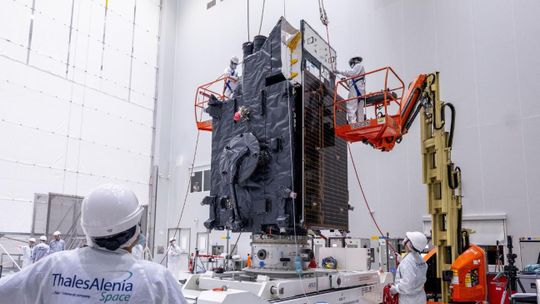
MTG-I2 preparation for fit check.
(2026 ESA-CNES-ARIANESPACE-ArianeGroup / Optique Vidéo de CSG—S MARTIN)
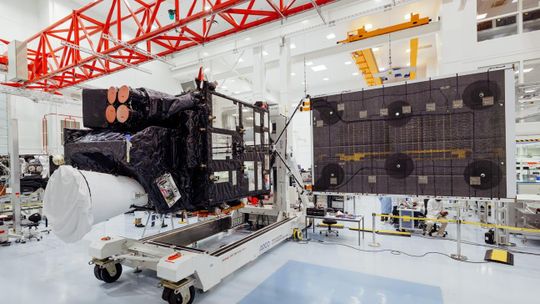
MTG-I2, like Meteosat-12, is equipped with a new-generation flexible combined imager (FCI), designed to improve the accuracy of weather forecasts from several minutes to several hours before events. It delivers a complete image of the Earth (in 16 wavebands) in only 10 minutes (versus 15 minutes for the previous generation) and includes a fast mode capable of providing images of Europe every 2.5 minutes. It has an improved spatial resolution of 500 meters to 1 km (approx. 0.3 to 0.6 miles).
(Source: Thales Alenia Space/Alban Pichon)
High-resolution imagery from the Meteosat-12 and MTG-I2 imaging satellites, combined with cutting-edge sounding data provided by MTG-S1, will take weather forecasting capabilities to the next level, particularly for the challenging task of nowcasting. These capabilities enable the near-real-time monitoring and forecasting of extreme weather phenomena, such as violent thunderstorms—a growing threat to populations exacerbated by climate change.
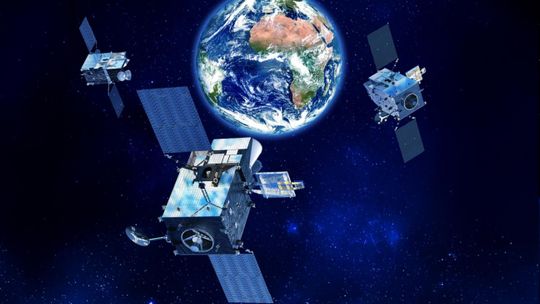
The Meteosat-12, MTG-I2, and MTG-S1 satellites form the first constellation of the Meteosat Third Generation system. At the end of their lifespans, they will be replaced by a constellation of three new satellites (two imagers and one sounder), scheduled for launch no earlier than 2033.
Half a century of geostationary weather satellites:
(Source: Thales Alenia Space/Briot)
European meteorology has become increasingly accurate over the decades. With the first-generation Meteosat satellites, images were updated every 30 minutes, a figure reduced to 15 minutes on the second generation. MTG will further reduce this refresh rate to just 10 minutes in full disk mode and 2.5 minutes in fast mode for Europe, making weather forecasts even more reliable than ever.
Meteosat satellites have been the main source of meteorological data for Europe and Africa since 1977. From the early beginning, Thales Alenia Space has been prime contractor for 3 generations of Meteosat satellites on behalf of ESA. The company delivered into orbit seven Meteosat satellites, four second-generation Meteosat satellites (MSG) and now 3 third-generation Meteosat satellites. The company, which serves as the prime contractor for MTG satellites in partnership with OHB, is also involved in the development of the ground segment for EUMETSAT, by designing and building the first-level image data processing component, while Thales is implementing the second-level data processing for both image and sounder instruments, producing data distributed by EUMETSAT and exploited by the meteorological instances of each member state. Telespazio, a joint venture between Leonardo (67%) and Thales (33%), is also involved in the Meteosat Third Generation program, supplying EUMETSAT with launch and early orbit phase (LEOP) services for this MTG-I2 satellite, as well as for Meteosat-12 and MTG-S1 satellites, successfully launched in 2022 and 2025. Telespazio also provides the ground segment, both for data acquisition (MDAF) and for satellite command and control (TTCF).
Date: 08.12.2025
Naturally, we always handle your personal data responsibly. Any personal data we receive from you is processed in accordance with applicable data protection legislation. For detailed information please see our privacy policy.
Consent to the use of data for promotional purposes
I hereby consent to Vogel Communications Group GmbH & Co. KG, Max-Planck-Str. 7-9, 97082 Würzburg including any affiliated companies according to §§ 15 et seq. AktG (hereafter: Vogel Communications Group) using my e-mail address to send editorial newsletters. A list of all affiliated companies can be found here
Newsletter content may include all products and services of any companies mentioned above, including for example specialist journals and books, events and fairs as well as event-related products and services, print and digital media offers and services such as additional (editorial) newsletters, raffles, lead campaigns, market research both online and offline, specialist webportals and e-learning offers. In case my personal telephone number has also been collected, it may be used for offers of aforementioned products, for services of the companies mentioned above, and market research purposes.
Additionally, my consent also includes the processing of my email address and telephone number for data matching for marketing purposes with select advertising partners such as LinkedIn, Google, and Meta. For this, Vogel Communications Group may transmit said data in hashed form to the advertising partners who then use said data to determine whether I am also a member of the mentioned advertising partner portals. Vogel Communications Group uses this feature for the purposes of re-targeting (up-selling, cross-selling, and customer loyalty), generating so-called look-alike audiences for acquisition of new customers, and as basis for exclusion for on-going advertising campaigns. Further information can be found in section “data matching for marketing purposes”.
In case I access protected data on Internet portals of Vogel Communications Group including any affiliated companies according to §§ 15 et seq. AktG, I need to provide further data in order to register for the access to such content. In return for this free access to editorial content, my data may be used in accordance with this consent for the purposes stated here. This does not apply to data matching for marketing purposes.
Right of revocation
I understand that I can revoke my consent at will. My revocation does not change the lawfulness of data processing that was conducted based on my consent leading up to my revocation. One option to declare my revocation is to use the contact form found at https://contact.vogel.de. In case I no longer wish to receive certain newsletters, I have subscribed to, I can also click on the unsubscribe link included at the end of a newsletter. Further information regarding my right of revocation and the implementation of it as well as the consequences of my revocation can be found in the data protection declaration, section editorial newsletter.
* EUMETSAT is the organization in charge of managing Europe’s weather satellites.




:quality(80)/p7i.vogel.de/wcms/30/07/300782652f0397e8a221f6edf5e087a4/pete-linforth-auf-pixabay-1920x1080v1.jpeg "(Source: Pete Linforth on Pixabay)")
:quality(80)/p7i.vogel.de/wcms/3a/4e/3a4eee9a02e9c88c4b88fe5b430be79d/bild1-1386x779v1.jpeg "Defence companies need more than investment and technology: They also need the skilled professionals who can turn both into new capabilities. (Source: YER Germany)")
:quality(80)/p7i.vogel.de/wcms/eb/e8/ebe871d26ae9dac0e71e99e23a8d7b43/c92090dc-3b0d-5e12-bf8b-0a763c150000-1506x847v1.png "Pioneering launch: The first Ariane 1 lifts off on December 24, 1979. (Source: ESA/CNES/Arianespace)")
:quality(80)/p7i.vogel.de/wcms/71/ec/71ecf89b9e6300685faabfbbf59343bb/0132787041v1.jpeg "Archer plans to acquire the Boeing subsidiaries, as well as Wisk, SkyGrid, and Insitu. (Source: Created with AI)")
:quality(80)/p7i.vogel.de/wcms/cd/a9/cda92b173afa9d0b455d4f11b281c9ea/0094-to-image--capstone-cdr-1440x810v1.png "(Source: Terran Orbital)")
:quality(80)/p7i.vogel.de/wcms/e0/45/e045bc5414d7263fb308bdd501b5fcc1/0133113962v1.jpeg "The HSWL 354 is the transmission used, for example, in the Leopard 2 main battle tank. Renk manufactures this system and is now preparing to significantly increase its cycle time. As a result, Renk is placing greater emphasis on the military sector as a customer ... (Source: Renk)")
:quality(80)/p7i.vogel.de/wcms/a1/5c/a15c2aeba563d5bc3e11fb879b21eb2c/0132989650v1.jpeg "FSS, the flexible clamping system for varying free-form surfaces, is designed for the aerospace industry and other sectors. (Source: Römheld GmbH Friedrichshütte)")
:quality(80)/p7i.vogel.de/wcms/9f/07/9f070dc919a95a6f19bcc1848e9f3089/image-2000-c966ec423c4d86c3769c5a9f1fff7655-1920x1079v1.jpeg "The Idefix rover is firmly mounted between the landing legs of the MMX spacecraft. Despite its compact size, Idefix essentially contains all the elements of a fully fledged scientific rover, yet thanks to its highly integrated design, it has a mass of only 25 kilograms (approx. 55 pounds). (Source: DLR (CC BY-NC-ND 3.0))")
:quality(80)/p7i.vogel.de/wcms/1f/d2/1fd2bffd9eeae597b0e2d2e3cad0adf0/20260828-en-5416166-1-1920x1079v1.jpeg "(Source: Saab)")
:quality(80)/p7i.vogel.de/wcms/d1/ea/d1ea25bed73e011051eb6d4ccf9acc95/hensoldt-and-eplane-1280x720v1.jpeg "Representatives from HENSOLDT and ePlane at the contract signing. (Source: HENSOLDT)")
:quality(80)/p7i.vogel.de/wcms/7b/35/7b351947b314400d23a07a25493ee6b3/encapsulation-mtg-i2-1-1294x728v1.jpeg "MTG-I2 being encapsulated. (Source: 2026 ESA-CNES-ARIANESPACE-ArianeGroup / Optique Vidéo de CSG—S MARTIN)")
:quality(80)/p7i.vogel.de/wcms/d0/3f/d03ffe56445e0af8485ff2f1388f10c0/20260822-en-5412280-1-1920x1080v1.jpeg "(Source: Saab AB)")
:quality(80)/p7i.vogel.de/wcms/6f/fe/6ffef325e7f233cc3521943158eb1ebd/0132763535v1.jpeg "Two companies are planning to establish, for the first time in 2027, an optical laser communication link directly between a satellite in low Earth orbit (LEO) and a re-entering spacecraft. (Source: ATMOS Space Cargo)")
:quality(80)/p7i.vogel.de/wcms/b2/6a/b26a277a3578fc2956b2c30d3b3b0146/0132928076v1.jpeg "Compact and standardised: CubeSats enable cost-effective space missions and are increasingly serving as a platform for testing new technologies—from sensors and communications to innovative power systems. (Source: City Labs, Inc.)")
:quality(80)/p7i.vogel.de/wcms/6d/f2/6df225601e1f8d4f9d07d53fd527cdb9/epc7050-7065-7066-pr-graphic-clean-1500x844v1.jpeg "(Source: EPC Space)")
:quality(80)/p7i.vogel.de/wcms/2a/ae/2aae2c389f328a77a3c1eb502b79f019/mc1779-image-space-csac-sa-65-1898x1067v1.jpeg "The Space CSAC-SA65 combines atomic-clock accuracy with built-in 1 PPS disciplining and low-power consumption. (Source: Microchip Technology Inc.)")
:quality(80)/p7i.vogel.de/wcms/88/c3/88c3d15379492ba52abe12f95b0aa4d3/dalo-2026-signing-4-1294x728v1.jpeg "(Left to Right) Danish Ministry of Defence Material and Procurement Agency Director Per Pugholm Olsen, Country Director Thales Denmark, Ireland, Iceland & Baltics, Martin Soegaard, Systematic CEO, Nikolaj Bramsen and Danish Minister of Defence, Jeppe Bruus. (Source: Rune Borre-Jensen)")
:quality(80)/p7i.vogel.de/wcms/ff/b1/ffb1d2c79ae4ac90473f50287e7bd7c0/saildrone-1567x881v1.jpeg "Saildrone Surveyor class unmanned surface vessel integrated with JAGM dual launcher. (Source: Lockheed Martin)")
:quality(80)/p7i.vogel.de/wcms/93/52/93529056c049ada3f0e5299694ca385b/2026-08-25-rheinmetall-laesst-modulares-camp-in-litauen-entstehen-media-06a35258-query-2x-0de5f682-1910x1075v1.jpeg "Rheinmetall is establishing a modular military camp in Lithuania under the G-CAP II SU programme. (Source: Rheinmetall AG)")
:quality(80)/p7i.vogel.de/wcms/ba/60/ba60f1a3891348d3bfb414721911c7bd/chatgpt-image-28--aug--2026-11-44-26-1228x691v1.png "(Source: AI - generated / ChatGPT)")
:quality(80)/p7i.vogel.de/wcms/90/a8/90a849f0023f11d1eb642eb4751a0321/bild2-h-c3-a4nel-ict-20truck-20and-20trailer-20parts-4320x2429v1.jpeg "Product information is visible at all times and retrieval of items
is confirmed by employees directly on the display of the Hänel MP 14 N
controller. (Source: René Marks)")
:quality(80)/p7i.vogel.de/wcms/4e/ca/4ecaa39f247490eded591b652c33aee3/thilmann-hcp-web-20kleiner-20ausschnitt-1442x811v1.jpeg "Entering the defence market can be challenging for start-ups, says HCP Sense CEO Ansgar Thilmann. (Picture: HCP Sense)")
:quality(80)/p7i.vogel.de/wcms/7a/51/7a511b80041d3f1335f3a5aa56fe75da/delivery-7022432-1280-1280x720v1.png "(Source: Mohamed_hassan)")
:quality(80)/p7i.vogel.de/wcms/f9/2f/f92f1ef8c739c34c70d99f7b0997621b/stra007-20--20cover-20image-5472x3076v1.jpeg "(Source: Stratasys)")
:quality(80)/p7i.vogel.de/wcms/ec/a9/eca9062ccbe4b042f8515846340410d8/aerospace-and-defence-stairways-platforms-and-much-morev1.jpeg "Modular constructions enable flexible modification. That applies to larger structures such as stairways and platforms, too. And that means aerospace and defence companies can reconfigure their maintenance platforms fast (itemitem)")
:quality(80)/p7i.vogel.de/wcms/30/2a/302a7b5723ad38fbde812fd3a468ad04/safety-on-stairways-in-industry-key-considerationsv1.jpeg "Stairways and platforms are used widely in maintenance and assembly areas in the aerospace and defence sectors. (Source: item)")
:quality(80)/p7i.vogel.de/wcms/f3/4e/f34ed744bb30817d3432c7ad522e6f30/engine-1v1.jpeg "Engineering with aluminium profiles really can be this easy – the item Engineeringtool and its smart functions help you save valuable time. (Source: item)")
:fill(fff,0)/p7i.vogel.de/companies/69/6d/696de2483d115/logo--fastems-rgb-horizontal.jpeg "logo--fastems-rgb-horizontal (Fastems)")
:fill(fff,0)/images.vogel.de/vogelonline/companyimg/84700/84735/65.jpg "logo_item_rgb_neu.jpg ()")
:quality(80)/p7i.vogel.de/wcms/aa/46/aa469f0b344d4efef02e9c9ccbe56919/second-mtg-imager-passes-thermal-vacuum-test-article-960x540v1.jpeg "Second MTG-Imager passes thermal vacuum test. (Source: ESA)")
:quality(80)/p7i.vogel.de/wcms/eb/e8/ebe871d26ae9dac0e71e99e23a8d7b43/c92090dc-3b0d-5e12-bf8b-0a763c150000-1506x847v1.png "Pioneering launch: The first Ariane 1 lifts off on December 24, 1979. (Source: ESA/CNES/Arianespace)")