Tactical Photonics presents the most accurate european payload in its class.
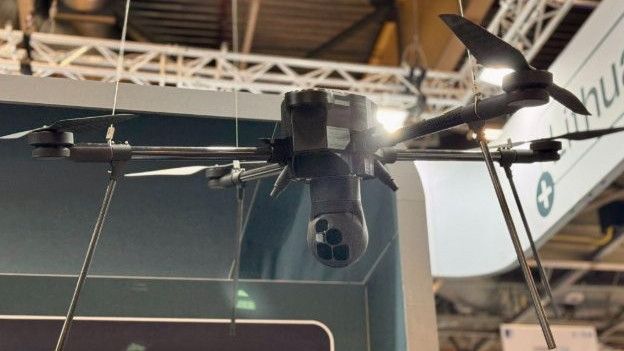
3D-printed plastic prototype of a payload mounted on a real-size drone, Eurosatory 2026
(Source: Tactical Photonics)
At under 2 kg and nearly half of the cost of US equivalents, it is the most accurate European payload in its class with the longest targeting range, designed for off-the-shelf integration across drone platforms. As Russia's GPS jamming spreads across the region, laser designation offers the only targeting solution that does not rely on GPS at all.
When GPS guidance fails, a drone can drift off course by as much as 100 km (approx. 62 miles). Over the last month, at least six drone incidents across Europe have been linked to GPS jamming and spoofing—and the problem is spreading. For ordinary Europeans, it means air raid sirens, evacuation orders, and, in Romania's case, waking up to a drone embedded in your apartment building.
Russian electronic warfare (EW) demonstrated the scale of this problem when Ukrainian strike drones were diverted across the region within 48 hours, one striking the chimney of an Estonian power plant.
When a drone is knocked off its course, it does not stop flying. It can wander hundreds of kilometers and deliver whatever payload it carries wherever it happens to land.
However, Europe has an emerging solution to this. Current targeting systems rely on GPS or radio links, both of which Russian jamming has shown it can disrupt. Laser targeting designators don’t need GPS at all. They work on fundamentally different principle: light cannot be intercepted or spoofed. Until now, similar high-tier systems had to be acquired through US-based companies, controlled by the US authorities.
Tactical Photonics, part of Aktyvus Photonics Group, is changing that by presenting the most accurate laser targeting payload in its 2 kg class, with the longest targeting range. To do so, the company joined forces with Lithuanian talents and built a separate entity powered by Aktyvus Photonics laser technology. A key benefit of laser designation is precision strike capability—ensuring guided munitions hit exactly where intended.
The payload functions as a laser designator, it marks targets with a laser spot, which laser-guided munitions then home in on to strike with precision. The payload does not carry or launch munitions itself, but determines exactly where they land.
"We built this because we were asked to—by Ukrainian and Baltic national forces. Europe has invested billions in the next generation of tactical drones, but it has not solved the targeting problem. And the payload is usually what determines whether the drone is useful or not," says Laurynas Šatas, CEO of Aktyvus Photonics Group.
“Lasers are key here, as they turn a surveillance drone into a precision strike platform, and these are still US-made, ITAR-controlled, and out of reach for programmes that cannot wait for a US State Department approval. There were no commercially viable companies in Europe providing laser payloads, and we intend to change that.”
According to the company, the payload weighs under 2 kg and is designed to hit small moving targets at ranges beyond 3 km (approx. 2 miles). This is enabled by 4-axis mechanical stabilisation—a critical differentiator in this class of system. Most payloads in this weight category rely on 2-axis stabilisation and digital image processing, which limits both range and accuracy. Four mechanical axes maintain a stable targeting lock on small moving targets even as the drone itself manoeuvres, replicating the performance of much larger systems in a fraction of the weight.
4 axes. 3 km range (approx. 2 miles). 2 kg. 1 system. For comparison, the equivalent US system from L3Harris WESCAM weighs approximately 15 kg and costs two times more. With this component, a drone can guide the full range of laser-guided STANAG 3733 NATO munitions.
Date: 08.12.2025
Naturally, we always handle your personal data responsibly. Any personal data we receive from you is processed in accordance with applicable data protection legislation. For detailed information please see our privacy policy.
Consent to the use of data for promotional purposes
I hereby consent to Vogel Communications Group GmbH & Co. KG, Max-Planck-Str. 7-9, 97082 Würzburg including any affiliated companies according to §§ 15 et seq. AktG (hereafter: Vogel Communications Group) using my e-mail address to send editorial newsletters. A list of all affiliated companies can be found here
Newsletter content may include all products and services of any companies mentioned above, including for example specialist journals and books, events and fairs as well as event-related products and services, print and digital media offers and services such as additional (editorial) newsletters, raffles, lead campaigns, market research both online and offline, specialist webportals and e-learning offers. In case my personal telephone number has also been collected, it may be used for offers of aforementioned products, for services of the companies mentioned above, and market research purposes.
Additionally, my consent also includes the processing of my email address and telephone number for data matching for marketing purposes with select advertising partners such as LinkedIn, Google, and Meta. For this, Vogel Communications Group may transmit said data in hashed form to the advertising partners who then use said data to determine whether I am also a member of the mentioned advertising partner portals. Vogel Communications Group uses this feature for the purposes of re-targeting (up-selling, cross-selling, and customer loyalty), generating so-called look-alike audiences for acquisition of new customers, and as basis for exclusion for on-going advertising campaigns. Further information can be found in section “data matching for marketing purposes”.
In case I access protected data on Internet portals of Vogel Communications Group including any affiliated companies according to §§ 15 et seq. AktG, I need to provide further data in order to register for the access to such content. In return for this free access to editorial content, my data may be used in accordance with this consent for the purposes stated here. This does not apply to data matching for marketing purposes.
Right of revocation
I understand that I can revoke my consent at will. My revocation does not change the lawfulness of data processing that was conducted based on my consent leading up to my revocation. One option to declare my revocation is to use the contact form found at https://contact.vogel.de. In case I no longer wish to receive certain newsletters, I have subscribed to, I can also click on the unsubscribe link included at the end of a newsletter. Further information regarding my right of revocation and the implementation of it as well as the consequences of my revocation can be found in the data protection declaration, section editorial newsletter.
Beyond precision, the system significantly increases situational awareness for the operator. It enables forces to operate beyond line of sight (BLOS), requires less crew training than comparable systems, and is designed for rapid deployment across multiple drone platforms.
"Military experts ask how can a European company build this better and cheaper than established American suppliers. Well, the answer is where we come from. Lithuania has been a global hub for laser science for decades. Some of the world's leading laser companies were and are being built here. We have extremely well-trained scientists and engineers. The knowledge is here, the supply chain is here, and the cost base reflects that. It is not a surprise that this technology gets cheaper when it is built in the country that helped invent it,” adds Šatas.
The system is compatible with fixed-wing drones and helicopter-type drones. It can also work alongside loitering munitions—which carry a SAL seeker that homes in on the laser-marked target, rather than marking targets themselves.
European defence investment grew by 14% last year, faster than any other continent, reaching €739 billion (approx. 847 billion USD), the steepest climb since the 1950s and double the level of a decade ago.
"As spending increases, Europe needs to become more independent in every area and own different parts of the supply chain,” continued Šatas.
“We are not building drones. We are building the part that determines how precise a drone can be, and making that part available in Europe at a price and scale that procurement officers can actually work with."
The payload made its public debut at Eurosatory 2026, one of the world's leading defence and security exhibitions, displayed on a small drone at the Lithuanian national stand. Production is set to scale to 600 units per year from 2027.




:quality(80)/p7i.vogel.de/wcms/f6/95/f6954fa7c09ba58863a3730f5e384a62/arek-socha-on-pixabay-1707x960v1.jpeg "A new national space strategy brings together UK’s plans for growth, defence, and national security to help reindustrialise the UK. (Source: Arek Socha on Pixabay)")
:quality(80)/p7i.vogel.de/wcms/63/0f/630f214fa760b8c7f7f7d6279d411fcf/d4ceed8f2f52-2026-08-30-hydef-06--msc4159-1200x675v1.webp "(Source: Diehl Defence)")
:quality(80)/p7i.vogel.de/wcms/4e/7d/4e7d38327c6c928b403249e3c24a2a7c/0132118791v1.jpeg "Porsche Holding SE announces that it is once again turning to rocket technology. Following its investment in Isar Aerospace, the company is now acquiring a stake in a U.S. firm ... (Source: Porsche)")
:quality(80)/p7i.vogel.de/wcms/1c/08/1c082bbd9d05b634168b617aa26fcdcf/safe-bg-lv-ro-v1-991x557v1.png "(Source: European Commission)")
:quality(80)/p7i.vogel.de/wcms/0a/14/0a1495d9b570ae32a5a7cc748b9a3c60/st-hannover-035-1920x1079v1-999x562v1.jpeg "Fastening technology you can experience first-hand—visitors to Schraubtec in Bochum (Germany) can see it for themselves at the Ruhr Congress on September 30, 2026. (Source: PHOTOVISION-DH GmbH)")
:quality(80)/p7i.vogel.de/wcms/cd/a9/cda92b173afa9d0b455d4f11b281c9ea/0094-to-image--capstone-cdr-1440x810v1.png "(Source: Terran Orbital)")
:quality(80)/p7i.vogel.de/wcms/e0/45/e045bc5414d7263fb308bdd501b5fcc1/0133113962v1.jpeg "The HSWL 354 is the transmission used, for example, in the Leopard 2 main battle tank. Renk manufactures this system and is now preparing to significantly increase its cycle time. As a result, Renk is placing greater emphasis on the military sector as a customer ... (Source: Renk)")
:quality(80)/p7i.vogel.de/wcms/a1/5c/a15c2aeba563d5bc3e11fb879b21eb2c/0132989650v1.jpeg "FSS, the flexible clamping system for varying free-form surfaces, is designed for the aerospace industry and other sectors. (Source: Römheld GmbH Friedrichshütte)")
:quality(80)/p7i.vogel.de/wcms/46/8e/468effa87546a2b036dc88ca40e2843e/129fbcac92ce7da872b13af0281b0799-l-png-1920x1079v1.webp "(Source: Arianespace)")
:quality(80)/p7i.vogel.de/wcms/8f/10/8f10697d4bfbd70edf615cca76eaedfd/pete-linforth-on-pixabay-1920x1080v1.jpeg "(Source: Pete Linforth on Pixabay / AI-generated)")
:quality(80)/p7i.vogel.de/wcms/0f/99/0f99561bf51818af92b2960656405aa5/roland-4d-pippes-on-pixabay-1460x820v1.jpeg "(Source: Roland 4D Pippes on Pixabay)")
:quality(80)/p7i.vogel.de/wcms/05/49/054906f874b94ef08b09d5920396e27d/airbus-h160-1920x1079v1.jpeg "Airbus H160 (Source: Airbus)")
:quality(80)/p7i.vogel.de/wcms/9d/8a/9d8addea8cc4e6f7a4793563ca397f2a/ai-im-milit-r-1672x940v1.png "(Source: KI-generiert / Gemini)")
:quality(80)/p7i.vogel.de/wcms/7f/5f/7f5fba2c729ec3aa256bf1a18d74529b/ai-chip-1672x940v1.png "(Source: KI-generiert / Gemini)")
:quality(80)/p7i.vogel.de/wcms/64/1b/641b6474b2a614cde7730c89ef2a3015/2026-09-09-rheinmetall-veroeffentlicht-battlesuite-schnittstellen-e8c18194-1225x690v1.jpeg "Rheinmetall’s Battlesuite provides a modular digital platform for connecting and integrating sensors, hardware and software components. (Source: Rheinmetall AG)")
:quality(80)/p7i.vogel.de/wcms/6f/fe/6ffef325e7f233cc3521943158eb1ebd/0132763535v1.jpeg "Two companies are planning to establish, for the first time in 2027, an optical laser communication link directly between a satellite in low Earth orbit (LEO) and a re-entering spacecraft. (Source: ATMOS Space Cargo)")
:quality(80)/p7i.vogel.de/wcms/8f/f9/8ff91b78b26cb5a2b8a29e39835005b1/2026-09-10-repmus-teaser-images-retouched-dsc01292-1024x683-1024x576v1.jpeg "(Source: Quantum Systems GmbH)")
:quality(80)/p7i.vogel.de/wcms/bf/4a/bf4a237e60d3d4bd1bbdbad918f3c697/airbus-defence-and-space-3-1280x720v1.jpeg "(Source: Airbus Defence and Space)")
:quality(80)/p7i.vogel.de/wcms/e0/d1/e0d112a0d54a4fa9603ec855f7d25b47/t-rex-content-photo-jpg-pc-adaptive-990-medium-988x556v1.jpeg "Swarm of UAVs conducting a fully autonomous collaborative swarm mission. (Source: Lockheed Martin)")
:quality(80)/p7i.vogel.de/wcms/79/fc/79fcaa7ca33e393b11a4740d7d8f3dbe/vilkasss-handshake-9459740-1911x1076v1.jpeg "(Source: Vilius Kukanauskas on Pixabay)")
:quality(80)/p7i.vogel.de/wcms/90/a8/90a849f0023f11d1eb642eb4751a0321/bild2-h-c3-a4nel-ict-20truck-20and-20trailer-20parts-4320x2429v1.jpeg "Product information is visible at all times and retrieval of items
is confirmed by employees directly on the display of the Hänel MP 14 N
controller. (Source: René Marks)")
:quality(80)/p7i.vogel.de/wcms/4e/ca/4ecaa39f247490eded591b652c33aee3/thilmann-hcp-web-20kleiner-20ausschnitt-1442x811v1.jpeg "Entering the defence market can be challenging for start-ups, says HCP Sense CEO Ansgar Thilmann. (Picture: HCP Sense)")
:quality(80)/p7i.vogel.de/wcms/7a/51/7a511b80041d3f1335f3a5aa56fe75da/delivery-7022432-1280-1280x720v1.png "(Source: Mohamed_hassan)")
:quality(80)/p7i.vogel.de/wcms/f9/2f/f92f1ef8c739c34c70d99f7b0997621b/stra007-20--20cover-20image-5472x3076v1.jpeg "(Source: Stratasys)")
:quality(80)/p7i.vogel.de/wcms/ec/a9/eca9062ccbe4b042f8515846340410d8/aerospace-and-defence-stairways-platforms-and-much-morev1.jpeg "Modular constructions enable flexible modification. That applies to larger structures such as stairways and platforms, too. And that means aerospace and defence companies can reconfigure their maintenance platforms fast (itemitem)")
:quality(80)/p7i.vogel.de/wcms/30/2a/302a7b5723ad38fbde812fd3a468ad04/safety-on-stairways-in-industry-key-considerationsv1.jpeg "Stairways and platforms are used widely in maintenance and assembly areas in the aerospace and defence sectors. (Source: item)")
:quality(80)/p7i.vogel.de/wcms/f3/4e/f34ed744bb30817d3432c7ad522e6f30/engine-1v1.jpeg "Engineering with aluminium profiles really can be this easy – the item Engineeringtool and its smart functions help you save valuable time. (Source: item)")
:fill(fff,0)/p7i.vogel.de/companies/69/6d/696de2483d115/logo--fastems-rgb-horizontal.jpeg "logo--fastems-rgb-horizontal (Fastems)")
:fill(fff,0)/images.vogel.de/vogelonline/companyimg/84700/84735/65.jpg "logo_item_rgb_neu.jpg ()")
:quality(80)/p7i.vogel.de/wcms/04/3b/043bb9d3cac1b001c57ac67fe627baf2/jpgv1.jpeg "jpgv1 (Source: )")
:quality(80)/p7i.vogel.de/wcms/6c/0f/6c0f988379c1c0aa73845b1210d9331c/basisbild-1672x940v1.png "basisbild-1672x940v1 (Source: AI-Generated/ChatGPT)")