An air-breathing electric thruster could turn the atmosphere that slows a low-flying satellite into propellant. The difficult part is closing the balance between intake, thrust and electrical power across a real mission.
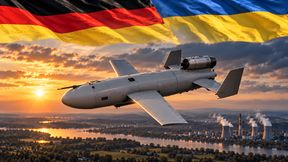
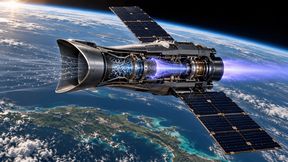
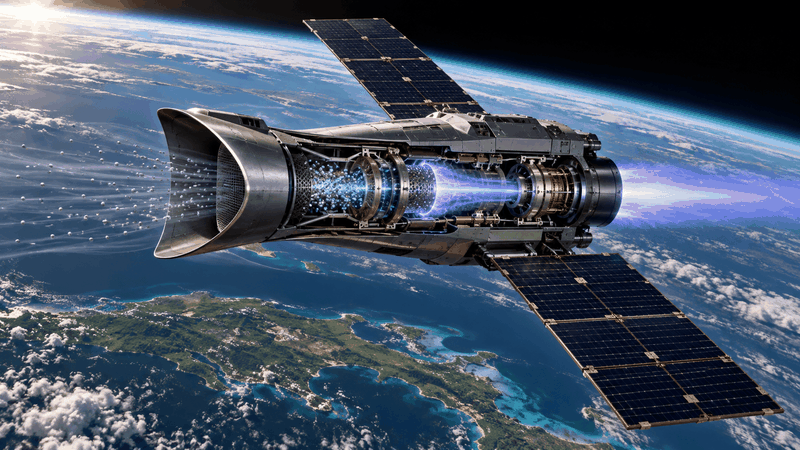
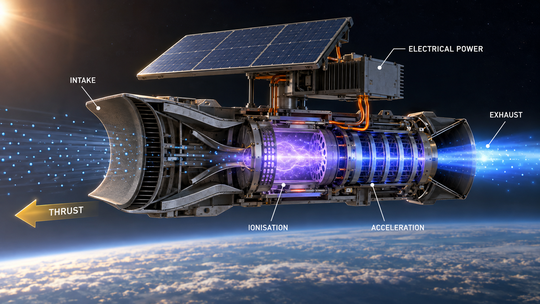
A conceptual VLEO satellite collects atmospheric particles for electric propulsion. Illustration, not an image of a flown spacecraft.
(Source: KI-generiert / Imagen)
The atmosphere becomes part of the propulsion system
Very low Earth orbit offers an attractive bargain for an observation satellite: move closer to the target and obtain finer ground detail for a given angular resolution, or use a smaller optical system for a comparable result. The price is atmospheric drag. Residual gas transfers momentum to the spacecraft, which must replace that loss if it is to maintain its orbit. Conventional electric propulsion does so by consuming stored propellant. Air-breathing electric propulsion, or ABEP, would collect some of the passing atmosphere instead.
This is a propulsion-system problem before it is a thruster problem. A satellite needs an intake that delivers usable gas, a discharge that works with its changing composition, and an accelerator that produces enough momentum for the available electrical power. All three must operate within the same mass, geometry and thermal budget. Demonstrating plasma in a laboratory is an important step; sustaining an orbit requires the complete spacecraft to close that balance.
A ground result is not an orbital result
In 2018, ESA reported a ground firing of an air-breathing electric propulsion system, developed with Sitael and QuinteScience. The experiment used simulated conditions for approximately 200 kilometres altitude and demonstrated operation with atmospheric gas. It was a ground demonstration, not a satellite maintaining its orbit by breathing the atmosphere. That distinction still defines how new claims should be assessed.
DARPA's Otter programme now seeks to develop and demonstrate air-breathing electric propulsion and to use an orbiting test system to study the VLEO environment. Its published scope spans 90 to 450 kilometres and envisages more than a year of orbital experimentation. This is a programme envelope, not evidence that practical satellites can operate routinely at every altitude within it. The lowest part presents especially severe atmospheric constraints.
Redwire announced a $44 million Otter Phase 2 award in November 2025, with its SabreSat platform supporting the effort. An award advances development; it does not establish that the planned orbital demonstration has already succeeded. As of the sources reviewed for this article, the compelling near-term story is the attempt to connect ground testing, atmospheric models and an integrated flight experiment.
An intake must collect without creating an excessive penalty
At orbital speed, the gas reaching an intake carries substantial relative momentum. In the rarefied-flow regime, individual interactions with walls matter. Geometry, surface scattering, gas species and pointing determine how much of the incident stream reaches the discharge and in what condition. An intake's nominal capture efficiency is therefore incomplete without the assumptions and operating conditions behind it.
Research by Romano and colleagues compares intake concepts using diffuse and specular surface behaviour. The analysis shows why favourable simulated efficiencies should not be treated as an installed flight specification. Surface properties, alignment and the distribution of incident particles influence the result. Manufacturing, contamination and exposure must preserve the behaviour that the model assumes if the intake is to retain its predicted advantage.
The useful quantity is net momentum
A first estimate of aerodynamic drag is D = ½ρv²CDA, where density, velocity, drag coefficient and reference area describe the chosen spacecraft model. Captured mass flow can be approximated as ṁ = ηcρvAi, using intake efficiency and aperture area. These equations are useful for screening concepts, provided their definitions remain consistent.
The momentum of incoming gas must be counted. Gross exhaust thrust cannot be compared with a drag estimate that silently omits the momentum collected by the intake. Equally, subtracting that captured momentum from thrust and then including it again in total drag counts the same loss twice. A control-volume calculation should identify which surfaces and gas flows belong to each term before a headline thrust margin is quoted.
Date: 08.12.2025
Naturally, we always handle your personal data responsibly. Any personal data we receive from you is processed in accordance with applicable data protection legislation. For detailed information please see our privacy policy.
Consent to the use of data for promotional purposes
I hereby consent to Vogel Communications Group GmbH & Co. KG, Max-Planck-Str. 7-9, 97082 Würzburg including any affiliated companies according to §§ 15 et seq. AktG (hereafter: Vogel Communications Group) using my e-mail address to send editorial newsletters. A list of all affiliated companies can be found here
Newsletter content may include all products and services of any companies mentioned above, including for example specialist journals and books, events and fairs as well as event-related products and services, print and digital media offers and services such as additional (editorial) newsletters, raffles, lead campaigns, market research both online and offline, specialist webportals and e-learning offers. In case my personal telephone number has also been collected, it may be used for offers of aforementioned products, for services of the companies mentioned above, and market research purposes.
Additionally, my consent also includes the processing of my email address and telephone number for data matching for marketing purposes with select advertising partners such as LinkedIn, Google, and Meta. For this, Vogel Communications Group may transmit said data in hashed form to the advertising partners who then use said data to determine whether I am also a member of the mentioned advertising partner portals. Vogel Communications Group uses this feature for the purposes of re-targeting (up-selling, cross-selling, and customer loyalty), generating so-called look-alike audiences for acquisition of new customers, and as basis for exclusion for on-going advertising campaigns. Further information can be found in section “data matching for marketing purposes”.
In case I access protected data on Internet portals of Vogel Communications Group including any affiliated companies according to §§ 15 et seq. AktG, I need to provide further data in order to register for the access to such content. In return for this free access to editorial content, my data may be used in accordance with this consent for the purposes stated here. This does not apply to data matching for marketing purposes.
Right of revocation
I understand that I can revoke my consent at will. My revocation does not change the lawfulness of data processing that was conducted based on my consent leading up to my revocation. One option to declare my revocation is to use the contact form found at https://contact.vogel.de. In case I no longer wish to receive certain newsletters, I have subscribed to, I can also click on the unsubscribe link included at the end of a newsletter. Further information regarding my right of revocation and the implementation of it as well as the consequences of my revocation can be found in the data protection declaration, section editorial newsletter.
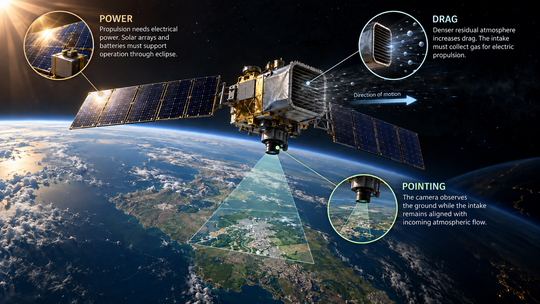
A density excursion can supply more gas while raising drag and electrical demand. Attitude changes that serve an imaging payload can reduce intake performance. The orbit-control strategy must handle both effects, including periods without sufficient thrust.
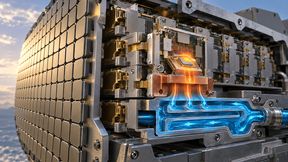
The intake, discharge and accelerator form one system. Net thrust must cover total drag while remaining within the spacecraft power budget.
(Source: KI-generiert / Imagen)
Ionisation and acceleration have to fit the power budget
Collected particles must reach a useful discharge density, be ionised and be accelerated to produce thrust. Different species affect ionisation, plasma losses and exhaust behaviour. An engineering assessment needs measurements of thrust, mass utilisation and electrical efficiency together, rather than a claim that the thruster can ignite on several gases. Stable ignition does not prove efficient operation over the mission envelope.
Fuel-flexible propulsion is relevant here, but it is not synonymous with ABEP. DARPA published a separate fuel-flexible electric propulsion solicitation in September 2026, seeking a system with greater than 30 per cent efficiency on specified alternative propellants and mixtures. That figure is a development objective. A flexible thruster could still depend on stored feedstock and need a separately qualified intake to become an air-breathing orbital system.
Power availability is a spacecraft constraint. Solar arrays can supply more electricity by becoming larger, but their area and orientation also affect drag. Eclipse periods require a strategy for storing energy or tolerating an orbital excursion until propulsion resumes. Batteries, power conversion and heat rejection consume mass and introduce limits that a stand-alone thruster performance curve does not show.
Longer endurance changes the payload trade
If ABEP closes this system balance, the mission need not end because a conventional propellant tank is empty. That would allow designers to reconsider how much mass to allocate to stored propellant and how long a spacecraft can deliver useful observations. It does not imply unlimited life. Power-system degradation, atomic-oxygen exposure, propulsion wear and payload reliability remain possible mission limits.
For Earth observation and ISR, lower altitude can improve spatial resolution and the communications link budget. It also narrows the ground area seen for a given field of view and changes coverage and constellation requirements. More detailed imagery from one pass does not automatically produce more frequent access to every target. Endurance should be evaluated against the operational mission, including pointing, revisit and data delivery.
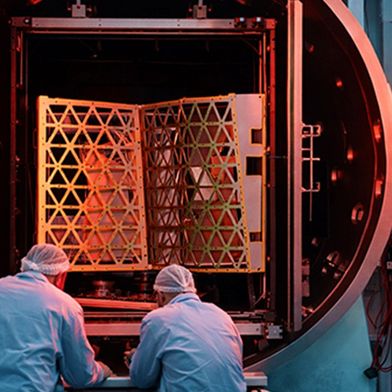
There are industrial consequences beyond the propulsion supplier. Intake surfaces require controlled properties; plasma systems need evidence on operation with realistic species; spacecraft integrators must validate coupled attitude, power and drag behaviour. Ground facilities need representative particle flows and careful accounting for background gas. Tests that inadvertently feed a thruster from the chamber can overstate what an orbital intake would supply.
What a convincing demonstration must measure
The decisive orbital evidence will be sustained drag compensation with a measured power budget, a defined atmospheric environment and a documented vehicle configuration. Intake capture, thruster performance and orbit evolution need to be interpreted together. A test should also show what happens during pointing changes, eclipses and density excursions, because those conditions determine whether the architecture can support an operational payload.
The attractive idea is simple: the atmosphere supplies what the atmosphere makes necessary. Making that idea useful requires the satellite to collect, process and accelerate the gas while remaining a productive spacecraft. ABEP could extend VLEO missions substantially. Its success will be measured by stable mission operations and recovered performance margins, rather than by the first photograph of a glowing plasma plume.
Lower altitude brings an imaging benefit and a drag penalty. Pointing, eclipses and atmospheric variation determine the operational margin.