The QuNET research initiative has completed its final key experiment, demonstrating a cross-state experimental quantum communication network in Germany. The network connects regional infrastructures in Bavaria, Berlin, Saxony and Thuringia, marking an important step towards highly secure communications and the practical application of quantum technologies.
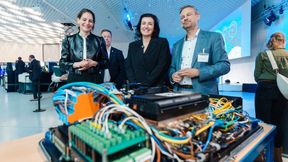
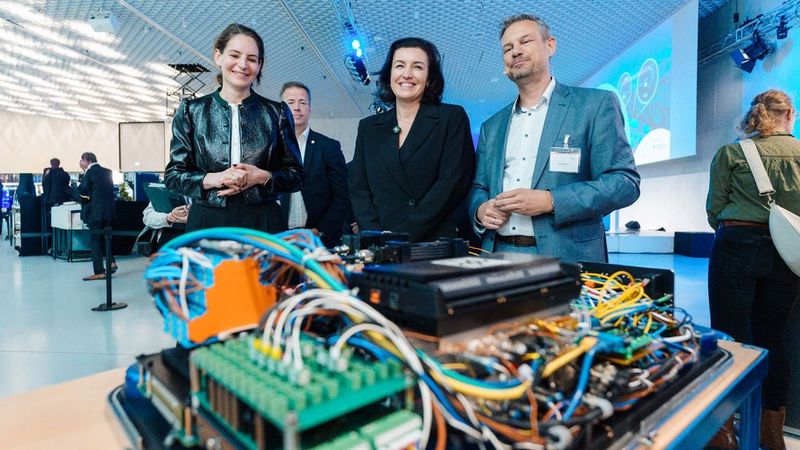
Presentation of DLR research within the QuNET initiative.
(Source: DLR)
With a live demonstration, the QuNET research initiative has completed its final key experiment: in Berlin, Dorothee Bär, Federal Minister for Research, Technology and Space, joined representatives from the federal states of Bavaria, Berlin, Saxony and Thuringia to activate an experimental, cross-state quantum communication network.
The QuNET initiative is researching the technological foundations for highly secure communications. At its heart is quantum key distribution (QKD). The German Aerospace Center (DLR) is part of the initiative's core consortium, together with the Fraunhofer Institute for Applied Optics and Precision Engineering IOF, the Fraunhofer Heinrich Hertz Institute for Telecommunications HHI, the Max Planck Institute for the Science of Light (MPL) and Friedrich-Alexander University Erlangen-Nürnberg (FAU). The Federal Ministry for Research, Technology and Space (BMFTR) funds the QuNET initiative.
“Today, with the final key experiment of the QuNET initiative, we have reached an important milestone in Germany's High-Tech Agenda. I am delighted that we were able to see first-hand how quantum communication can protect our sensitive data against attacks in the quantum age of the future. This strengthens our technological sovereignty and value creation. The task now is to move research rapidly into widespread practical application in order to deliver the cybersecurity of tomorrow,” explains Federal Minister Dorothee Bär.
Federal states provide regional networks, Federal Minister connects them
In the final and largest QuNET key experiment, which also marked the initiative's official closing event, researchers demonstrated the exchange of quantum-encrypted data in an experimental, cross-state quantum communication network. Working with users from business, science and society, they tested the network in a realistic scenario.
To this end, political representatives of the participating federal states first activated their respective regional subnetworks on 28 October 2026, at locations in Erlangen, Erfurt and Berlin. In Bavaria, this was carried out by Minister-President Dr Markus Söder; in Berlin, by Governing Mayor Kai Wegner; and in Thuringia, by Minister-President Mario Voigt. Saxony was also represented by Dr Babett Gläser, Head of the Research Department at the Saxon State Ministry for Science, Culture and Tourism.
Through their own state-level initiatives, the federal states had made a significant contribution to establishing local quantum communication research infrastructures. These provided the foundation on which the cross-state QuNET network could be built.
Following the successful provision of the regional subnetworks, Federal Minister Dorothee Bär initiated their interconnection in Berlin to form a joint quantum communication network, followed by a live demonstration.
Project milestone: quantum channels tested in flight last year
Several key experiments paved the way for this achievement. For example, in a flight experiment led by the DLR Institute of Communications and Navigation, researchers measured various quantum channels between an aircraft and a ground station last year, sent photons to an ion trap and tested quantum key distribution technologies.
“When developing mobile quantum nodes, we were able to contribute our core technologies from optical communications via satellites and aircraft, and demonstrate them in this flight experiment. This experience will enable us to help build future quantum networks over long distances. Free-space connections via satellites, aircraft and stratospheric platforms will form part of the solution for tomorrow's secure quantum communication systems,” explains Dr Florian David, Director of the DLR Institute of Communications and Navigation in Oberpfaffenhofen (Germany).
Live demonstration using fictional healthcare data
During the latest live demonstration in Berlin, implemented under the technical leadership of the MPL and FAU, different quantum cryptography systems were interconnected to form a network.
Date: 08.12.2025
Naturally, we always handle your personal data responsibly. Any personal data we receive from you is processed in accordance with applicable data protection legislation. For detailed information please see our privacy policy.
Consent to the use of data for promotional purposes
I hereby consent to Vogel Communications Group GmbH & Co. KG, Max-Planck-Str. 7-9, 97082 Würzburg including any affiliated companies according to §§ 15 et seq. AktG (hereafter: Vogel Communications Group) using my e-mail address to send editorial newsletters. A list of all affiliated companies can be found here
Newsletter content may include all products and services of any companies mentioned above, including for example specialist journals and books, events and fairs as well as event-related products and services, print and digital media offers and services such as additional (editorial) newsletters, raffles, lead campaigns, market research both online and offline, specialist webportals and e-learning offers. In case my personal telephone number has also been collected, it may be used for offers of aforementioned products, for services of the companies mentioned above, and market research purposes.
Additionally, my consent also includes the processing of my email address and telephone number for data matching for marketing purposes with select advertising partners such as LinkedIn, Google, and Meta. For this, Vogel Communications Group may transmit said data in hashed form to the advertising partners who then use said data to determine whether I am also a member of the mentioned advertising partner portals. Vogel Communications Group uses this feature for the purposes of re-targeting (up-selling, cross-selling, and customer loyalty), generating so-called look-alike audiences for acquisition of new customers, and as basis for exclusion for on-going advertising campaigns. Further information can be found in section “data matching for marketing purposes”.
In case I access protected data on Internet portals of Vogel Communications Group including any affiliated companies according to §§ 15 et seq. AktG, I need to provide further data in order to register for the access to such content. In return for this free access to editorial content, my data may be used in accordance with this consent for the purposes stated here. This does not apply to data matching for marketing purposes.
Right of revocation
I understand that I can revoke my consent at will. My revocation does not change the lawfulness of data processing that was conducted based on my consent leading up to my revocation. One option to declare my revocation is to use the contact form found at https://contact.vogel.de. In case I no longer wish to receive certain newsletters, I have subscribed to, I can also click on the unsubscribe link included at the end of a newsletter. Further information regarding my right of revocation and the implementation of it as well as the consequences of my revocation can be found in the data protection declaration, section editorial newsletter.
The demonstration focused on a practical application scenario: fictional pharmacy reimbursement records were transmitted as test datasets using quantum-secured communications. The actual transmission took place via fibre-optic cables. This is because QuNET investigated not only components and systems for quantum communication, but also their integration into existing communications infrastructures.
“The future of quantum communication will be shaped by a hybrid, quantum-secured infrastructure comprising fibre-optic networks, free-space networks and satellite networks,” says Professor Andreas Tünnermann, spokesperson for the QuNET initiative. “That is precisely what we are demonstrating in this final QuNET key experiment: different systems and regional networks can work together. This brings us an important step closer to the goal of a practically usable network infrastructure for highly secure communications.”
The next generation follows QuNET
With the live demonstration in Berlin, the QuNET initiative is now approaching the end of its seven-year research programme. At the same time, the next phase is beginning: moving beyond an experimental quantum network focused on QKD applications towards creating value in Germany from the technologies and research results.