Hybrid drone threats are placing new demands on the protection of civilian and critical infrastructure, requiring networked detection, command-and-control and tailored countermeasures.
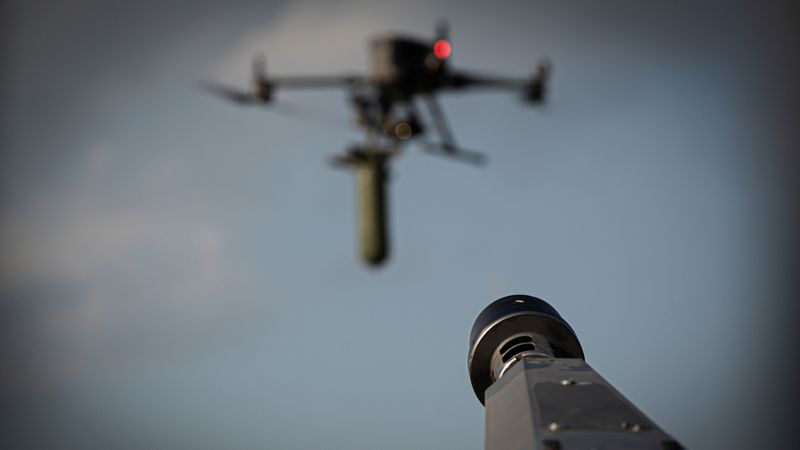
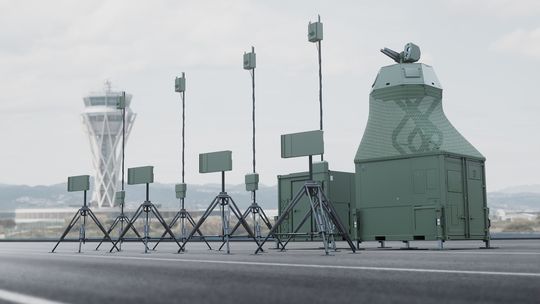
Rheinmetall’s Skyspotter system provides electro-optical detection and tracking for comprehensive drone surveillance at civilian airfields.
(Source: Rheinmetall AG)
The skies over Germany are the scene of a hybrid threat. The incident at Leipzig/Halle Airport (Germany), in which a drone equipped with the military plastic explosive Semtex was discovered near a cargo aircraft, made it clear that the protection of airspace is an existential task for security authorities and operators of critical infrastructure. Point defence is no longer sufficient; what is needed are networked and cross-system approaches. As a leading international systems house for security and defence, Rheinmetall is ideally positioned to reliably address these challenges both technologically and operationally. We are proven experts in air defence and drone protection. Our counter-drone systems are proving their capabilities in operational use—in Ukraine, in the Arab region and in the protection of critical infrastructure in Germany.
For counter-drone protection at sensitive facilities such as airports, a combination of high-performance sensors and situation-adapted effectors is required. Rheinmetall pursues an approach that combines different physical detection principles. These include 3D radar solutions, radio direction finders as well as acoustic and scalable systems. They passively detect people, vehicles and drones, independently of line of sight. Relevant events are identified with the support of AI and provided in near real time to create a reliable operational picture. These sensors can be combined according to requirements and the situation.
One component is the electro-optical detection and tracking system Skyspotter: it continuously scans the airspace and provides 360-degree coverage. By combining thermal imaging and daylight cameras with AI-based image processing, the system verifies and tracks even the smallest low-flying or radio-silent drones. At airports, Skyspotter has demonstrated its capabilities under real-world conditions. This sensor mix ensures comprehensive airspace surveillance without disrupting flight operations
The core consists of mission-tailored digital command-and-control systems. These combine sensor data in real time and provide the operational command with an up-to-date air situation picture. This makes it possible to identify threats precisely, while also immediately showing when the threat has been neutralised and there are no longer any drones in the air. This helps civilian airports save time and resume operations. To further expand this protection in the civilian sphere, we are taking the next step towards a nationwide counter-drone system together with Telekom. T-Systems infrastructure, particularly mobile communications towers, can be used to install radio direction finding across the country. This makes it possible to detect radio-controlled (radio frequency, RF) drones.
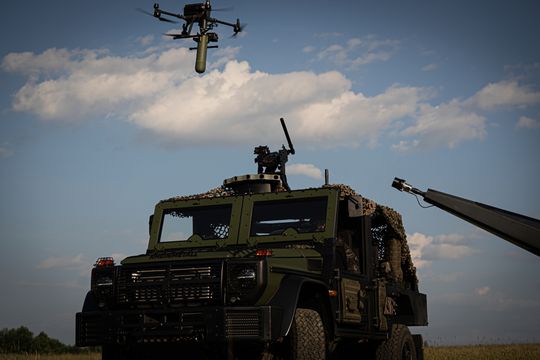
As soon as a threat has been identified, tailored countermeasures must be taken. To combat threats, in the so-called soft-kill domain we primarily rely on targeted jammers (electronic defence methods that block the drone’s radio or GPS signals without physically destroying it) or autonomous ramming drones, known as interceptors, which intercept hostile systems in flight. Under the modular building-block principle, additional effectors can be deployed, including high-energy laser systems. Another example is the Skynex system, which protects critical infrastructure in Ukraine using programmable Ahead ammunition.
Airspace Security: How Rheinmetall Addresses the Hybrid Drone Threat—Skyspotter at a civilian airfield.
(Source: Rheinmetall AG)
Here, differentiation is important: Skyspotter is primarily designed to protect critical infrastructure in peacetime. If the conflict escalates or the threat level rises sharply, the system can be flexibly upgraded with hard-kill capabilities (kinetic defence methods for physically destroying or shooting down the target). Networking with the mobile Skyranger air defence system is generally possible, but is currently not envisaged for the protection of civilian airports.
(Source: Rheinmetall AG)
The deployment of this technology requires a clear legal framework. The incident in Leipzig reignited the debate over responsibilities and powers. The responsibilities are clearly separated: within the framework of national and collective defence, the Bundeswehr is responsible for the military protection of German airspace. Within Germany, public safety and threat prevention are primarily the responsibility of the federal states and federal authorities. The Federal Police plays a central role in protecting borders and airports. While, as part of threat prevention, the Federal Police may initiate sovereign measures such as disrupting radio signals or intercepting drones, the Bundeswehr’s powers to intervene domestically are strictly regulated by the Basic Law and limited to providing administrative assistance. In view of current threats, further harmonisation is required to close security gaps.
Date: 08.12.2025
Naturally, we always handle your personal data responsibly. Any personal data we receive from you is processed in accordance with applicable data protection legislation. For detailed information please see our privacy policy.
Consent to the use of data for promotional purposes
I hereby consent to Vogel Communications Group GmbH & Co. KG, Max-Planck-Str. 7-9, 97082 Würzburg including any affiliated companies according to §§ 15 et seq. AktG (hereafter: Vogel Communications Group) using my e-mail address to send editorial newsletters. A list of all affiliated companies can be found here
Newsletter content may include all products and services of any companies mentioned above, including for example specialist journals and books, events and fairs as well as event-related products and services, print and digital media offers and services such as additional (editorial) newsletters, raffles, lead campaigns, market research both online and offline, specialist webportals and e-learning offers. In case my personal telephone number has also been collected, it may be used for offers of aforementioned products, for services of the companies mentioned above, and market research purposes.
Additionally, my consent also includes the processing of my email address and telephone number for data matching for marketing purposes with select advertising partners such as LinkedIn, Google, and Meta. For this, Vogel Communications Group may transmit said data in hashed form to the advertising partners who then use said data to determine whether I am also a member of the mentioned advertising partner portals. Vogel Communications Group uses this feature for the purposes of re-targeting (up-selling, cross-selling, and customer loyalty), generating so-called look-alike audiences for acquisition of new customers, and as basis for exclusion for on-going advertising campaigns. Further information can be found in section “data matching for marketing purposes”.
In case I access protected data on Internet portals of Vogel Communications Group including any affiliated companies according to §§ 15 et seq. AktG, I need to provide further data in order to register for the access to such content. In return for this free access to editorial content, my data may be used in accordance with this consent for the purposes stated here. This does not apply to data matching for marketing purposes.
Right of revocation
I understand that I can revoke my consent at will. My revocation does not change the lawfulness of data processing that was conducted based on my consent leading up to my revocation. One option to declare my revocation is to use the contact form found at https://contact.vogel.de. In case I no longer wish to receive certain newsletters, I have subscribed to, I can also click on the unsubscribe link included at the end of a newsletter. Further information regarding my right of revocation and the implementation of it as well as the consequences of my revocation can be found in the data protection declaration, section editorial newsletter.
As a strategic partner, Rheinmetall stands ready to provide technological support for this process. With our modular “Drone Defence Toolbox”, we offer scalable solutions tailored to the respective legal powers—from passive detection and soft-kill capabilities for authorities to military air defence, which is divided into different layers according to range. As a cross-system technology house, Rheinmetall closes the technological gap, enabling policymakers and authorities to close the legal gap.




:quality(80)/p7i.vogel.de/wcms/36/7a/367adfa7fa6186160e10fafd2b403eb3/0134084456v1.jpeg "After Elon Musk has so far been rather reserved about a merger of Tesla and SpaceX that has been discussed for some time, it is now likely becoming more concrete—at least it seems so... (Source: Tesla)")
:quality(80)/p7i.vogel.de/wcms/d5/08/d508987ea0ae62aefdaa155f9bbd71af/military-material-soldier-2533669-1920x1079v1.jpeg "LinkedIn’s Top Startups 2026 ranking highlights Germany’s emerging companies, with AI, defence technology and energy innovation featuring prominently. (Source: Military_Material on Pixabay)")
:quality(80)/p7i.vogel.de/wcms/c9/8d/c98daffbad4087fc5338d2ddc0909e40/japan-pr-9-1680x944v1.png "(Source: Thales)")
:quality(80)/p7i.vogel.de/wcms/df/26/df26de98f6069219d5e044b50fae40a8/s960-ddc-official-20261015-286-068-960x540v1.jpeg "Minister for Defence Readiness and Industry, Luke Pollard and German State Secretary for Armament, Innovation and Cyber, Jens Plötner (from left to right). (Source: GOV.UK)")
:quality(80)/p7i.vogel.de/wcms/1e/05/1e05d4b35c5b6fae825d9ad2f852df33/rotor-clip-advanced-vision-inspection-1920x1079v1.jpeg "(Source: Rotor Clip)")
:quality(80)/p7i.vogel.de/wcms/17/05/1705108734040844028c8f0f054c06e2/202079-1350x759v1.jpeg "(Source: Rheinmetall AG)")
:quality(80)/p7i.vogel.de/wcms/d3/1c/d31caf0a2300bf7762f9dfbd272f0a4e/lockheed-martin-hadrian-1920x1079v1.jpeg "Hadrian will bring innovative, highly automated machining cells to the Grand Prairie facility, operated by the world-class Lockheed Martin production workforce. (Source: Lockheed Martin Corporation)")
:quality(80)/p7i.vogel.de/wcms/74/bb/74bbce6f561e163a760f8e6acb2412b5/art-0001-titelbild-1672x940v1.png "RF output and heat rejection share the same module. Conceptual illustration of a radar array and its thermal path; not a product photograph. (Source: KI-generiert / Imagen)")
:quality(80)/p7i.vogel.de/wcms/74/34/7434bf25f22bb5ff84146fccb984bc28/0134080905v1.jpeg "GKN Aerospace and Saab have signed a long-term cooperation agreement covering the Gripen E/F propulsion system. (Source: Saab)")
:quality(80)/p7i.vogel.de/wcms/53/63/5363287e81bcc7fd8e0ce9ec17ec6b93/enbata-over-archipelagos-auraaero-1536x864v1.png "(Source: AURA AERO)")
:quality(80)/p7i.vogel.de/wcms/03/52/0352ed6450d99eefb77378b17e99bd72/art-0007-titelbild-1672x940v1.png "Reusable research vehicles make the flight-to-redesign loop possible. Conceptual illustration; no actual X-15 or Talon-A vehicle is depicted. (Source: KI-generiert / Imagen)")
:quality(80)/p7i.vogel.de/wcms/91/6b/916b895a08748965aae63dca99dbaead/20261015-en-5442891-1-1024x575v1.jpeg "(Source: Saab AB)")
:quality(80)/p7i.vogel.de/wcms/50/85/50856774ce46ad8f94f37e328ba3b6d3/ptc-frau-arbeitet-mit-model-am-pc-neben-turbine-1911x1076v1.jpeg "(Source: PTC)")
:quality(80)/p7i.vogel.de/wcms/9c/60/9c60e13e660fe6b444ec71c59b5598ce/publicdomainarchive-on-pixabay-1920x1079v1.jpeg "(Source: PublicDomainArchive on Pixabay)")
:quality(80)/p7i.vogel.de/wcms/ed/e6/ede67e479952b7bad62244697e3cd3db/aa383c9a-015c-424b-95da-d8d56156c227-1536x864v1.png "Intelic's AI-supported command-and-control system Nexus can integrate sensors and interceptor drones to counter aerial threats (Illustration). (Picture: AI generated)")
:quality(80)/p7i.vogel.de/wcms/cb/a2/cba2ecda891b2874327a30f69f773bdb/hexaforce-15-1920x1079v1.jpeg "(Source: Thales/Gauthier Chauffrut)")
:quality(80)/p7i.vogel.de/wcms/a5/ce/a5ce58d51cba9063688079379feb732d/desko-id-analyze-passkontrolle-1-1920x1079v1.jpeg "(Bild: Desko)")
:quality(80)/p7i.vogel.de/wcms/df/5c/df5cb22ae3c8e224730e3543453abf54/argus-interceptor-phantom-8-von-29-1920x1079v1.png "Argus Interceptor Phantom (Source: Argus Interception)")
:quality(80)/p7i.vogel.de/wcms/44/f8/44f8dfc31e436cc3a2d5a4c98c2ff46f/drohnenabwehr-am-kraftwerk-bei-d-mmerung-1672x940v1.png "Across Europe, governments are increasingly considering allowing operators of critical civilian infrastructure to take responsibility for actively defending their facilities against hostile drones using military-grade counter-UAV technology. (Graphic: AI generated)")
:quality(80)/p7i.vogel.de/wcms/25/1f/251f3ec674139d548928e3a2f0a0a040/airbus-1920x1079v1.jpeg "IRIS-T SLM Live Firing. (Source: Bundeswehr/ Hildemann)")
:quality(80)/p7i.vogel.de/wcms/90/a8/90a849f0023f11d1eb642eb4751a0321/bild2-h-c3-a4nel-ict-20truck-20and-20trailer-20parts-4320x2429v1.jpeg "Product information is visible at all times and retrieval of items
is confirmed by employees directly on the display of the Hänel MP 14 N
controller. (Source: René Marks)")
:quality(80)/p7i.vogel.de/wcms/4e/ca/4ecaa39f247490eded591b652c33aee3/thilmann-hcp-web-20kleiner-20ausschnitt-1442x811v1.jpeg "Entering the defence market can be challenging for start-ups, says HCP Sense CEO Ansgar Thilmann. (Picture: HCP Sense)")
:quality(80)/p7i.vogel.de/wcms/7a/51/7a511b80041d3f1335f3a5aa56fe75da/delivery-7022432-1280-1280x720v1.png "(Source: Mohamed_hassan)")
:quality(80)/p7i.vogel.de/wcms/f9/2f/f92f1ef8c739c34c70d99f7b0997621b/stra007-20--20cover-20image-5472x3076v1.jpeg "(Source: Stratasys)")
:quality(80)/p7i.vogel.de/wcms/ec/a9/eca9062ccbe4b042f8515846340410d8/aerospace-and-defence-stairways-platforms-and-much-morev1.jpeg "Modular constructions enable flexible modification. That applies to larger structures such as stairways and platforms, too. And that means aerospace and defence companies can reconfigure their maintenance platforms fast (itemitem)")
:quality(80)/p7i.vogel.de/wcms/30/2a/302a7b5723ad38fbde812fd3a468ad04/safety-on-stairways-in-industry-key-considerationsv1.jpeg "Stairways and platforms are used widely in maintenance and assembly areas in the aerospace and defence sectors. (Source: item)")
:quality(80)/p7i.vogel.de/wcms/f3/4e/f34ed744bb30817d3432c7ad522e6f30/engine-1v1.jpeg "Engineering with aluminium profiles really can be this easy – the item Engineeringtool and its smart functions help you save valuable time. (Source: item)")
:fill(fff,0)/p7i.vogel.de/companies/69/6d/696de2483d115/logo--fastems-rgb-horizontal.jpeg "logo--fastems-rgb-horizontal (Fastems)")
:fill(fff,0)/images.vogel.de/vogelonline/companyimg/84700/84735/65.jpg "logo_item_rgb_neu.jpg ()")
:quality(80)/p7i.vogel.de/wcms/48/8e/488efd3795a1a40f937259652c98cc11/pexels-drone-1866742-1920x1079v1.jpeg "A comprehensive drone detection system combines different sensor technologies to create a reliable situational picture and support the assessment and documentation of potential threats. (Source: Pexels on Pixabay)")
:quality(80)/p7i.vogel.de/wcms/5c/c8/5cc8b4a52ecb84e1fea34e2e57871402/decster1-map-7813844-3200x1801v1.png "decster1-map-7813844-3200x1801v1 (Source: Darren Collis on Pixabay)")