The drone attack at Leipzig/Halle Airport in early August clearly demonstrated how vulnerable Germany's infrastructure is. Protecting airports, critical infrastructures, and public facilities from the misuse of drones must therefore be intensified. This is now the focus of the new Drone Security Technology Center, which began operations on August 18, 2026, at Magdeburg-Cochstedt Airport (Germany).
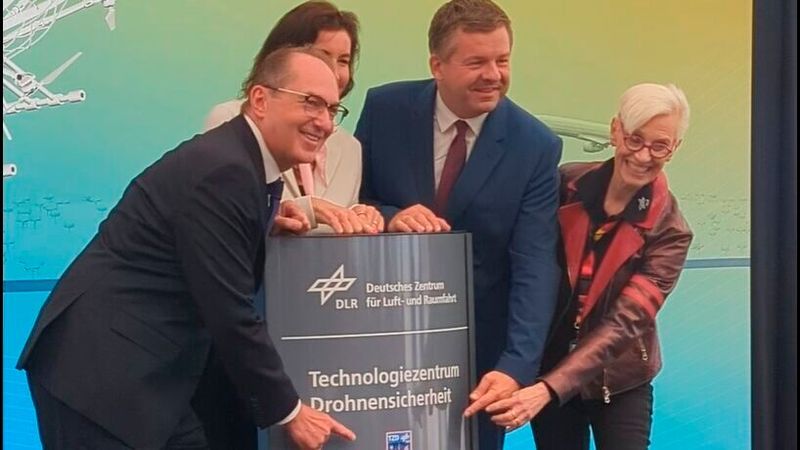
Federal Minister of the Interior Alexander Dobrindt, Federal Minister of Research Dorothee Bär, Sven Schulze, Prime Minister of Saxony-Anhalt, and Prof. Dr.-Ing. Anke Kaysser-Pyzalla, Chairwoman of the DLR Executive Board, ceremonially inaugurated the Drone Security Technology Center at Magdeburg-Cochstedt Airport on 18 August 2026.
(Source: Stefanie Eckardt)
Sad but true: disruptions to air traffic caused by drones have almost become part of everyday life. The figures also confirm this: in 2025 alone, 116 significant drone incidents were recorded at 25 commercial airports. The estimated economic damage amounts to at least 60 million euros (approx. 70 million USD). How vulnerable Germany is was underscored by the attempted attack with an explosive drone on Leipzig Airport on August 4, 2026. A danger that is well-known, as Federal Minister of the Interior Alexander Dobrindt explained at the ceremonial opening of the new Drone Security Technology Center in Cochstedt: "We have known since before Leipzig that we are threatened by drones. Hybrid attacks aim to defeat us politically and economically. Whoever targets and hits Germany is hitting all of Europe." To counter the "shadow war of the 21st century," "joint efforts, which we as the federal and state governments are undertaking," are necessary.
An important achievement of these joint efforts was inaugurated on August 18, 2026—the new Drone Security Technology Center at the German Aerospace Center (DLR) site at Magdeburg-Cochstedt Airport. Located about 35 kilometers (approx. 22 miles) south-southwest of the Saxony-Anhalt capital Magdeburg, the Cochstedt Airport was built in 1957 and converted into a commercial airport in 1994. In 2019, the airport was sold to the DLR, which uses it as a real-world laboratory for drones and a research airport. In 2021, the DLR opened a "National Testing Center for Unmanned Aerial Systems" there; since 2022, takeoffs and landings for smaller aircraft within the framework of visual flight operations have also been possible upon prior registration.
This makes the site ideally suited for conducting research in real-world operations, as Dorothee Bär, Federal Minister for Research, Technology, and Space, emphasised: "Here, new applications and technologies are being tested—for the economy, for authorities, and now increasingly for our security. We must all work together—the federal government alongside the states, science, industry, security agencies, and public administration—for Germany's future, a future of freedom, security, and prosperity." She described Cochstedt as a beacon for drone research from which she expects great things: "We are leaders in basic research, but we must become faster in application." This is now set to happen in Cochstedt.
Speed is a decisive factor
Speed sounds appealing to Saxony-Anhalt's Prime Minister Sven Schulze, who, as a graduate industrial engineer, has his professional roots in the automotive industry: "Compared to automotive development, the development cycles in drone technology take only a few weeks." Especially in the development of military drone technology. Because, as unfortunately seen in the Ukraine-Russia war, technology rapidly becomes obsolete due to electronic warfare tactics such as jamming or spoofing. Software adjustments, AI integrations, and modifications to FPV drones are developed, tested, and deployed to the front within 2 to 4 weeks.
Technologies for unmanned aerial systems as well as their detection and defence are evolving at a rapid pace. Therefore, the Drone Security Technology Center is expected to contribute in the future to evaluating new approaches early on, further developing them, and transferring them into practical application more quickly. A particularly important aspect is the use of drones in security-relevant situations as well as the effective defence against drone threats.
The focus is on research and development that aligns with specific operational requirements. The DLR has committed itself to realistically evaluating existing and future technologies. This includes, for example, methods for safe drone operation as well as technologies for the detection and defence against unwanted drones. Different scenarios and both current and future drone systems will be simulated and analysed under controlled conditions.
Date: 08.12.2025
Naturally, we always handle your personal data responsibly. Any personal data we receive from you is processed in accordance with applicable data protection legislation. For detailed information please see our privacy policy.
Consent to the use of data for promotional purposes
I hereby consent to Vogel Communications Group GmbH & Co. KG, Max-Planck-Str. 7-9, 97082 Würzburg including any affiliated companies according to §§ 15 et seq. AktG (hereafter: Vogel Communications Group) using my e-mail address to send editorial newsletters. A list of all affiliated companies can be found here
Newsletter content may include all products and services of any companies mentioned above, including for example specialist journals and books, events and fairs as well as event-related products and services, print and digital media offers and services such as additional (editorial) newsletters, raffles, lead campaigns, market research both online and offline, specialist webportals and e-learning offers. In case my personal telephone number has also been collected, it may be used for offers of aforementioned products, for services of the companies mentioned above, and market research purposes.
Additionally, my consent also includes the processing of my email address and telephone number for data matching for marketing purposes with select advertising partners such as LinkedIn, Google, and Meta. For this, Vogel Communications Group may transmit said data in hashed form to the advertising partners who then use said data to determine whether I am also a member of the mentioned advertising partner portals. Vogel Communications Group uses this feature for the purposes of re-targeting (up-selling, cross-selling, and customer loyalty), generating so-called look-alike audiences for acquisition of new customers, and as basis for exclusion for on-going advertising campaigns. Further information can be found in section “data matching for marketing purposes”.
In case I access protected data on Internet portals of Vogel Communications Group including any affiliated companies according to §§ 15 et seq. AktG, I need to provide further data in order to register for the access to such content. In return for this free access to editorial content, my data may be used in accordance with this consent for the purposes stated here. This does not apply to data matching for marketing purposes.
Right of revocation
I understand that I can revoke my consent at will. My revocation does not change the lawfulness of data processing that was conducted based on my consent leading up to my revocation. One option to declare my revocation is to use the contact form found at https://contact.vogel.de. In case I no longer wish to receive certain newsletters, I have subscribed to, I can also click on the unsubscribe link included at the end of a newsletter. Further information regarding my right of revocation and the implementation of it as well as the consequences of my revocation can be found in the data protection declaration, section editorial newsletter.
Close gaps, expand expertise
Furthermore, the DLR aims to work with companies to further develop new approaches more quickly, thereby specifically closing existing capability gaps. To this end, the DLR provides extensive expertise, development environments, simulators, as well as laboratory and testing infrastructures. "Through transfer and knowledge exchange, new approaches from research can be quickly and purposefully converted into usable solutions," emphasised Prof. Dr.-Ing. Anke Kaysser-Pyzalla, Chairwoman of the DLR Executive Board. "Because we do not develop technology for its own sake—we solve specific problems and meet specific needs. Research must have an impact—especially when it comes to the security of our country."
The offering is aimed at companies of various sizes—from start-ups to established manufacturers. They can develop, test, and demonstrate technologies together with the center. At the same time, the requirements of future users are meant to be incorporated into development as early as possible.
Even outside such projects, authorities and companies can use the infrastructure of the technology center for tests and demonstrations. Representatives of authorities can also participate in projects, through internships, or within the framework of qualification programs.
Drone development at the DLR site in Braunschweig
In addition to Cochstedt, the DLR site in Braunschweig (Germany) is also part of the Technology Center. In the Lower Saxony city, a laboratory is located where drones and related technologies are developed and tested before being trialed under real-world conditions in Cochstedt. Braunschweig, for instance, features a drone cage with a base area of 1,500 square meters and also offers space for setups such as obstacles or landing pads. A net is stretched over steel beams to ensure that the drones do not leave the test environment. (se)




:quality(80)/p7i.vogel.de/wcms/36/7a/367adfa7fa6186160e10fafd2b403eb3/0134084456v1.jpeg "After Elon Musk has so far been rather reserved about a merger of Tesla and SpaceX that has been discussed for some time, it is now likely becoming more concrete—at least it seems so... (Source: Tesla)")
:quality(80)/p7i.vogel.de/wcms/d5/08/d508987ea0ae62aefdaa155f9bbd71af/military-material-soldier-2533669-1920x1079v1.jpeg "LinkedIn’s Top Startups 2026 ranking highlights Germany’s emerging companies, with AI, defence technology and energy innovation featuring prominently. (Source: Military_Material on Pixabay)")
:quality(80)/p7i.vogel.de/wcms/c9/8d/c98daffbad4087fc5338d2ddc0909e40/japan-pr-9-1680x944v1.png "(Source: Thales)")
:quality(80)/p7i.vogel.de/wcms/df/26/df26de98f6069219d5e044b50fae40a8/s960-ddc-official-20261015-286-068-960x540v1.jpeg "Minister for Defence Readiness and Industry, Luke Pollard and German State Secretary for Armament, Innovation and Cyber, Jens Plötner (from left to right). (Source: GOV.UK)")
:quality(80)/p7i.vogel.de/wcms/1e/05/1e05d4b35c5b6fae825d9ad2f852df33/rotor-clip-advanced-vision-inspection-1920x1079v1.jpeg "(Source: Rotor Clip)")
:quality(80)/p7i.vogel.de/wcms/17/05/1705108734040844028c8f0f054c06e2/202079-1350x759v1.jpeg "(Source: Rheinmetall AG)")
:quality(80)/p7i.vogel.de/wcms/d3/1c/d31caf0a2300bf7762f9dfbd272f0a4e/lockheed-martin-hadrian-1920x1079v1.jpeg "Hadrian will bring innovative, highly automated machining cells to the Grand Prairie facility, operated by the world-class Lockheed Martin production workforce. (Source: Lockheed Martin Corporation)")
:quality(80)/p7i.vogel.de/wcms/74/bb/74bbce6f561e163a760f8e6acb2412b5/art-0001-titelbild-1672x940v1.png "RF output and heat rejection share the same module. Conceptual illustration of a radar array and its thermal path; not a product photograph. (Source: KI-generiert / Imagen)")
:quality(80)/p7i.vogel.de/wcms/74/34/7434bf25f22bb5ff84146fccb984bc28/0134080905v1.jpeg "GKN Aerospace and Saab have signed a long-term cooperation agreement covering the Gripen E/F propulsion system. (Source: Saab)")
:quality(80)/p7i.vogel.de/wcms/53/63/5363287e81bcc7fd8e0ce9ec17ec6b93/enbata-over-archipelagos-auraaero-1536x864v1.png "(Source: AURA AERO)")
:quality(80)/p7i.vogel.de/wcms/03/52/0352ed6450d99eefb77378b17e99bd72/art-0007-titelbild-1672x940v1.png "Reusable research vehicles make the flight-to-redesign loop possible. Conceptual illustration; no actual X-15 or Talon-A vehicle is depicted. (Source: KI-generiert / Imagen)")
:quality(80)/p7i.vogel.de/wcms/91/6b/916b895a08748965aae63dca99dbaead/20261015-en-5442891-1-1024x575v1.jpeg "(Source: Saab AB)")
:quality(80)/p7i.vogel.de/wcms/50/85/50856774ce46ad8f94f37e328ba3b6d3/ptc-frau-arbeitet-mit-model-am-pc-neben-turbine-1911x1076v1.jpeg "(Source: PTC)")
:quality(80)/p7i.vogel.de/wcms/9c/60/9c60e13e660fe6b444ec71c59b5598ce/publicdomainarchive-on-pixabay-1920x1079v1.jpeg "(Source: PublicDomainArchive on Pixabay)")
:quality(80)/p7i.vogel.de/wcms/ed/e6/ede67e479952b7bad62244697e3cd3db/aa383c9a-015c-424b-95da-d8d56156c227-1536x864v1.png "Intelic's AI-supported command-and-control system Nexus can integrate sensors and interceptor drones to counter aerial threats (Illustration). (Picture: AI generated)")
:quality(80)/p7i.vogel.de/wcms/cb/a2/cba2ecda891b2874327a30f69f773bdb/hexaforce-15-1920x1079v1.jpeg "(Source: Thales/Gauthier Chauffrut)")
:quality(80)/p7i.vogel.de/wcms/a5/ce/a5ce58d51cba9063688079379feb732d/desko-id-analyze-passkontrolle-1-1920x1079v1.jpeg "(Bild: Desko)")
:quality(80)/p7i.vogel.de/wcms/df/5c/df5cb22ae3c8e224730e3543453abf54/argus-interceptor-phantom-8-von-29-1920x1079v1.png "Argus Interceptor Phantom (Source: Argus Interception)")
:quality(80)/p7i.vogel.de/wcms/44/f8/44f8dfc31e436cc3a2d5a4c98c2ff46f/drohnenabwehr-am-kraftwerk-bei-d-mmerung-1672x940v1.png "Across Europe, governments are increasingly considering allowing operators of critical civilian infrastructure to take responsibility for actively defending their facilities against hostile drones using military-grade counter-UAV technology. (Graphic: AI generated)")
:quality(80)/p7i.vogel.de/wcms/25/1f/251f3ec674139d548928e3a2f0a0a040/airbus-1920x1079v1.jpeg "IRIS-T SLM Live Firing. (Source: Bundeswehr/ Hildemann)")
:quality(80)/p7i.vogel.de/wcms/90/a8/90a849f0023f11d1eb642eb4751a0321/bild2-h-c3-a4nel-ict-20truck-20and-20trailer-20parts-4320x2429v1.jpeg "Product information is visible at all times and retrieval of items
is confirmed by employees directly on the display of the Hänel MP 14 N
controller. (Source: René Marks)")
:quality(80)/p7i.vogel.de/wcms/4e/ca/4ecaa39f247490eded591b652c33aee3/thilmann-hcp-web-20kleiner-20ausschnitt-1442x811v1.jpeg "Entering the defence market can be challenging for start-ups, says HCP Sense CEO Ansgar Thilmann. (Picture: HCP Sense)")
:quality(80)/p7i.vogel.de/wcms/7a/51/7a511b80041d3f1335f3a5aa56fe75da/delivery-7022432-1280-1280x720v1.png "(Source: Mohamed_hassan)")
:quality(80)/p7i.vogel.de/wcms/f9/2f/f92f1ef8c739c34c70d99f7b0997621b/stra007-20--20cover-20image-5472x3076v1.jpeg "(Source: Stratasys)")
:quality(80)/p7i.vogel.de/wcms/ec/a9/eca9062ccbe4b042f8515846340410d8/aerospace-and-defence-stairways-platforms-and-much-morev1.jpeg "Modular constructions enable flexible modification. That applies to larger structures such as stairways and platforms, too. And that means aerospace and defence companies can reconfigure their maintenance platforms fast (itemitem)")
:quality(80)/p7i.vogel.de/wcms/30/2a/302a7b5723ad38fbde812fd3a468ad04/safety-on-stairways-in-industry-key-considerationsv1.jpeg "Stairways and platforms are used widely in maintenance and assembly areas in the aerospace and defence sectors. (Source: item)")
:quality(80)/p7i.vogel.de/wcms/f3/4e/f34ed744bb30817d3432c7ad522e6f30/engine-1v1.jpeg "Engineering with aluminium profiles really can be this easy – the item Engineeringtool and its smart functions help you save valuable time. (Source: item)")
:fill(fff,0)/p7i.vogel.de/companies/69/6d/696de2483d115/logo--fastems-rgb-horizontal.jpeg "logo--fastems-rgb-horizontal (Fastems)")
:fill(fff,0)/images.vogel.de/vogelonline/companyimg/84700/84735/65.jpg "logo_item_rgb_neu.jpg ()")
:quality(80)/p7i.vogel.de/wcms/92/7d/927d241d8718196f4e70064ab0f9d31a/dsc04220-1440x809v1.jpeg "As part of a ceremonial conference on “whole-of-government defence and resilience”, Fraunhofer FKIE provided its first insights into research and innovation topics at its new institute site in Leipzig. Prof. Dr Christoph Igel, Deputy Director of Fraunhofer FKIE and network spokesperson for the Saxon research network “Innovation in Integrated Security and Sustainability” (I2SN), opened the conference. (Source: Fraunhofer FKIE/Jörg Riethausen)")
:quality(80)/p7i.vogel.de/wcms/c2/4f/c24fcb0b6f2bdf01f06c2c27973dc774/0132916289v1.jpeg "With this unmanned flight system, a novel reconnaissance drone, the Lower Saxony company Aerodata aims to help combat drone attacks in Germany more effectively ... (Source: Aerodata)")