Launched as the “air combat system of the future”, the Franco‑German FCAS project now appears to be on the brink of collapse. A leadership dispute between the defence firms Dassault and Airbus, together with divergent requirements for a next‑generation fighter, have made the ambitious €100‑billion programme increasingly unlikely to succeed.
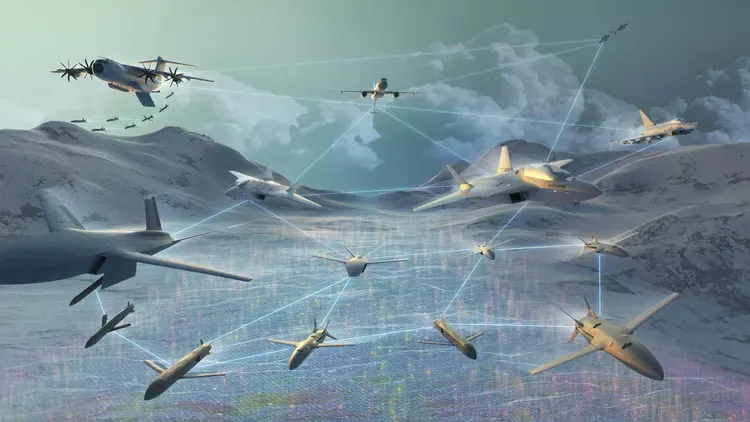
(Source: Airbus)
FCAS stands for Future Combat Air System. The concept was to include drones and novel communications systems as part of a future air combat ecosystem. It was planned as the backbone of Franco‑German air defence from the 2040s onwards. A stealth‑equipped manned fighter was intended to replace the Eurofighter Typhoon in the German Air Force and the Rafale in the French Air Force in the long term. The fighter would have been supported by drones linked together in a data cloud.
Project milestones so far
France’s President Emmanuel Macron and then‑Chancellor Angela Merkel (CDU) launched the project at a Franco‑German ministerial council in 2017. Two years later Spain announced its participation. Since 2023 Belgium has held a kind of observer status.
The second phase was due to begin in 2026, with a flyable demonstrator to be developed by 2029. However, the companies involved have long been at odds over responsibilities and leadership claims.
Dassault insists on control
Under the current agreements, France, Germany and Spain were each to fund one third of FCAS development. In France Dassault Aviation would lead, in Germany Airbus and in Spain Indra.
Dassault chief Éric Trappier insists his company should take a leadership role in FCAS and receive a substantially larger share of the development work. He points to his firm’s experience in building combat aircraft — expertise Airbus, as a civil aircraft manufacturer, does not possess. Granting Dassault a greater role would upset the previously negotiated distribution of tasks.
Divergent requirements for a modern fighter
The French Air Force has different requirements from the German Air Force. French jets are expected to operate from aircraft carriers and be capable of delivering nuclear weapons, whereas the German Air Force requires a fast air superiority fighter. It is therefore increasingly likely that Germany and France will each develop their own fighter derived from a common platform. Defence politicians view this as militarily sensible.
Where does the German government stand?
Chancellor Friedrich Merz (CDU) for some time insisted on the original arrangements with France and Spain. In February, however, he publicly questioned the project for the first time, citing the differing requirements for a modern combat aircraft. He said Paris wanted to build a machine tailored solely to its own needs. “If we cannot resolve this, then we cannot sustain the project,” Merz said.
What is Macron’s position?
Following Merz’s comments, the French president declared he remained “committed to FCAS’s success”. “Given the strategic challenges for our Europe, it would be incomprehensible if industrial differences could not be overcome,” Macron stressed. Yet he has also not ruled out the possibility that the project could fail.
In the dispute over leadership of FCAS, the governments in Berlin and Paris at the end of March tasked two defence executives with one last attempt to broker a solution. No official results have yet been published.
According to Handelsblatt, the French side warned of a potential victory by the Rassemblement National in next year’s presidential election. The French right‑wing populists have said they would end cooperative defence programmes if they come to power. France also reportedly threatened again to abandon the joint tank project MGCS should FCAS not continue.
Volker Mayer‑Lay (CDU), the Bundestag rapporteur for the Air Force from the ruling coalition, told AFP that “with the mediation now coming to an end, all options have been exhausted.” If mediation produces no viable result, “FCAS in its present configuration has failed,” he said.
What alternatives exist?
Industry sources say Airbus is willing to develop a national fighter. It is also conceivable that Germany could join forces with Sweden to develop such an aircraft.
Meanwhile the UK, Italy and Japan are pursuing their own stealth fighter under the Global Combat Air Programme (GCAP) or the Tempest banner, intended to replace Japan’s F‑2 fighters and the British and Italian Typhoons. Germany could join that project; however, since it is already well advanced, it is unclear how much influence Germany could still exert.
Date: 08.12.2025
Naturally, we always handle your personal data responsibly. Any personal data we receive from you is processed in accordance with applicable data protection legislation. For detailed information please see our privacy policy.
Consent to the use of data for promotional purposes
I hereby consent to Vogel Communications Group GmbH & Co. KG, Max-Planck-Str. 7-9, 97082 Würzburg including any affiliated companies according to §§ 15 et seq. AktG (hereafter: Vogel Communications Group) using my e-mail address to send editorial newsletters. A list of all affiliated companies can be found here
Newsletter content may include all products and services of any companies mentioned above, including for example specialist journals and books, events and fairs as well as event-related products and services, print and digital media offers and services such as additional (editorial) newsletters, raffles, lead campaigns, market research both online and offline, specialist webportals and e-learning offers. In case my personal telephone number has also been collected, it may be used for offers of aforementioned products, for services of the companies mentioned above, and market research purposes.
Additionally, my consent also includes the processing of my email address and telephone number for data matching for marketing purposes with select advertising partners such as LinkedIn, Google, and Meta. For this, Vogel Communications Group may transmit said data in hashed form to the advertising partners who then use said data to determine whether I am also a member of the mentioned advertising partner portals. Vogel Communications Group uses this feature for the purposes of re-targeting (up-selling, cross-selling, and customer loyalty), generating so-called look-alike audiences for acquisition of new customers, and as basis for exclusion for on-going advertising campaigns. Further information can be found in section “data matching for marketing purposes”.
In case I access protected data on Internet portals of Vogel Communications Group including any affiliated companies according to §§ 15 et seq. AktG, I need to provide further data in order to register for the access to such content. In return for this free access to editorial content, my data may be used in accordance with this consent for the purposes stated here. This does not apply to data matching for marketing purposes.
Right of revocation
I understand that I can revoke my consent at will. My revocation does not change the lawfulness of data processing that was conducted based on my consent leading up to my revocation. One option to declare my revocation is to use the contact form found at https://contact.vogel.de. In case I no longer wish to receive certain newsletters, I have subscribed to, I can also click on the unsubscribe link included at the end of a newsletter. Further information regarding my right of revocation and the implementation of it as well as the consequences of my revocation can be found in the data protection declaration, section editorial newsletter.




:quality(80)/p7i.vogel.de/wcms/63/0f/630f214fa760b8c7f7f7d6279d411fcf/d4ceed8f2f52-2026-08-30-hydef-06--msc4159-1200x675v1.webp "(Source: Diehl Defence)")
:quality(80)/p7i.vogel.de/wcms/4e/7d/4e7d38327c6c928b403249e3c24a2a7c/0132118791v1.jpeg "Porsche Holding SE announces that it is once again turning to rocket technology. Following its investment in Isar Aerospace, the company is now acquiring a stake in a U.S. firm ... (Source: Porsche)")
:quality(80)/p7i.vogel.de/wcms/1c/08/1c082bbd9d05b634168b617aa26fcdcf/safe-bg-lv-ro-v1-991x557v1.png "(Source: European Commission)")
:quality(80)/p7i.vogel.de/wcms/7c/52/7c52df7b44f70e6ccd2ee0f5356e3847/aravalli-safran-1164x655v1.webp "The Aravalli will be a new engine in the 3,500 to 4,000 shp power class to be developed by SAFHAL. (Source: Safran)")
:quality(80)/p7i.vogel.de/wcms/cd/a9/cda92b173afa9d0b455d4f11b281c9ea/0094-to-image--capstone-cdr-1440x810v1.png "(Source: Terran Orbital)")
:quality(80)/p7i.vogel.de/wcms/e0/45/e045bc5414d7263fb308bdd501b5fcc1/0133113962v1.jpeg "The HSWL 354 is the transmission used, for example, in the Leopard 2 main battle tank. Renk manufactures this system and is now preparing to significantly increase its cycle time. As a result, Renk is placing greater emphasis on the military sector as a customer ... (Source: Renk)")
:quality(80)/p7i.vogel.de/wcms/a1/5c/a15c2aeba563d5bc3e11fb879b21eb2c/0132989650v1.jpeg "FSS, the flexible clamping system for varying free-form surfaces, is designed for the aerospace industry and other sectors. (Source: Römheld GmbH Friedrichshütte)")
:quality(80)/p7i.vogel.de/wcms/9f/07/9f070dc919a95a6f19bcc1848e9f3089/image-2000-c966ec423c4d86c3769c5a9f1fff7655-1920x1079v1.jpeg "The Idefix rover is firmly mounted between the landing legs of the MMX spacecraft. Despite its compact size, Idefix essentially contains all the elements of a fully fledged scientific rover, yet thanks to its highly integrated design, it has a mass of only 25 kilograms (approx. 55 pounds). (Source: DLR (CC BY-NC-ND 3.0))")
:quality(80)/p7i.vogel.de/wcms/05/49/054906f874b94ef08b09d5920396e27d/airbus-h160-1920x1079v1.jpeg "Airbus H160 (Source: Airbus)")
:quality(80)/p7i.vogel.de/wcms/8f/13/8f1333ed6f357fe8a8edda50c332c6e5/0133173457v1.jpeg "The high-altitude unmanned platform HAP-alpha during its first flight at low altitude over Magdeburg/Cochstedt Airport. (Source: DLR)")
:quality(80)/p7i.vogel.de/wcms/0b/93/0b93fcec0baed888b9964be24db64d30/nato-demonstrates-kelluu-repmus-1-1920x1079v1.png "Representatives from Finnish company Kelluu test their unmanned airship at REPMUS 2025. The drills included tests of technology developed through NATO’s Defence Innovation Accelerator for the North Atlantic (DIANA). (Source: NATO)")
:quality(80)/p7i.vogel.de/wcms/1f/d2/1fd2bffd9eeae597b0e2d2e3cad0adf0/20260828-en-5416166-1-1920x1079v1.jpeg "(Source: Saab)")
:quality(80)/p7i.vogel.de/wcms/64/1b/641b6474b2a614cde7730c89ef2a3015/2026-09-09-rheinmetall-veroeffentlicht-battlesuite-schnittstellen-e8c18194-1225x690v1.jpeg "Rheinmetall’s Battlesuite provides a modular digital platform for connecting and integrating sensors, hardware and software components. (Source: Rheinmetall AG)")
:quality(80)/p7i.vogel.de/wcms/6f/fe/6ffef325e7f233cc3521943158eb1ebd/0132763535v1.jpeg "Two companies are planning to establish, for the first time in 2027, an optical laser communication link directly between a satellite in low Earth orbit (LEO) and a re-entering spacecraft. (Source: ATMOS Space Cargo)")
:quality(80)/p7i.vogel.de/wcms/b2/6a/b26a277a3578fc2956b2c30d3b3b0146/0132928076v1.jpeg "Compact and standardised: CubeSats enable cost-effective space missions and are increasingly serving as a platform for testing new technologies—from sensors and communications to innovative power systems. (Source: City Labs, Inc.)")
:quality(80)/p7i.vogel.de/wcms/6d/f2/6df225601e1f8d4f9d07d53fd527cdb9/epc7050-7065-7066-pr-graphic-clean-1500x844v1.jpeg "(Source: EPC Space)")
:quality(80)/p7i.vogel.de/wcms/32/9d/329dc4b23c6991a51542b36c0dda73f1/chatgpt-image-10--sept--2026-12-15-43-1671x940v1.png "(Source: Portags / hensec secure solutions / Translated with AI)")
:quality(80)/p7i.vogel.de/wcms/d2/a9/d2a93832b5593fb89e110d893b347a13/199682-1920x1079v1.jpeg "Rheinmetall’s Skyspotter system provides electro-optical detection and tracking for comprehensive drone surveillance at civilian airfields. (Source: Rheinmetall AG)")
:quality(80)/p7i.vogel.de/wcms/1f/70/1f7071213ee84ae05050ab71e000a3f8/s960-blakcro-3-960x540v1.png "Blakcro T1 multi-role trike in flight. (Source: GOV.UK)")
:quality(80)/p7i.vogel.de/wcms/9d/d6/9dd61fd68817d5639462786c7a286fb4/jr3-demo-900-900x506v1.jpeg "Lockheed Martin’s Joint Reduced Range Rocket (JR3) successfully launches during a flight test at Yuma Proving Ground, Arizona. (Source: Lockheed Martin)")
:quality(80)/p7i.vogel.de/wcms/90/a8/90a849f0023f11d1eb642eb4751a0321/bild2-h-c3-a4nel-ict-20truck-20and-20trailer-20parts-4320x2429v1.jpeg "Product information is visible at all times and retrieval of items
is confirmed by employees directly on the display of the Hänel MP 14 N
controller. (Source: René Marks)")
:quality(80)/p7i.vogel.de/wcms/4e/ca/4ecaa39f247490eded591b652c33aee3/thilmann-hcp-web-20kleiner-20ausschnitt-1442x811v1.jpeg "Entering the defence market can be challenging for start-ups, says HCP Sense CEO Ansgar Thilmann. (Picture: HCP Sense)")
:quality(80)/p7i.vogel.de/wcms/7a/51/7a511b80041d3f1335f3a5aa56fe75da/delivery-7022432-1280-1280x720v1.png "(Source: Mohamed_hassan)")
:quality(80)/p7i.vogel.de/wcms/f9/2f/f92f1ef8c739c34c70d99f7b0997621b/stra007-20--20cover-20image-5472x3076v1.jpeg "(Source: Stratasys)")
:quality(80)/p7i.vogel.de/wcms/ec/a9/eca9062ccbe4b042f8515846340410d8/aerospace-and-defence-stairways-platforms-and-much-morev1.jpeg "Modular constructions enable flexible modification. That applies to larger structures such as stairways and platforms, too. And that means aerospace and defence companies can reconfigure their maintenance platforms fast (itemitem)")
:quality(80)/p7i.vogel.de/wcms/30/2a/302a7b5723ad38fbde812fd3a468ad04/safety-on-stairways-in-industry-key-considerationsv1.jpeg "Stairways and platforms are used widely in maintenance and assembly areas in the aerospace and defence sectors. (Source: item)")
:quality(80)/p7i.vogel.de/wcms/f3/4e/f34ed744bb30817d3432c7ad522e6f30/engine-1v1.jpeg "Engineering with aluminium profiles really can be this easy – the item Engineeringtool and its smart functions help you save valuable time. (Source: item)")
:fill(fff,0)/p7i.vogel.de/companies/69/6d/696de2483d115/logo--fastems-rgb-horizontal.jpeg "logo--fastems-rgb-horizontal (Fastems)")
:fill(fff,0)/images.vogel.de/vogelonline/companyimg/84700/84735/65.jpg "logo_item_rgb_neu.jpg ()")
:quality(80)/p7i.vogel.de/wcms/19/72/19724f03fde7fa583b2cad4f661a3b26/futuristisches-20flugzeug-1080x608v1.png "futuristisches-20flugzeug-1080x608v1 (Source: AI-generated)")
:quality(80)/p7i.vogel.de/wcms/a8/4d/a84d8108e6339a00b3bf6c71c831e9f3/chatgpt-20image-208--20juni-202026-2c-2018-32-57-1672x940v1.png "FCAS Falls Apart – The Joint Fighter Aircraft is dead, but combat cloud and drone projects are set to continue. (Picture: AI-generated)")
:quality(80)/p7i.vogel.de/wcms/e5/e3/e5e3afb54a2f4ff9d177cb4c5d992981/resizev1.webp "resizev1 (Source: Airbus)")