The "ReFuelEU Aviation" regulation aims to reduce aviation CO₂ emissions by 60 percent by 2050 (compared to 1990). Additive manufacturing could help achieve this goal...
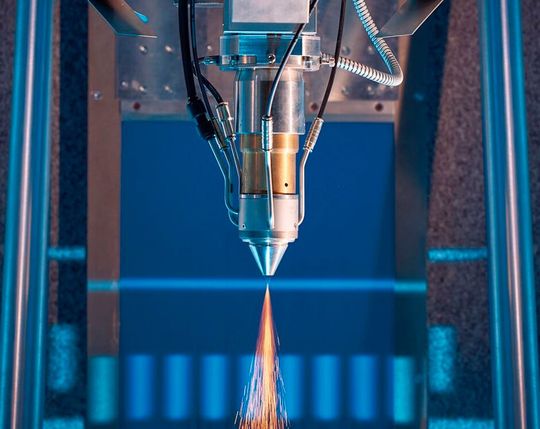
At the Fraunhofer ILT, two projects are examining how aviation and aerospace can be made more sustainable through 3D printing. A new laser deposition welding process monitors the additive manufacturing process, detects anomalies, and addresses them immediately.
(Image: Fraunhofer-ILT / R. Baumgart)
In addition to the "ReFuelEU Aviation" regulation, a comprehensive EU Space Law (EUSL) is also being added, as noted by researchers from the Fraunhofer Institute for Laser Technology (ILT) in Aachen. This law sets out rules for sustainability in the space industry of the future. How can aerospace be made greener in light of these regulations? This is also questioned by Luke Schüller, a research associate at Fraunhofer ILT, in a specialist article. He can immediately provide an answer: "Strict political climate protection requirements can be implemented with lightweight construction, 3D printing, and new high-performance materials." A key role is played by the LPBF process (Laser Powder Bed Fusion), in which metal powder is fused layer by layer using a laser beam to create 3D components. This method allows for the production of complex and high-strength components that are not only lighter but also more resilient than components manufactured using conventional methods—important characteristics for the aviation of tomorrow.
With special powder into the hydrogen future
The ILT is therefore working on corresponding developments within the framework of the research initiative "TIRIKA" (Technologies and Innovations for Resource-Conserving, Climate-Friendly Aviation) of the Federal Ministry for Economic Affairs and Climate Action. The focus is on the use of hydrogen as an emission-free energy carrier for aviation. The researchers have already developed special powders with material manufacturers that meet the high demands of the aviation industry for hydrogen propulsion. The experts have developed LPBF processes for commercial materials and have finally validated them through various testing procedures in collaboration with partners. Through targeted process adjustments in the LPBF process, a relative component density of over 99.5 percent and a high build rate of over 100 cm³/h can be achieved, emphasizes Schüller. The aluminum alloys are not only light and strong but also resistant to contact with hydrogen, which can lead to embrittlement and material fatigue at high temperatures and pressures. This makes them ideal candidates for use in future emissions-free hydrogen engines. Additionally, the new powders, due to the uniform laser melting process, allow for the production of complex geometries and functional structures that are not feasible with casting or forging.
This is how 0.4-millimeter particles are detected electronically
During the additive manufacturing process, precise sensors detect artifacts as small as 0.4 millimeters directly in the powder bed as well as in the melting process. This information allows time-consuming downstream inspections to be minimized and production efficiency to be significantly increased. Advanced processes, however, influence not only the quality and efficiency of production but also its environmental impact. The ILT relies on Life Cycle Assessment (LCA) when evaluating the environmental friendliness of additive manufacturing processes. This assessment considers the entire life cycle of a component, spanning from raw material procurement through manufacturing to recycling. Life Cycle Assessment is regarded as an indispensable tool for evaluating the environmental impacts of products throughout their entire life cycle and for identifying sustainable alternatives. To effectively implement this comprehensive process, it is crucial to obtain high-quality and meaningful data early in the digital value chain.
A complex process scores in three ways
Three important arguments support this initially very laborious path! First, data enables a faster and more efficient design of start-up processes for new products. Second, they support the assessment of quality, cost, energy, and resource consumption in the production cycle. And third, they contribute to greater transparency in the processes and thus to the optimization of the entire manufacturing chain, as the project partners enumerate. The results of the LCA analyses showed that despite the comparatively high energy consumption during the LPBF process, the ecological footprint of additive manufacturing is significantly smaller than that of conventional production methods. 3D printing is therefore particularly suitable for the repair of components because it minimizes material losses and conserves resources.
Date: 08.12.2025
Naturally, we always handle your personal data responsibly. Any personal data we receive from you is processed in accordance with applicable data protection legislation. For detailed information please see our privacy policy.
Consent to the use of data for promotional purposes
I hereby consent to Vogel Communications Group GmbH & Co. KG, Max-Planck-Str. 7-9, 97082 Würzburg including any affiliated companies according to §§ 15 et seq. AktG (hereafter: Vogel Communications Group) using my e-mail address to send editorial newsletters. A list of all affiliated companies can be found here
Newsletter content may include all products and services of any companies mentioned above, including for example specialist journals and books, events and fairs as well as event-related products and services, print and digital media offers and services such as additional (editorial) newsletters, raffles, lead campaigns, market research both online and offline, specialist webportals and e-learning offers. In case my personal telephone number has also been collected, it may be used for offers of aforementioned products, for services of the companies mentioned above, and market research purposes.
Additionally, my consent also includes the processing of my email address and telephone number for data matching for marketing purposes with select advertising partners such as LinkedIn, Google, and Meta. For this, Vogel Communications Group may transmit said data in hashed form to the advertising partners who then use said data to determine whether I am also a member of the mentioned advertising partner portals. Vogel Communications Group uses this feature for the purposes of re-targeting (up-selling, cross-selling, and customer loyalty), generating so-called look-alike audiences for acquisition of new customers, and as basis for exclusion for on-going advertising campaigns. Further information can be found in section “data matching for marketing purposes”.
In case I access protected data on Internet portals of Vogel Communications Group including any affiliated companies according to §§ 15 et seq. AktG, I need to provide further data in order to register for the access to such content. In return for this free access to editorial content, my data may be used in accordance with this consent for the purposes stated here. This does not apply to data matching for marketing purposes.
Right of revocation
I understand that I can revoke my consent at will. My revocation does not change the lawfulness of data processing that was conducted based on my consent leading up to my revocation. One option to declare my revocation is to use the contact form found at https://contact.vogel.de. In case I no longer wish to receive certain newsletters, I have subscribed to, I can also click on the unsubscribe link included at the end of a newsletter. Further information regarding my right of revocation and the implementation of it as well as the consequences of my revocation can be found in the data protection declaration, section editorial newsletter.



:quality(80)/p7i.vogel.de/wcms/a5/e5/a5e5eecaf9443bd94c6833c158d7cced/20260924-en-5431005-1-640x360v1.jpeg "(Source: Saab AB)")
:quality(80)/p7i.vogel.de/wcms/e0/e7/e0e7bcd804912a34cd152be69b05a70f/rfa-esaboost-uk-1024x682-1024x576v1.jpeg "(Source: RFA)")
:quality(80)/p7i.vogel.de/wcms/32/42/3242e8a344e00905a0d8c7fc465178a9/defence-industry-sruvey-990x557v1.jpeg "(Source: European Commission)")
:quality(80)/p7i.vogel.de/wcms/b2/db/b2db599d38480ee76cb0632c3c5ac968/sentinel3c-sadeploymentthalesaleniaspace-alban-pichon-3-1680x944v1.jpeg "(Source: Thales Alenia Space, A. Pichon)")
:quality(80)/p7i.vogel.de/wcms/4a/9f/4a9f831c424718e98ef3cf6b10b4dc3e/hot-fire-jarvisv1-900x506v1.jpeg "Developed in record time: A “JARVIS-class” jet engine capable of up to 100 pounds of thrust. It was designed in a four-week sprint using generative AI and established CAD/CAE tools. (Source: MIT)")
:quality(80)/p7i.vogel.de/wcms/13/12/1312059ec82b1ed9e3df080350b29dc4/f46335bf-a581-4786-959f-4a0e9a74aed1-1671x940v1.png "Military radar architecture using distributed RF sensor nodes connected through optical fibre to central processing. (Source: KI-generiert / Gemini)")
:quality(80)/p7i.vogel.de/wcms/0a/14/0a1495d9b570ae32a5a7cc748b9a3c60/st-hannover-035-1920x1079v1-999x562v1.jpeg "Fastening technology you can experience first-hand—visitors to Schraubtec in Bochum (Germany) can see it for themselves at the Ruhr Congress on September 30, 2026. (Source: PHOTOVISION-DH GmbH)")
:quality(80)/p7i.vogel.de/wcms/cd/a9/cda92b173afa9d0b455d4f11b281c9ea/0094-to-image--capstone-cdr-1440x810v1.png "(Source: Terran Orbital)")
:quality(80)/p7i.vogel.de/wcms/fc/1c/fc1c256ca19020e8f6e398fdb9ba2025/thedigitalartist-ai-generated-8061336-1920x1080v1.jpeg "(Source: Pete Linforth on Pixabay)")
:quality(80)/p7i.vogel.de/wcms/5a/5a/5a5a0a2b51dbe1dd52c884b951db8cc7/aefa03eb-8efe-4b02-b8dd-824db7ae426f-1672x940v1.png "(Source: KI-generiert / Gemini)")
:quality(80)/p7i.vogel.de/wcms/1f/c2/1fc25ec2bd47a47b4617766e40033de2/image-2000-74f03b8e935a22580e24d2b05fe5ca3c-1920x1079v1.jpeg "The Airbus A310 ZERO-G stands ready for the 47th DLR parabolic flight campaign. It took place in Bordeaux from 7 to 18 September 2026. A total of twelve experiments from the fields of biology, physics, technology and materials science were on board. (Source: DLR (CC BY-NC-ND 3.0))")
:quality(80)/p7i.vogel.de/wcms/22/81/22812f686fd6ec1235f02392a3df56b9/34370ad9-163a-5941-9825-9c87a0e50000-1920x1079v1.png "Ariane 6 A64 flight VA267 with 32 satellites for Amazon LEO constellation, ready for launch at Europe's Spaceport in Kourou, French Guiana on 12 February 2026. (Source: ESA—M. Pédoussaut)")
:quality(80)/p7i.vogel.de/wcms/cb/a2/cba2ecda891b2874327a30f69f773bdb/hexaforce-15-1920x1079v1.jpeg "(Source: Thales/Gauthier Chauffrut)")
:quality(80)/p7i.vogel.de/wcms/9d/8a/9d8addea8cc4e6f7a4793563ca397f2a/ai-im-milit-r-1672x940v1.png "(Source: KI-generiert / Gemini)")
:quality(80)/p7i.vogel.de/wcms/7f/5f/7f5fba2c729ec3aa256bf1a18d74529b/ai-chip-1672x940v1.png "(Source: KI-generiert / Gemini)")
:quality(80)/p7i.vogel.de/wcms/64/1b/641b6474b2a614cde7730c89ef2a3015/2026-09-09-rheinmetall-veroeffentlicht-battlesuite-schnittstellen-e8c18194-1225x690v1.jpeg "Rheinmetall’s Battlesuite provides a modular digital platform for connecting and integrating sensors, hardware and software components. (Source: Rheinmetall AG)")
:quality(80)/p7i.vogel.de/wcms/f1/c8/f1c88c768ba87dd2d71c708945c7df78/s960-applied-intuition04-960x640-960x540v1.jpeg "(Source: UK Government)")
:quality(80)/p7i.vogel.de/wcms/ef/1e/ef1eaddf8243b9c30cbfef17a4151def/aufmacherv1.jpeg "What works against drones—and what should be kept in mind when it comes to chain-based defence strategies? (Source: Mattheck)")
:quality(80)/p7i.vogel.de/wcms/b1/f0/b1f00d146f272acbef15ea82996259de/s960-halo-shield-2-960x540v1.png "Quell’s SkySpyke system in action (Source: UK Government)")
:quality(80)/p7i.vogel.de/wcms/2b/3d/2b3d42b7dc255aaaf5cadf57dab47d3b/43907b28dda9-sky-striker-demo-2-1600x899v1.webp "Diehl Defence and Elbit Systems demonstrate the capabilities of the SkyStriker loitering munition during a live demonstration. (Source: Diehl Defence)")
:quality(80)/p7i.vogel.de/wcms/90/a8/90a849f0023f11d1eb642eb4751a0321/bild2-h-c3-a4nel-ict-20truck-20and-20trailer-20parts-4320x2429v1.jpeg "Product information is visible at all times and retrieval of items
is confirmed by employees directly on the display of the Hänel MP 14 N
controller. (Source: René Marks)")
:quality(80)/p7i.vogel.de/wcms/4e/ca/4ecaa39f247490eded591b652c33aee3/thilmann-hcp-web-20kleiner-20ausschnitt-1442x811v1.jpeg "Entering the defence market can be challenging for start-ups, says HCP Sense CEO Ansgar Thilmann. (Picture: HCP Sense)")
:quality(80)/p7i.vogel.de/wcms/7a/51/7a511b80041d3f1335f3a5aa56fe75da/delivery-7022432-1280-1280x720v1.png "(Source: Mohamed_hassan)")
:quality(80)/p7i.vogel.de/wcms/f9/2f/f92f1ef8c739c34c70d99f7b0997621b/stra007-20--20cover-20image-5472x3076v1.jpeg "(Source: Stratasys)")
:quality(80)/p7i.vogel.de/wcms/ec/a9/eca9062ccbe4b042f8515846340410d8/aerospace-and-defence-stairways-platforms-and-much-morev1.jpeg "Modular constructions enable flexible modification. That applies to larger structures such as stairways and platforms, too. And that means aerospace and defence companies can reconfigure their maintenance platforms fast (itemitem)")
:quality(80)/p7i.vogel.de/wcms/30/2a/302a7b5723ad38fbde812fd3a468ad04/safety-on-stairways-in-industry-key-considerationsv1.jpeg "Stairways and platforms are used widely in maintenance and assembly areas in the aerospace and defence sectors. (Source: item)")
:quality(80)/p7i.vogel.de/wcms/f3/4e/f34ed744bb30817d3432c7ad522e6f30/engine-1v1.jpeg "Engineering with aluminium profiles really can be this easy – the item Engineeringtool and its smart functions help you save valuable time. (Source: item)")
:fill(fff,0)/p7i.vogel.de/companies/69/6d/696de2483d115/logo--fastems-rgb-horizontal.jpeg "logo--fastems-rgb-horizontal (Fastems)")
:fill(fff,0)/images.vogel.de/vogelonline/companyimg/84700/84735/65.jpg "logo_item_rgb_neu.jpg ()")
:quality(80)/p7i.vogel.de/wcms/c5/ae/c5ae900d260c64049119f9027cac5c2e/0128777874v1.jpeg "The aerospace industry is one of the beneficiaries of current developments in metallic 3D printing. Small quantities and the high complexity of lightweight, high-performance components are already among the strengths of additive manufacturing. (Image:Fraunhofer-ILT)")
:quality(80)/p7i.vogel.de/wcms/d4/3d/d43d1899dfcd204dad88c676b169a54b/0126930817v1.jpeg "In the new 3D printer, two different materials are simultaneously melted by the laser on the rotating platform. (Image:Michael Tucker / ETH Zurich)")