Rheinmetall is advancing autonomous military logistics with the InterRoC VII research project, combining AI, sensor fusion, and interoperable vehicle technologies for future convoy operations.
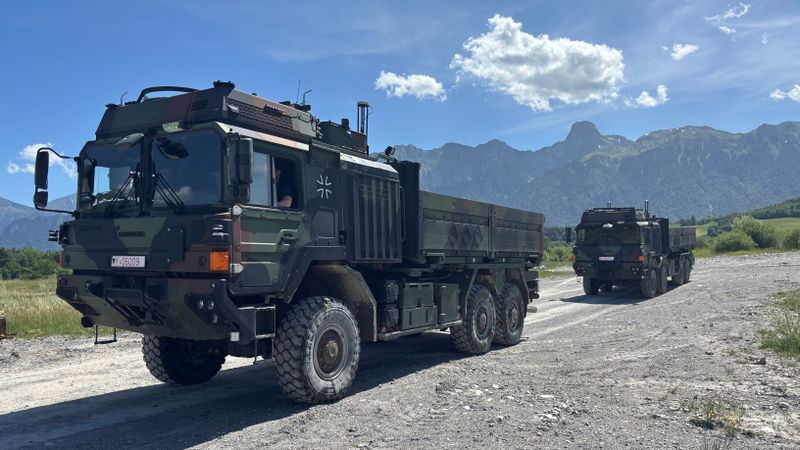
On behalf of the BAAAINBw, Rheinmetall has assumed overall responsibility for the autonomous convoy research project InterRoC VII.
(Source: Rheinmetall AG)
On behalf of the German Federal Office of Bundeswehr Equipment, Information Technology and In Service Support (BAAINBw), Rheinmetall MAN Military Vehicles GmbH has assumed overall responsibility for the InterRoC VII (Interoperable Robotic Convoy VII) research project. With this initiative, Rheinmetall is further strengthening its leading role in the development of highly automated military logistics systems and reaching another milestone on the path towards the digitalisation of military mobility.
The transfer of project responsibility took place shortly before Rheinmetall achieved the highest ranking in the convoy scenarios category at the European Land Robot Trial (ELROB) 2026, held at the Thun military training area in Switzerland. The international testing event is regarded as Europe's leading demonstration platform for unmanned ground systems and autonomous robotics under realistic military operating conditions. There, Rheinmetall demonstrated the capabilities of its autonomous logistics solutions in demanding convoy and transport scenarios.
Advancing interoperable convoys
InterRoC VII is the latest element in the successful Interoperable Robotic Convoy (InterRoC) research programme. The project's objective is to further develop highly automated convoy operations and evaluate interoperable vehicle formations in which different vehicle platforms operate autonomously and safely together.
The focus is on advanced automation, perception, and decision making functions together with robust path planning for heterogeneous vehicle formations. The technologies under development are designed to ensure reliable and safe convoy operations even under demanding military conditions.
HX vehicle family forms the technological foundation
For InterRoC VII, Rheinmetall MAN Military Vehicles is using vehicles from its proven HX family. These military logistics vehicles are equipped with Rheinmetall's modular PATH sensor kit and a drive by wire kit that is deeply integrated into the vehicle architecture.
The open system architecture allows the continuous integration of additional sensors, AI based software functions, and mission specific algorithms. This creates a scalable autonomy platform that can be flexibly adapted to future requirements and new operational scenarios.
Autonomous operation without satellite navigation
The systems developed within the research project build on Rheinmetall's many years of research and development in autonomous ground vehicles. The company already possesses technologies that enable automated driving functions both on roads and across off road terrain under real military operating conditions.
A key technological focus is the ability to operate safely in so called GNSS denied environments. Even if satellite based navigation is disrupted or unavailable, the vehicles can reliably perceive their surroundings, determine their position, and autonomously conduct complex convoy operations. This capability provides a decisive operational advantage, particularly in electronically contested operational environments.
Demonstration during ELROB 2026
The capabilities demonstrated during ELROB 2026 are being directly incorporated into the InterRoC VII research project. The event in Thun provided an opportunity to demonstrate autonomous convoy operations, sensor fusion, and decision making algorithms under realistic conditions while further developing these technologies together with international armed forces, research institutions, and industrial partners. The insights gained form an important foundation for the project's next stages of development.
Contributing to the digitalisation of military logistics
With InterRoC VII, Rheinmetall reinforces its position as one of the world's leading providers of autonomous military logistics systems. Automating logistics transport tasks increases the efficiency of military supply chains, improves operational endurance, and simultaneously reduces risks to deployed personnel. The research project therefore makes a significant contribution to the digitalisation of the battlefield and to the development of the next generation of connected military mobility solutions for the Bundeswehr.
Future cooperation with technology specialists
AI as the key to expanding capabilities: As part of the work on object classification and environmental perception, Driveblocks GmbH is making a significant contribution as a specialised software and AI provider. Driveblocks develops modular autonomy and perception systems that combine sensor fusion from cameras and LiDAR data with AI based models. The objective is robust real time detection of complex three dimensional environments, including object classification, free space detection, terrain recognition, and safety critical decision support.
Date: 08.12.2025
Naturally, we always handle your personal data responsibly. Any personal data we receive from you is processed in accordance with applicable data protection legislation. For detailed information please see our privacy policy.
Consent to the use of data for promotional purposes
I hereby consent to Vogel Communications Group GmbH & Co. KG, Max-Planck-Str. 7-9, 97082 Würzburg including any affiliated companies according to §§ 15 et seq. AktG (hereafter: Vogel Communications Group) using my e-mail address to send editorial newsletters. A list of all affiliated companies can be found here
Newsletter content may include all products and services of any companies mentioned above, including for example specialist journals and books, events and fairs as well as event-related products and services, print and digital media offers and services such as additional (editorial) newsletters, raffles, lead campaigns, market research both online and offline, specialist webportals and e-learning offers. In case my personal telephone number has also been collected, it may be used for offers of aforementioned products, for services of the companies mentioned above, and market research purposes.
Additionally, my consent also includes the processing of my email address and telephone number for data matching for marketing purposes with select advertising partners such as LinkedIn, Google, and Meta. For this, Vogel Communications Group may transmit said data in hashed form to the advertising partners who then use said data to determine whether I am also a member of the mentioned advertising partner portals. Vogel Communications Group uses this feature for the purposes of re-targeting (up-selling, cross-selling, and customer loyalty), generating so-called look-alike audiences for acquisition of new customers, and as basis for exclusion for on-going advertising campaigns. Further information can be found in section “data matching for marketing purposes”.
In case I access protected data on Internet portals of Vogel Communications Group including any affiliated companies according to §§ 15 et seq. AktG, I need to provide further data in order to register for the access to such content. In return for this free access to editorial content, my data may be used in accordance with this consent for the purposes stated here. This does not apply to data matching for marketing purposes.
Right of revocation
I understand that I can revoke my consent at will. My revocation does not change the lawfulness of data processing that was conducted based on my consent leading up to my revocation. One option to declare my revocation is to use the contact form found at https://contact.vogel.de. In case I no longer wish to receive certain newsletters, I have subscribed to, I can also click on the unsubscribe link included at the end of a newsletter. Further information regarding my right of revocation and the implementation of it as well as the consequences of my revocation can be found in the data protection declaration, section editorial newsletter.
The technology is specifically designed for demanding off road environments such as unstructured terrain, vegetation, dust, snow, and changing visibility conditions. It is already being deployed in applications across the defence, construction, and agricultural sectors.




:quality(80)/p7i.vogel.de/wcms/36/7a/367adfa7fa6186160e10fafd2b403eb3/0134084456v1.jpeg "After Elon Musk has so far been rather reserved about a merger of Tesla and SpaceX that has been discussed for some time, it is now likely becoming more concrete—at least it seems so... (Source: Tesla)")
:quality(80)/p7i.vogel.de/wcms/d5/08/d508987ea0ae62aefdaa155f9bbd71af/military-material-soldier-2533669-1920x1079v1.jpeg "LinkedIn’s Top Startups 2026 ranking highlights Germany’s emerging companies, with AI, defence technology and energy innovation featuring prominently. (Source: Military_Material on Pixabay)")
:quality(80)/p7i.vogel.de/wcms/c9/8d/c98daffbad4087fc5338d2ddc0909e40/japan-pr-9-1680x944v1.png "(Source: Thales)")
:quality(80)/p7i.vogel.de/wcms/df/26/df26de98f6069219d5e044b50fae40a8/s960-ddc-official-20261015-286-068-960x540v1.jpeg "Minister for Defence Readiness and Industry, Luke Pollard and German State Secretary for Armament, Innovation and Cyber, Jens Plötner (from left to right). (Source: GOV.UK)")
:quality(80)/p7i.vogel.de/wcms/1e/05/1e05d4b35c5b6fae825d9ad2f852df33/rotor-clip-advanced-vision-inspection-1920x1079v1.jpeg "(Source: Rotor Clip)")
:quality(80)/p7i.vogel.de/wcms/17/05/1705108734040844028c8f0f054c06e2/202079-1350x759v1.jpeg "(Source: Rheinmetall AG)")
:quality(80)/p7i.vogel.de/wcms/d3/1c/d31caf0a2300bf7762f9dfbd272f0a4e/lockheed-martin-hadrian-1920x1079v1.jpeg "Hadrian will bring innovative, highly automated machining cells to the Grand Prairie facility, operated by the world-class Lockheed Martin production workforce. (Source: Lockheed Martin Corporation)")
:quality(80)/p7i.vogel.de/wcms/74/bb/74bbce6f561e163a760f8e6acb2412b5/art-0001-titelbild-1672x940v1.png "RF output and heat rejection share the same module. Conceptual illustration of a radar array and its thermal path; not a product photograph. (Source: KI-generiert / Imagen)")
:quality(80)/p7i.vogel.de/wcms/74/34/7434bf25f22bb5ff84146fccb984bc28/0134080905v1.jpeg "GKN Aerospace and Saab have signed a long-term cooperation agreement covering the Gripen E/F propulsion system. (Source: Saab)")
:quality(80)/p7i.vogel.de/wcms/53/63/5363287e81bcc7fd8e0ce9ec17ec6b93/enbata-over-archipelagos-auraaero-1536x864v1.png "(Source: AURA AERO)")
:quality(80)/p7i.vogel.de/wcms/03/52/0352ed6450d99eefb77378b17e99bd72/art-0007-titelbild-1672x940v1.png "Reusable research vehicles make the flight-to-redesign loop possible. Conceptual illustration; no actual X-15 or Talon-A vehicle is depicted. (Source: KI-generiert / Imagen)")
:quality(80)/p7i.vogel.de/wcms/91/6b/916b895a08748965aae63dca99dbaead/20261015-en-5442891-1-1024x575v1.jpeg "(Source: Saab AB)")
:quality(80)/p7i.vogel.de/wcms/50/85/50856774ce46ad8f94f37e328ba3b6d3/ptc-frau-arbeitet-mit-model-am-pc-neben-turbine-1911x1076v1.jpeg "(Source: PTC)")
:quality(80)/p7i.vogel.de/wcms/9c/60/9c60e13e660fe6b444ec71c59b5598ce/publicdomainarchive-on-pixabay-1920x1079v1.jpeg "(Source: PublicDomainArchive on Pixabay)")
:quality(80)/p7i.vogel.de/wcms/ed/e6/ede67e479952b7bad62244697e3cd3db/aa383c9a-015c-424b-95da-d8d56156c227-1536x864v1.png "Intelic's AI-supported command-and-control system Nexus can integrate sensors and interceptor drones to counter aerial threats (Illustration). (Picture: AI generated)")
:quality(80)/p7i.vogel.de/wcms/cb/a2/cba2ecda891b2874327a30f69f773bdb/hexaforce-15-1920x1079v1.jpeg "(Source: Thales/Gauthier Chauffrut)")
:quality(80)/p7i.vogel.de/wcms/a5/ce/a5ce58d51cba9063688079379feb732d/desko-id-analyze-passkontrolle-1-1920x1079v1.jpeg "(Bild: Desko)")
:quality(80)/p7i.vogel.de/wcms/df/5c/df5cb22ae3c8e224730e3543453abf54/argus-interceptor-phantom-8-von-29-1920x1079v1.png "Argus Interceptor Phantom (Source: Argus Interception)")
:quality(80)/p7i.vogel.de/wcms/44/f8/44f8dfc31e436cc3a2d5a4c98c2ff46f/drohnenabwehr-am-kraftwerk-bei-d-mmerung-1672x940v1.png "Across Europe, governments are increasingly considering allowing operators of critical civilian infrastructure to take responsibility for actively defending their facilities against hostile drones using military-grade counter-UAV technology. (Graphic: AI generated)")
:quality(80)/p7i.vogel.de/wcms/25/1f/251f3ec674139d548928e3a2f0a0a040/airbus-1920x1079v1.jpeg "IRIS-T SLM Live Firing. (Source: Bundeswehr/ Hildemann)")
:quality(80)/p7i.vogel.de/wcms/90/a8/90a849f0023f11d1eb642eb4751a0321/bild2-h-c3-a4nel-ict-20truck-20and-20trailer-20parts-4320x2429v1.jpeg "Product information is visible at all times and retrieval of items
is confirmed by employees directly on the display of the Hänel MP 14 N
controller. (Source: René Marks)")
:quality(80)/p7i.vogel.de/wcms/4e/ca/4ecaa39f247490eded591b652c33aee3/thilmann-hcp-web-20kleiner-20ausschnitt-1442x811v1.jpeg "Entering the defence market can be challenging for start-ups, says HCP Sense CEO Ansgar Thilmann. (Picture: HCP Sense)")
:quality(80)/p7i.vogel.de/wcms/7a/51/7a511b80041d3f1335f3a5aa56fe75da/delivery-7022432-1280-1280x720v1.png "(Source: Mohamed_hassan)")
:quality(80)/p7i.vogel.de/wcms/f9/2f/f92f1ef8c739c34c70d99f7b0997621b/stra007-20--20cover-20image-5472x3076v1.jpeg "(Source: Stratasys)")
:quality(80)/p7i.vogel.de/wcms/ec/a9/eca9062ccbe4b042f8515846340410d8/aerospace-and-defence-stairways-platforms-and-much-morev1.jpeg "Modular constructions enable flexible modification. That applies to larger structures such as stairways and platforms, too. And that means aerospace and defence companies can reconfigure their maintenance platforms fast (itemitem)")
:quality(80)/p7i.vogel.de/wcms/30/2a/302a7b5723ad38fbde812fd3a468ad04/safety-on-stairways-in-industry-key-considerationsv1.jpeg "Stairways and platforms are used widely in maintenance and assembly areas in the aerospace and defence sectors. (Source: item)")
:quality(80)/p7i.vogel.de/wcms/f3/4e/f34ed744bb30817d3432c7ad522e6f30/engine-1v1.jpeg "Engineering with aluminium profiles really can be this easy – the item Engineeringtool and its smart functions help you save valuable time. (Source: item)")
:fill(fff,0)/p7i.vogel.de/companies/69/6d/696de2483d115/logo--fastems-rgb-horizontal.jpeg "logo--fastems-rgb-horizontal (Fastems)")
:fill(fff,0)/images.vogel.de/vogelonline/companyimg/84700/84735/65.jpg "logo_item_rgb_neu.jpg ()")
:quality(80)/p7i.vogel.de/wcms/08/d3/08d3b5c8ffadc86ca661637fec03342b/qs-newpost-featured-daimler-1113x626v1.jpeg "Quantum Systems and Daimler Truck build autonomous convoys for the German Armed Forces. (Source: Quantum-Systems GmbH)")
:quality(80)/p7i.vogel.de/wcms/24/be/24be8a3901cb87d32228f51ef73af239/fkie-radioaktives-material-schnell-und-praezise-lokalisieren-bild-1-1600x899v1.jpeg "fkie-radioaktives-material-schnell-und-praezise-lokalisieren-bild-1-1600x899v1 (Copyright: Fraunhofer FKIE)")