



:quality(80)/p7i.vogel.de/wcms/b8/a1/b8a140d8496d6744a5fd8573e048bce4/esanasa-k--barber-1920x1080v1.jpeg "NASA’s SpaceX Crew-12 Splashdown (NHQ202610080008) ESA (European Space Agency) astronaut Sophie Adenot is helped out of the SpaceX Dragon Freedom spacecraft onboard the SpaceX recovery ship SHANNON after she and NASA astronauts Jessica Meir, Jack Hathaway, and Roscosmos cosmonaut Andrey Fedyaev landed in the Pacific Ocean off the coast of Los Angeles, Calif., Thursday, Oct. 8, 2026. (Source: ESA/ NASA–Keegan Barber)")
:quality(80)/p7i.vogel.de/wcms/70/78/7078a1bd268b3f708eab4913d2cd0b92/eudex-ganter-messe-essen-1920x1080v1.jpeg "An unmanned aerial platform from Maddos, autonomous ground robots from ARX Robotics and standard parts from Ganter illustrate the breadth of Eudex. Ganter supplies components for positioning, fastening and locking in defence applications too. (Source: Messe Essen)")
:quality(80)/p7i.vogel.de/wcms/a2/da/a2da4222cfe9ec14a72668ce4100fd5b/pistorius-experimentalserie-land-1400x787v1.jpeg "Defence Minister Boris Pistorius at the Land Experimental Series at the Bergen military training area in Lower Saxony. Innovative systems are being tested for their suitability for use by the troops — not in a laboratory, but out in the open. (Source: Bundeswehr/Janin Garzke)")
:quality(80)/p7i.vogel.de/wcms/ae/e3/aee34d59fdc80ce5fc6722e1107500b6/word-press-featured-image-1024x695-1024x576v1.jpeg "(Source: Bundesregierung/Tobias Koch)")
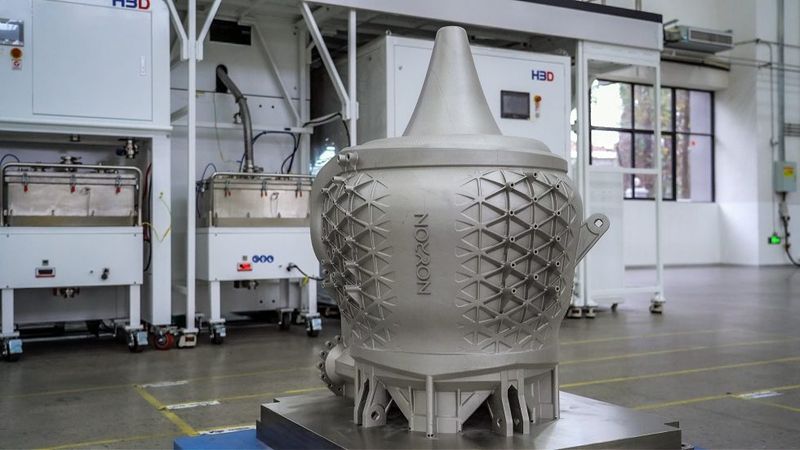
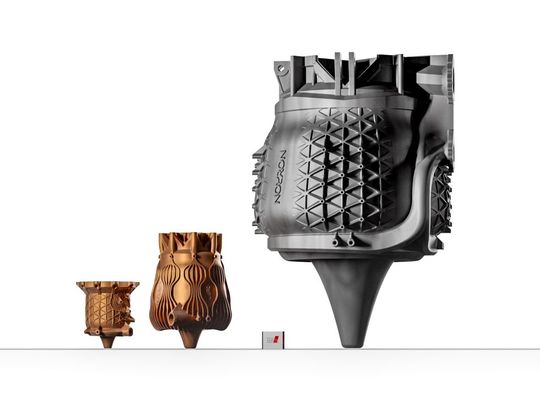
:quality(80)/p7i.vogel.de/wcms/a6/71/a6713b64fb8aee687258fcf1014ea3b5/2026-03-08-aerospike-09-980x551v1.jpeg "The engine was developed with the aid of Noyron, LEAP 71’s computer-aided design model. Noyron uses basic physical principles, engineering logic, and manufacturing specifications to design autonomously without human intervention. (Source: LEAP 71)")
:quality(80)/p7i.vogel.de/wcms/91/c9/91c93dbd66b08824c35643875aabe61f/bild1-1245x700v1.jpeg "Two scientists in front of a vacuum chamber used for testing. (Source: Busch Group)")
:quality(80)/p7i.vogel.de/wcms/76/1d/761de63f32752dc5a9722559c527fc1f/design-ohne-titel-5-1920x1079v1.png "(Source: Analog Devices)")
:quality(80)/p7i.vogel.de/wcms/33/a7/33a7f8ac37b143e73964dad10c8aafbc/0133560493v1.jpeg "Benedikt Gundling and Tobias Hannen in front of a tank component of the Ariane 6. (Source: Grob Works)")
:quality(80)/p7i.vogel.de/wcms/0c/e8/0ce8f0a9f1d56d603e7ff50f38caf7b2/abbildung-1-feierliche-er-ffnung-der-space-factory-im-esa-phi-lab-austria-1920x1079v1.jpeg "Official opening of the Space Factory at ESA Phi-Lab Austria at Vienna Airport. (Source: Vienna Airport)")
:quality(80)/p7i.vogel.de/wcms/22/f8/22f8044bacf96ce5f5c1c36a04000a34/hensec-aisvogel-seeueberwachung-1536x864v1.jpeg "aisvogel—airborne sensor platform for maritime intelligence (Source: hensec—secure solutions)")
:quality(80)/p7i.vogel.de/wcms/72/b0/72b0b2076f21d59e64cd8bdf5e9d8c57/image-1920-93a1849ed81939cb2c94fb0d76d4d72a-1920x1079v1.jpeg "Economic report on Germany as an aviation location: connectivity, competitive conditions, climate impacts and development. (Source: william87—stock.adobe.com)")
:quality(80)/p7i.vogel.de/wcms/6e/32/6e326befcb6db2834c32c9485bd3db20/hyperion-and-posidonia-satellites-1920x1079v1.png "(Source: Open Cosmos)")
:quality(80)/p7i.vogel.de/wcms/b6/6d/b66d11215bcdb8e107ca626e6cfd3643/tungart7-future-9045696-1920x1079v1.jpeg "Transparent and controllable AI architectures can support crisis management by making data sources, reasoning processes and uncertainties visible to human decision-makers. (Source: Tung Lam on Pixabay)")
:quality(80)/p7i.vogel.de/wcms/ed/e6/ede67e479952b7bad62244697e3cd3db/aa383c9a-015c-424b-95da-d8d56156c227-1536x864v1.png "Intelic's AI-supported command-and-control system Nexus can integrate sensors and interceptor drones to counter aerial threats (Illustration). (Picture: AI generated)")
:quality(80)/p7i.vogel.de/wcms/cb/a2/cba2ecda891b2874327a30f69f773bdb/hexaforce-15-1920x1079v1.jpeg "(Source: Thales/Gauthier Chauffrut)")
:quality(80)/p7i.vogel.de/wcms/9d/8a/9d8addea8cc4e6f7a4793563ca397f2a/ai-im-milit-r-1672x940v1.png "(Source: KI-generiert / Gemini)")
:quality(80)/p7i.vogel.de/wcms/d4/8e/d48e922adf87b94ec8356eabaaebc9b8/morfius-image-resize-jpg-pc-adaptive-full-medium-900x506v1.jpeg "Lockheed Martin’s MORFIUS® X-Rotor is the first of its kind counter-drone system. (Source: Lockheed Martin)")
:quality(80)/p7i.vogel.de/wcms/93/7e/937e0958ca684b36382d6025daa4880e/2026-10-06-rheinmetall-integriert-human-machine-teaming-in-gepanzerte-fahrzeuge-media-06a35258-query-2x-c641d5e7-1910x1075v1.jpeg "Rheinmetall and Breaker are integrating Human-Machine Teaming into the Boxer Combat Reconnaissance Vehicle, enabling crews to control teams of autonomous systems by voice command. (Source: Rheinmetall AG)")
:quality(80)/p7i.vogel.de/wcms/d4/8a/d48a3c3d03168bfd49db0a816aa308ae/image1-39-1294x728v1.png "(Source: Department of National Defence (DND))")
:quality(80)/p7i.vogel.de/wcms/54/d5/54d5207a3dab5139de6761523319cf84/airbus-delivers-first-batch-of-new-eutelsat-s-oneweb-satellites-23-1920x1079v1.jpeg "(Source: Airbus Defence and Space SAS 2026)")
:quality(80)/p7i.vogel.de/wcms/90/a8/90a849f0023f11d1eb642eb4751a0321/bild2-h-c3-a4nel-ict-20truck-20and-20trailer-20parts-4320x2429v1.jpeg "Product information is visible at all times and retrieval of items
is confirmed by employees directly on the display of the Hänel MP 14 N
controller. (Source: René Marks)")
:quality(80)/p7i.vogel.de/wcms/4e/ca/4ecaa39f247490eded591b652c33aee3/thilmann-hcp-web-20kleiner-20ausschnitt-1442x811v1.jpeg "Entering the defence market can be challenging for start-ups, says HCP Sense CEO Ansgar Thilmann. (Picture: HCP Sense)")
:quality(80)/p7i.vogel.de/wcms/7a/51/7a511b80041d3f1335f3a5aa56fe75da/delivery-7022432-1280-1280x720v1.png "(Source: Mohamed_hassan)")
:quality(80)/p7i.vogel.de/wcms/f9/2f/f92f1ef8c739c34c70d99f7b0997621b/stra007-20--20cover-20image-5472x3076v1.jpeg "(Source: Stratasys)")
:quality(80)/p7i.vogel.de/wcms/ec/a9/eca9062ccbe4b042f8515846340410d8/aerospace-and-defence-stairways-platforms-and-much-morev1.jpeg "Modular constructions enable flexible modification. That applies to larger structures such as stairways and platforms, too. And that means aerospace and defence companies can reconfigure their maintenance platforms fast (itemitem)")
:quality(80)/p7i.vogel.de/wcms/30/2a/302a7b5723ad38fbde812fd3a468ad04/safety-on-stairways-in-industry-key-considerationsv1.jpeg "Stairways and platforms are used widely in maintenance and assembly areas in the aerospace and defence sectors. (Source: item)")
:quality(80)/p7i.vogel.de/wcms/f3/4e/f34ed744bb30817d3432c7ad522e6f30/engine-1v1.jpeg "Engineering with aluminium profiles really can be this easy – the item Engineeringtool and its smart functions help you save valuable time. (Source: item)")
:fill(fff,0)/p7i.vogel.de/companies/69/6d/696de2483d115/logo--fastems-rgb-horizontal.jpeg "logo--fastems-rgb-horizontal (Fastems)")
:fill(fff,0)/images.vogel.de/vogelonline/companyimg/84700/84735/65.jpg "logo_item_rgb_neu.jpg ()")
Date: 08.12.2025
Naturally, we always handle your personal data responsibly. Any personal data we receive from you is processed in accordance with applicable data protection legislation. For detailed information please see our privacy policy.
Consent to the use of data for promotional purposes
I hereby consent to Vogel Communications Group GmbH & Co. KG, Max-Planck-Str. 7-9, 97082 Würzburg including any affiliated companies according to §§ 15 et seq. AktG (hereafter: Vogel Communications Group) using my e-mail address to send editorial newsletters. A list of all affiliated companies can be found here
Newsletter content may include all products and services of any companies mentioned above, including for example specialist journals and books, events and fairs as well as event-related products and services, print and digital media offers and services such as additional (editorial) newsletters, raffles, lead campaigns, market research both online and offline, specialist webportals and e-learning offers. In case my personal telephone number has also been collected, it may be used for offers of aforementioned products, for services of the companies mentioned above, and market research purposes.
Additionally, my consent also includes the processing of my email address and telephone number for data matching for marketing purposes with select advertising partners such as LinkedIn, Google, and Meta. For this, Vogel Communications Group may transmit said data in hashed form to the advertising partners who then use said data to determine whether I am also a member of the mentioned advertising partner portals. Vogel Communications Group uses this feature for the purposes of re-targeting (up-selling, cross-selling, and customer loyalty), generating so-called look-alike audiences for acquisition of new customers, and as basis for exclusion for on-going advertising campaigns. Further information can be found in section “data matching for marketing purposes”.
In case I access protected data on Internet portals of Vogel Communications Group including any affiliated companies according to §§ 15 et seq. AktG, I need to provide further data in order to register for the access to such content. In return for this free access to editorial content, my data may be used in accordance with this consent for the purposes stated here. This does not apply to data matching for marketing purposes.
Right of revocation
I understand that I can revoke my consent at will. My revocation does not change the lawfulness of data processing that was conducted based on my consent leading up to my revocation. One option to declare my revocation is to use the contact form found at https://contact.vogel.de. In case I no longer wish to receive certain newsletters, I have subscribed to, I can also click on the unsubscribe link included at the end of a newsletter. Further information regarding my right of revocation and the implementation of it as well as the consequences of my revocation can be found in the data protection declaration, section editorial newsletter.
:quality(80)/p7i.vogel.de/wcms/14/df/14df0a79499a68f3f51c2ef27da13e29/0128179719v1.jpeg "Nikon SLM Solutions printed the component from Inconel 718, an aerospace nickel alloy specifically designed to withstand the immense thermal loads and pressures of a full-flow staged combustion cycle (FFSC). (Image:Nikon SLM)")
:quality(80)/p7i.vogel.de/wcms/c1/80/c180ace150e784fb8ff6af01cd569c18/202201-006-600-cern-1920x1080v1.png "202201-006-600-cern-1920x1080v1 (Picture: CERN)")