A new joint economic report by the German Aerospace Center (DLR) and the German Aviation Association (BDL) examines key developments in Germany’s aviation sector, highlighting changes in connectivity, passenger flows, regulatory conditions, costs and the transition towards climate-compatible air transport.
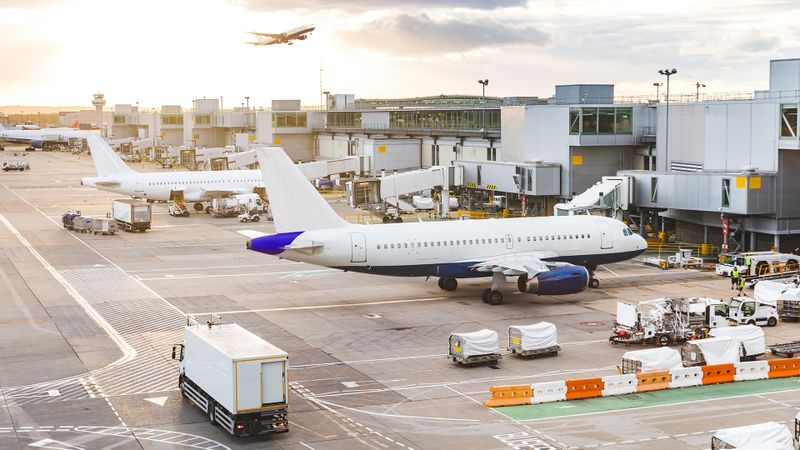
Economic report on Germany as an aviation location: connectivity, competitive conditions, climate impacts and development.
(Source: william87—stock.adobe.com)
Global air transport recovered from the coronavirus crisis faster than widely expected. At the same time, however, significant structural changes are becoming apparent in the aviation market, particularly in Europe. This is one of the findings of the economic report on Germany as an aviation location, published jointly for the first time by the German Aerospace Center (DLR) and the German Aviation Association (BDL). Among other things, the report examines developments in connectivity and passenger flows as well as challenges relating to climate protection and regulation.
The report, presented in Berlin on 5 October 2026, analyses key developments in air transport over a period of up to 15 years and assesses their significance for the economy, mobility, climate protection and international competitiveness.
“Air transport is a central component of an efficient mobility system and indispensable for Germany as an internationally competitive economic location. With the joint economic report, we are creating a fact-based foundation for discussions about the future of our aviation sector. This makes it possible to assess long-term developments on the basis of reliable data,” says Dr Markus Fischer, DLR Executive Board Member for Aeronautics.
“The report shows a gradual detachment of Germany from international air transport,” adds Dr Joachim Lang, Director General of the BDL. “Connections are being discontinued, while passengers and freight are shifting to hubs outside Europe. For an export-oriented nation, this is a problem for its economic location. And nothing is gained for the climate if emissions are merely shifted elsewhere. We need lower location costs and a level playing field in climate protection regulations so that all competitors operate under the same conditions.”
Number of destinations declined after the coronavirus crisis
According to the report’s analysis, the air transport sector and aviation industry generated gross value added of €58.4 billion (approx. 65 billion USD) in Germany in 2024. Around 536,900 jobs were directly or indirectly associated with aviation. The sector therefore accounted for approximately 1.3 per cent of Germany’s gross domestic product.
The report shows that the quality of air transport connections is crucial for internationally connected economic centres. Factors assessed include destinations that can be reached directly, flight frequencies and services at the beginning and end of the day for business travel—meaning connections in the early morning and late evening.
Between 2014 and 2019, the number of directly accessible destinations at many German airports increased more rapidly than the number of departures. The route network therefore became broader. Following the coronavirus pandemic, airports developed differently. In 2024, Frankfurt was once again approximately at pre-crisis levels in terms of direct destinations, while the other major locations remained significantly below 2019 levels, with up to around 18 per cent fewer destination airports. Flight frequencies and early-morning and late-evening connections also declined in many locations.
Hubs outside the EU used more frequently
Since 2010, significant shifts in transfer patterns and hubs have emerged in intercontinental air transport. Passenger flows on long-haul routes are increasingly shifting towards hubs outside the European Union, particularly in Turkey and the Gulf region. Between Germany and destinations in East and Southeast Asia, the share of connections via non-EU hubs increased from 34 to 54 per cent. At the same time, the share of connecting journeys via German hubs fell from 56 to 36 per cent. Similar developments can be seen in air transport to Africa.
Average ticket prices doubled between 2010 and 2024
The report also examines the impact of regulatory conditions and rising location costs. State-imposed costs for air transport in Germany—including aviation tax, aviation security charges and air navigation charges—have more than doubled at their peak since 2019. On average, they now amount to around €30 (approx. 33 USD) per passenger.
Date: 08.12.2025
Naturally, we always handle your personal data responsibly. Any personal data we receive from you is processed in accordance with applicable data protection legislation. For detailed information please see our privacy policy.
Consent to the use of data for promotional purposes
I hereby consent to Vogel Communications Group GmbH & Co. KG, Max-Planck-Str. 7-9, 97082 Würzburg including any affiliated companies according to §§ 15 et seq. AktG (hereafter: Vogel Communications Group) using my e-mail address to send editorial newsletters. A list of all affiliated companies can be found here
Newsletter content may include all products and services of any companies mentioned above, including for example specialist journals and books, events and fairs as well as event-related products and services, print and digital media offers and services such as additional (editorial) newsletters, raffles, lead campaigns, market research both online and offline, specialist webportals and e-learning offers. In case my personal telephone number has also been collected, it may be used for offers of aforementioned products, for services of the companies mentioned above, and market research purposes.
Additionally, my consent also includes the processing of my email address and telephone number for data matching for marketing purposes with select advertising partners such as LinkedIn, Google, and Meta. For this, Vogel Communications Group may transmit said data in hashed form to the advertising partners who then use said data to determine whether I am also a member of the mentioned advertising partner portals. Vogel Communications Group uses this feature for the purposes of re-targeting (up-selling, cross-selling, and customer loyalty), generating so-called look-alike audiences for acquisition of new customers, and as basis for exclusion for on-going advertising campaigns. Further information can be found in section “data matching for marketing purposes”.
In case I access protected data on Internet portals of Vogel Communications Group including any affiliated companies according to §§ 15 et seq. AktG, I need to provide further data in order to register for the access to such content. In return for this free access to editorial content, my data may be used in accordance with this consent for the purposes stated here. This does not apply to data matching for marketing purposes.
Right of revocation
I understand that I can revoke my consent at will. My revocation does not change the lawfulness of data processing that was conducted based on my consent leading up to my revocation. One option to declare my revocation is to use the contact form found at https://contact.vogel.de. In case I no longer wish to receive certain newsletters, I have subscribed to, I can also click on the unsubscribe link included at the end of a newsletter. Further information regarding my right of revocation and the implementation of it as well as the consequences of my revocation can be found in the data protection declaration, section editorial newsletter.
At the same time, average ticket prices for flights departing from and arriving in Germany doubled between 2010 and 2024, rising from just under €150 to around €300 (approx. 168 to around 335 USD) most recently. In addition to government charges, higher personnel and operating costs, among other factors, are contributing to this development.
The report also highlights the importance of competitively neutral regulatory conditions for climate protection. In some cases, different requirements and cost structures result in traffic flows and emissions being shifted to regions outside Europe (“carbon leakage”), without reducing global emissions.
Air traffic growth through more efficient fleet utilisation
According to DLR forecasts, the global number of air travellers will rise to 154 per cent of the pre-coronavirus level by 2034. The number of passengers is growing significantly faster than the number of flights. This is due to larger and more efficient aircraft with higher seating capacity.
Climate protection and technological development
Air transport currently accounts for around three per cent of global CO2 emissions. When non-CO2 effects such as contrails and nitrogen oxides are included, its share of global climate effects is around five per cent.
The report examines various approaches that can reduce these effects. These include more efficient aircraft, sustainable aviation fuels (SAF), optimised flight routes and the reduction of persistent contrails. Initial analyses indicate that, in individual cases, such climate effects can be reduced through adapted flight planning.
“Global demand for air transport will continue to grow. More efficient aircraft, higher load factors, sustainable fuels and optimised flight routes are key levers for combining mobility and climate protection,” says Dr Florian Linke, Director of the DLR Institute of Air Transport.




:quality(80)/p7i.vogel.de/wcms/b8/a1/b8a140d8496d6744a5fd8573e048bce4/esanasa-k--barber-1920x1080v1.jpeg "NASA’s SpaceX Crew-12 Splashdown (NHQ202610080008) ESA (European Space Agency) astronaut Sophie Adenot is helped out of the SpaceX Dragon Freedom spacecraft onboard the SpaceX recovery ship SHANNON after she and NASA astronauts Jessica Meir, Jack Hathaway, and Roscosmos cosmonaut Andrey Fedyaev landed in the Pacific Ocean off the coast of Los Angeles, Calif., Thursday, Oct. 8, 2026. (Source: ESA/ NASA–Keegan Barber)")
:quality(80)/p7i.vogel.de/wcms/70/78/7078a1bd268b3f708eab4913d2cd0b92/eudex-ganter-messe-essen-1920x1080v1.jpeg "An unmanned aerial platform from Maddos, autonomous ground robots from ARX Robotics and standard parts from Ganter illustrate the breadth of Eudex. Ganter supplies components for positioning, fastening and locking in defence applications too. (Source: Messe Essen)")
:quality(80)/p7i.vogel.de/wcms/a2/da/a2da4222cfe9ec14a72668ce4100fd5b/pistorius-experimentalserie-land-1400x787v1.jpeg "Defence Minister Boris Pistorius at the Land Experimental Series at the Bergen military training area in Lower Saxony. Innovative systems are being tested for their suitability for use by the troops — not in a laboratory, but out in the open. (Source: Bundeswehr/Janin Garzke)")
:quality(80)/p7i.vogel.de/wcms/ae/e3/aee34d59fdc80ce5fc6722e1107500b6/word-press-featured-image-1024x695-1024x576v1.jpeg "(Source: Bundesregierung/Tobias Koch)")
:quality(80)/p7i.vogel.de/wcms/a6/71/a6713b64fb8aee687258fcf1014ea3b5/2026-03-08-aerospike-09-980x551v1.jpeg "The engine was developed with the aid of Noyron, LEAP 71’s computer-aided design model. Noyron uses basic physical principles, engineering logic, and manufacturing specifications to design autonomously without human intervention. (Source: LEAP 71)")
:quality(80)/p7i.vogel.de/wcms/91/c9/91c93dbd66b08824c35643875aabe61f/bild1-1245x700v1.jpeg "Two scientists in front of a vacuum chamber used for testing. (Source: Busch Group)")
:quality(80)/p7i.vogel.de/wcms/76/1d/761de63f32752dc5a9722559c527fc1f/design-ohne-titel-5-1920x1079v1.png "(Source: Analog Devices)")
:quality(80)/p7i.vogel.de/wcms/33/a7/33a7f8ac37b143e73964dad10c8aafbc/0133560493v1.jpeg "Benedikt Gundling and Tobias Hannen in front of a tank component of the Ariane 6. (Source: Grob Works)")
:quality(80)/p7i.vogel.de/wcms/0c/e8/0ce8f0a9f1d56d603e7ff50f38caf7b2/abbildung-1-feierliche-er-ffnung-der-space-factory-im-esa-phi-lab-austria-1920x1079v1.jpeg "Official opening of the Space Factory at ESA Phi-Lab Austria at Vienna Airport. (Source: Vienna Airport)")
:quality(80)/p7i.vogel.de/wcms/22/f8/22f8044bacf96ce5f5c1c36a04000a34/hensec-aisvogel-seeueberwachung-1536x864v1.jpeg "aisvogel—airborne sensor platform for maritime intelligence (Source: hensec—secure solutions)")
:quality(80)/p7i.vogel.de/wcms/72/b0/72b0b2076f21d59e64cd8bdf5e9d8c57/image-1920-93a1849ed81939cb2c94fb0d76d4d72a-1920x1079v1.jpeg "Economic report on Germany as an aviation location: connectivity, competitive conditions, climate impacts and development. (Source: william87—stock.adobe.com)")
:quality(80)/p7i.vogel.de/wcms/6e/32/6e326befcb6db2834c32c9485bd3db20/hyperion-and-posidonia-satellites-1920x1079v1.png "(Source: Open Cosmos)")
:quality(80)/p7i.vogel.de/wcms/b6/6d/b66d11215bcdb8e107ca626e6cfd3643/tungart7-future-9045696-1920x1079v1.jpeg "Transparent and controllable AI architectures can support crisis management by making data sources, reasoning processes and uncertainties visible to human decision-makers. (Source: Tung Lam on Pixabay)")
:quality(80)/p7i.vogel.de/wcms/ed/e6/ede67e479952b7bad62244697e3cd3db/aa383c9a-015c-424b-95da-d8d56156c227-1536x864v1.png "Intelic's AI-supported command-and-control system Nexus can integrate sensors and interceptor drones to counter aerial threats (Illustration). (Picture: AI generated)")
:quality(80)/p7i.vogel.de/wcms/cb/a2/cba2ecda891b2874327a30f69f773bdb/hexaforce-15-1920x1079v1.jpeg "(Source: Thales/Gauthier Chauffrut)")
:quality(80)/p7i.vogel.de/wcms/9d/8a/9d8addea8cc4e6f7a4793563ca397f2a/ai-im-milit-r-1672x940v1.png "(Source: KI-generiert / Gemini)")
:quality(80)/p7i.vogel.de/wcms/d4/8e/d48e922adf87b94ec8356eabaaebc9b8/morfius-image-resize-jpg-pc-adaptive-full-medium-900x506v1.jpeg "Lockheed Martin’s MORFIUS® X-Rotor is the first of its kind counter-drone system. (Source: Lockheed Martin)")
:quality(80)/p7i.vogel.de/wcms/93/7e/937e0958ca684b36382d6025daa4880e/2026-10-06-rheinmetall-integriert-human-machine-teaming-in-gepanzerte-fahrzeuge-media-06a35258-query-2x-c641d5e7-1910x1075v1.jpeg "Rheinmetall and Breaker are integrating Human-Machine Teaming into the Boxer Combat Reconnaissance Vehicle, enabling crews to control teams of autonomous systems by voice command. (Source: Rheinmetall AG)")
:quality(80)/p7i.vogel.de/wcms/d4/8a/d48a3c3d03168bfd49db0a816aa308ae/image1-39-1294x728v1.png "(Source: Department of National Defence (DND))")
:quality(80)/p7i.vogel.de/wcms/54/d5/54d5207a3dab5139de6761523319cf84/airbus-delivers-first-batch-of-new-eutelsat-s-oneweb-satellites-23-1920x1079v1.jpeg "(Source: Airbus Defence and Space SAS 2026)")
:quality(80)/p7i.vogel.de/wcms/90/a8/90a849f0023f11d1eb642eb4751a0321/bild2-h-c3-a4nel-ict-20truck-20and-20trailer-20parts-4320x2429v1.jpeg "Product information is visible at all times and retrieval of items
is confirmed by employees directly on the display of the Hänel MP 14 N
controller. (Source: René Marks)")
:quality(80)/p7i.vogel.de/wcms/4e/ca/4ecaa39f247490eded591b652c33aee3/thilmann-hcp-web-20kleiner-20ausschnitt-1442x811v1.jpeg "Entering the defence market can be challenging for start-ups, says HCP Sense CEO Ansgar Thilmann. (Picture: HCP Sense)")
:quality(80)/p7i.vogel.de/wcms/7a/51/7a511b80041d3f1335f3a5aa56fe75da/delivery-7022432-1280-1280x720v1.png "(Source: Mohamed_hassan)")
:quality(80)/p7i.vogel.de/wcms/f9/2f/f92f1ef8c739c34c70d99f7b0997621b/stra007-20--20cover-20image-5472x3076v1.jpeg "(Source: Stratasys)")
:quality(80)/p7i.vogel.de/wcms/ec/a9/eca9062ccbe4b042f8515846340410d8/aerospace-and-defence-stairways-platforms-and-much-morev1.jpeg "Modular constructions enable flexible modification. That applies to larger structures such as stairways and platforms, too. And that means aerospace and defence companies can reconfigure their maintenance platforms fast (itemitem)")
:quality(80)/p7i.vogel.de/wcms/30/2a/302a7b5723ad38fbde812fd3a468ad04/safety-on-stairways-in-industry-key-considerationsv1.jpeg "Stairways and platforms are used widely in maintenance and assembly areas in the aerospace and defence sectors. (Source: item)")
:quality(80)/p7i.vogel.de/wcms/f3/4e/f34ed744bb30817d3432c7ad522e6f30/engine-1v1.jpeg "Engineering with aluminium profiles really can be this easy – the item Engineeringtool and its smart functions help you save valuable time. (Source: item)")
:fill(fff,0)/p7i.vogel.de/companies/69/6d/696de2483d115/logo--fastems-rgb-horizontal.jpeg "logo--fastems-rgb-horizontal (Fastems)")
:fill(fff,0)/images.vogel.de/vogelonline/companyimg/84700/84735/65.jpg "logo_item_rgb_neu.jpg ()")
:quality(80)/p7i.vogel.de/wcms/3b/b0/3bb036fac08ff1d93b0c0c6331c9f4b1/abu-dabhi-airports-p2366335-nr-4380x2464v1.jpeg "Abu Dhabi Airport saved 3,000 tons of CO₂ due to a digital assistance system for air-traffic controllers in the tower. (Source: Frequentis)")
:quality(80)/p7i.vogel.de/wcms/e2/13/e2132f7707f46c8af1b08393cc8c9b9f/teasers-geld2-6v1.jpeg "teasers-geld2-6v1 (Source: )")