ESA astronaut Sophie Adenot has arrived back in Europe, landing in Cologne, Germany, following her return to Earth with Crew-12 after 237 days, nearly eight months, aboard the International Space Station for her εpsilon mission.
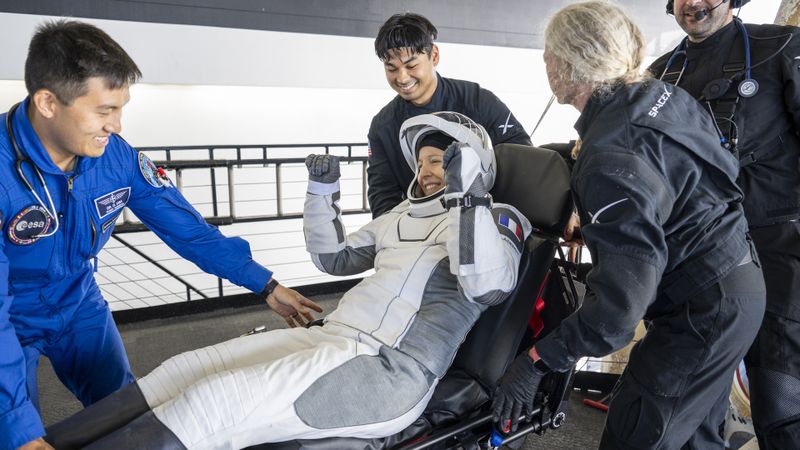
NASA’s SpaceX Crew-12 Splashdown (NHQ202610080008) ESA (European Space Agency) astronaut Sophie Adenot is helped out of the SpaceX Dragon Freedom spacecraft onboard the SpaceX recovery ship SHANNON after she and NASA astronauts Jessica Meir, Jack Hathaway, and Roscosmos cosmonaut Andrey Fedyaev landed in the Pacific Ocean off the coast of Los Angeles, Calif., Thursday, Oct. 8, 2026.
(Source: ESA/ NASA–Keegan Barber)
Sophie, together with NASA astronauts Jessica Meir and Jack Hathaway and Roscosmos cosmonaut Andrei Fedyaev, undocked on 7 October at 12:05 GMT/14:05 CEST, beginning a 27 hours and 29 minutes return journey back to Earth.
After splashdown on 8 October at 15:34 GMT/17:34 CEST and initial medical checks aboard the recovery vessel, Sophie and her crewmates travelled to shore by helicopter before boarding a NASA plane at the nearest airport. They were flown together to Ellington Field in Houston for initial post-flight activities.
On 9 October Sophie boarded a French Air and Space Force Airbus A330 MRTT Phénix bound for ESA’s European Astronaut Centre (EAC) in Cologne, Germany. She landed at 04:21 GMT / 06:21 CEST on 10 October and was warmly welcomed on the apron by family, friends, colleagues, journalists and representatives from ESA Member States.
“We are delighted to welcome back our ESA astronaut Sophie Adenot who embodied our values through her successful mission,” says Josef Aschbacher, ESA’s Director General. “The inspiration that Sophie has provided with her mission matters a great deal as we enter into such a decisive moment for Europe. Human spaceflight and exploration remain at the centre of our attention as we prepare for the Intermediate Ministerial Council Meeting in Rome in December. Our ambition is clear: Europe must secure a role in exploration commensurate with its political and economic weight.”
Next steps for Sophie
Sophie will spend the next two to three weeks adjusting to Earth’s gravity and undergoing data collections at :envihab, a German Aerospace Center (DLR) facility located next to EAC. DLR teams work closely with ESA, providing operational, medical and scientific expertise to support astronauts’ return, recovery and readaptation to life on Earth. Sophie will then continue her rehabilitation and follow-up activities with the EAC training team.
A record-breaking mission
Sophie spent a total of 237 days, 5 hours and 18 minutes in space after being launched on 13 February 2026 from Cape Canaveral Space Force Station in Florida, USA. The εpsilon mission set a new European record for the longest single spaceflight, exceeding by more than 35 days the previous record held by ESA astronaut Luca Parmitano for his Beyond mission. Crew-12 is also the longest SpaceX Dragon mission to date, surpassing the previous record of 235 days set by Crew-8.
Sophie is the second European woman, after ESA astronaut Samantha Cristoforetti, and the first French woman to conduct an Extra Vehicular Activity (EVA), or spacewalk. Sophie completed three spacewalks in 14 days, spending a total of 19 hours and 42 minutes working outside the Station. Throughout εpsilon, Sophie carried out a wide range of European experiments spanning fields from health research to materials science, biology, fluid physics, radiation physics and fundamental science.
Alongside this broad research programme, Sophie also helped to test technologies for future exploration missions, including the new European exercise device E4D and in-orbit metal 3D printing, and supported commercial research payloads.
Over the course of Expedition 74 and 75, Sophie worked on experiments and payloads for International Space Station partners, contributing to the international research programme carried out aboard the orbiting laboratory.
Sophie also spent around 218 hours working on 35 European payloads, and about 25 hours on ESA systems maintenance or upgrades in Columbus, Europe’s microgravity research facility in orbit. She completed all the εpsilon-specific experiments proposed by the French space agency CNES, and all ESA experiments that were assigned to her.
“Sophie was the first of her class to be assigned to a mission, embarking on a fast-track journey she brilliantly completed. Her return now marks the successful completion of an outstanding mission aboard the International Space Station, says Daniel Neuenschwander, ESA Director of Human and Robotic Exploration. “During εpsilon, she has contributed to an ambitious programme of science, technology and exploration, while representing Europe in an international endeavour that depends on the commitment of thousands of people. Missions like εpsilon help build the knowledge, experience and inspiration we need as Europe pursues its ambitions for exploration and discovery. We are immensely proud to welcome her back to Europe and grateful to all the teams and partners who supported her throughout this journey.”
Date: 08.12.2025
Naturally, we always handle your personal data responsibly. Any personal data we receive from you is processed in accordance with applicable data protection legislation. For detailed information please see our privacy policy.
Consent to the use of data for promotional purposes
I hereby consent to Vogel Communications Group GmbH & Co. KG, Max-Planck-Str. 7-9, 97082 Würzburg including any affiliated companies according to §§ 15 et seq. AktG (hereafter: Vogel Communications Group) using my e-mail address to send editorial newsletters. A list of all affiliated companies can be found here
Newsletter content may include all products and services of any companies mentioned above, including for example specialist journals and books, events and fairs as well as event-related products and services, print and digital media offers and services such as additional (editorial) newsletters, raffles, lead campaigns, market research both online and offline, specialist webportals and e-learning offers. In case my personal telephone number has also been collected, it may be used for offers of aforementioned products, for services of the companies mentioned above, and market research purposes.
Additionally, my consent also includes the processing of my email address and telephone number for data matching for marketing purposes with select advertising partners such as LinkedIn, Google, and Meta. For this, Vogel Communications Group may transmit said data in hashed form to the advertising partners who then use said data to determine whether I am also a member of the mentioned advertising partner portals. Vogel Communications Group uses this feature for the purposes of re-targeting (up-selling, cross-selling, and customer loyalty), generating so-called look-alike audiences for acquisition of new customers, and as basis for exclusion for on-going advertising campaigns. Further information can be found in section “data matching for marketing purposes”.
In case I access protected data on Internet portals of Vogel Communications Group including any affiliated companies according to §§ 15 et seq. AktG, I need to provide further data in order to register for the access to such content. In return for this free access to editorial content, my data may be used in accordance with this consent for the purposes stated here. This does not apply to data matching for marketing purposes.
Right of revocation
I understand that I can revoke my consent at will. My revocation does not change the lawfulness of data processing that was conducted based on my consent leading up to my revocation. One option to declare my revocation is to use the contact form found at https://contact.vogel.de. In case I no longer wish to receive certain newsletters, I have subscribed to, I can also click on the unsubscribe link included at the end of a newsletter. Further information regarding my right of revocation and the implementation of it as well as the consequences of my revocation can be found in the data protection declaration, section editorial newsletter.
Inspiration and outreach
During her free time, Sophie took more than 1,1 million social media followers along on the εpsilon adventure, sharing insights into the science experiments she worked on and life aboard the Station, as well as views of Earth from orbit and her Sunday Morning Science series, which took advantage of microgravity to demonstrate scientific concepts. Sophie’s social media content during εpsilon generated more than 403 million views.
Sophie also reached and inspired more than 290,000 students through the CNES educational experiment Chloriss conducted in about 4,000 schools, ESA’s AstroPi challenge, the International Space Station’s amateur radio programme ARISS, and a poetry contest. She also took part in more than 40 live events with schools, museums, institutions and journalists around the world.
True to the meaning behind εpsilon, Sophie’s contribution was one of many that came together to make the mission possible. Behind εpsilon’s achievements was a collective effort involving ESA teams and centres across Europe, including EAC, the Columbus Control Centre (Col-CC) and the network of User Support and Operations Centres (USOCs), alongside national space agencies such as CNES and many partners.




:quality(80)/p7i.vogel.de/wcms/b8/a1/b8a140d8496d6744a5fd8573e048bce4/esanasa-k--barber-1920x1080v1.jpeg "NASA’s SpaceX Crew-12 Splashdown (NHQ202610080008) ESA (European Space Agency) astronaut Sophie Adenot is helped out of the SpaceX Dragon Freedom spacecraft onboard the SpaceX recovery ship SHANNON after she and NASA astronauts Jessica Meir, Jack Hathaway, and Roscosmos cosmonaut Andrey Fedyaev landed in the Pacific Ocean off the coast of Los Angeles, Calif., Thursday, Oct. 8, 2026. (Source: ESA/ NASA–Keegan Barber)")
:quality(80)/p7i.vogel.de/wcms/70/78/7078a1bd268b3f708eab4913d2cd0b92/eudex-ganter-messe-essen-1920x1080v1.jpeg "An unmanned aerial platform from Maddos, autonomous ground robots from ARX Robotics and standard parts from Ganter illustrate the breadth of Eudex. Ganter supplies components for positioning, fastening and locking in defence applications too. (Source: Messe Essen)")
:quality(80)/p7i.vogel.de/wcms/a2/da/a2da4222cfe9ec14a72668ce4100fd5b/pistorius-experimentalserie-land-1400x787v1.jpeg "Defence Minister Boris Pistorius at the Land Experimental Series at the Bergen military training area in Lower Saxony. Innovative systems are being tested for their suitability for use by the troops — not in a laboratory, but out in the open. (Source: Bundeswehr/Janin Garzke)")
:quality(80)/p7i.vogel.de/wcms/ae/e3/aee34d59fdc80ce5fc6722e1107500b6/word-press-featured-image-1024x695-1024x576v1.jpeg "(Source: Bundesregierung/Tobias Koch)")
:quality(80)/p7i.vogel.de/wcms/a6/71/a6713b64fb8aee687258fcf1014ea3b5/2026-03-08-aerospike-09-980x551v1.jpeg "The engine was developed with the aid of Noyron, LEAP 71’s computer-aided design model. Noyron uses basic physical principles, engineering logic, and manufacturing specifications to design autonomously without human intervention. (Source: LEAP 71)")
:quality(80)/p7i.vogel.de/wcms/91/c9/91c93dbd66b08824c35643875aabe61f/bild1-1245x700v1.jpeg "Two scientists in front of a vacuum chamber used for testing. (Source: Busch Group)")
:quality(80)/p7i.vogel.de/wcms/76/1d/761de63f32752dc5a9722559c527fc1f/design-ohne-titel-5-1920x1079v1.png "(Source: Analog Devices)")
:quality(80)/p7i.vogel.de/wcms/33/a7/33a7f8ac37b143e73964dad10c8aafbc/0133560493v1.jpeg "Benedikt Gundling and Tobias Hannen in front of a tank component of the Ariane 6. (Source: Grob Works)")
:quality(80)/p7i.vogel.de/wcms/0c/e8/0ce8f0a9f1d56d603e7ff50f38caf7b2/abbildung-1-feierliche-er-ffnung-der-space-factory-im-esa-phi-lab-austria-1920x1079v1.jpeg "Official opening of the Space Factory at ESA Phi-Lab Austria at Vienna Airport. (Source: Vienna Airport)")
:quality(80)/p7i.vogel.de/wcms/22/f8/22f8044bacf96ce5f5c1c36a04000a34/hensec-aisvogel-seeueberwachung-1536x864v1.jpeg "aisvogel—airborne sensor platform for maritime intelligence (Source: hensec—secure solutions)")
:quality(80)/p7i.vogel.de/wcms/72/b0/72b0b2076f21d59e64cd8bdf5e9d8c57/image-1920-93a1849ed81939cb2c94fb0d76d4d72a-1920x1079v1.jpeg "Economic report on Germany as an aviation location: connectivity, competitive conditions, climate impacts and development. (Source: william87—stock.adobe.com)")
:quality(80)/p7i.vogel.de/wcms/6e/32/6e326befcb6db2834c32c9485bd3db20/hyperion-and-posidonia-satellites-1920x1079v1.png "(Source: Open Cosmos)")
:quality(80)/p7i.vogel.de/wcms/b6/6d/b66d11215bcdb8e107ca626e6cfd3643/tungart7-future-9045696-1920x1079v1.jpeg "Transparent and controllable AI architectures can support crisis management by making data sources, reasoning processes and uncertainties visible to human decision-makers. (Source: Tung Lam on Pixabay)")
:quality(80)/p7i.vogel.de/wcms/ed/e6/ede67e479952b7bad62244697e3cd3db/aa383c9a-015c-424b-95da-d8d56156c227-1536x864v1.png "Intelic's AI-supported command-and-control system Nexus can integrate sensors and interceptor drones to counter aerial threats (Illustration). (Picture: AI generated)")
:quality(80)/p7i.vogel.de/wcms/cb/a2/cba2ecda891b2874327a30f69f773bdb/hexaforce-15-1920x1079v1.jpeg "(Source: Thales/Gauthier Chauffrut)")
:quality(80)/p7i.vogel.de/wcms/9d/8a/9d8addea8cc4e6f7a4793563ca397f2a/ai-im-milit-r-1672x940v1.png "(Source: KI-generiert / Gemini)")
:quality(80)/p7i.vogel.de/wcms/d4/8e/d48e922adf87b94ec8356eabaaebc9b8/morfius-image-resize-jpg-pc-adaptive-full-medium-900x506v1.jpeg "Lockheed Martin’s MORFIUS® X-Rotor is the first of its kind counter-drone system. (Source: Lockheed Martin)")
:quality(80)/p7i.vogel.de/wcms/93/7e/937e0958ca684b36382d6025daa4880e/2026-10-06-rheinmetall-integriert-human-machine-teaming-in-gepanzerte-fahrzeuge-media-06a35258-query-2x-c641d5e7-1910x1075v1.jpeg "Rheinmetall and Breaker are integrating Human-Machine Teaming into the Boxer Combat Reconnaissance Vehicle, enabling crews to control teams of autonomous systems by voice command. (Source: Rheinmetall AG)")
:quality(80)/p7i.vogel.de/wcms/d4/8a/d48a3c3d03168bfd49db0a816aa308ae/image1-39-1294x728v1.png "(Source: Department of National Defence (DND))")
:quality(80)/p7i.vogel.de/wcms/54/d5/54d5207a3dab5139de6761523319cf84/airbus-delivers-first-batch-of-new-eutelsat-s-oneweb-satellites-23-1920x1079v1.jpeg "(Source: Airbus Defence and Space SAS 2026)")
:quality(80)/p7i.vogel.de/wcms/90/a8/90a849f0023f11d1eb642eb4751a0321/bild2-h-c3-a4nel-ict-20truck-20and-20trailer-20parts-4320x2429v1.jpeg "Product information is visible at all times and retrieval of items
is confirmed by employees directly on the display of the Hänel MP 14 N
controller. (Source: René Marks)")
:quality(80)/p7i.vogel.de/wcms/4e/ca/4ecaa39f247490eded591b652c33aee3/thilmann-hcp-web-20kleiner-20ausschnitt-1442x811v1.jpeg "Entering the defence market can be challenging for start-ups, says HCP Sense CEO Ansgar Thilmann. (Picture: HCP Sense)")
:quality(80)/p7i.vogel.de/wcms/7a/51/7a511b80041d3f1335f3a5aa56fe75da/delivery-7022432-1280-1280x720v1.png "(Source: Mohamed_hassan)")
:quality(80)/p7i.vogel.de/wcms/f9/2f/f92f1ef8c739c34c70d99f7b0997621b/stra007-20--20cover-20image-5472x3076v1.jpeg "(Source: Stratasys)")
:quality(80)/p7i.vogel.de/wcms/ec/a9/eca9062ccbe4b042f8515846340410d8/aerospace-and-defence-stairways-platforms-and-much-morev1.jpeg "Modular constructions enable flexible modification. That applies to larger structures such as stairways and platforms, too. And that means aerospace and defence companies can reconfigure their maintenance platforms fast (itemitem)")
:quality(80)/p7i.vogel.de/wcms/30/2a/302a7b5723ad38fbde812fd3a468ad04/safety-on-stairways-in-industry-key-considerationsv1.jpeg "Stairways and platforms are used widely in maintenance and assembly areas in the aerospace and defence sectors. (Source: item)")
:quality(80)/p7i.vogel.de/wcms/f3/4e/f34ed744bb30817d3432c7ad522e6f30/engine-1v1.jpeg "Engineering with aluminium profiles really can be this easy – the item Engineeringtool and its smart functions help you save valuable time. (Source: item)")
:fill(fff,0)/p7i.vogel.de/companies/69/6d/696de2483d115/logo--fastems-rgb-horizontal.jpeg "logo--fastems-rgb-horizontal (Fastems)")
:fill(fff,0)/images.vogel.de/vogelonline/companyimg/84700/84735/65.jpg "logo_item_rgb_neu.jpg ()")
:quality(80)/p7i.vogel.de/wcms/6d/d3/6dd3143994ad1e850474c4cf07956e21/image-vacuum-20technology-20for-20space-20research-header-1200x800pix-20-281-29-1200x675v1.jpeg "Vacuum systems allow scientists to simulate space conditions on Earth, ensuring experiments and technologies are ready for operation in orbit. (Source: Busch Group)")
:quality(80)/p7i.vogel.de/wcms/9f/07/9f070dc919a95a6f19bcc1848e9f3089/image-2000-c966ec423c4d86c3769c5a9f1fff7655-1920x1079v1.jpeg "The Idefix rover is firmly mounted between the landing legs of the MMX spacecraft. Despite its compact size, Idefix essentially contains all the elements of a fully fledged scientific rover, yet thanks to its highly integrated design, it has a mass of only 25 kilograms (approx. 55 pounds). (Source: DLR (CC BY-NC-ND 3.0))")