At the inaugural Euro Defence Expo in Essen, the focus was less on military technology and more on industrial solutions for the defence sector. The trade fair highlighted the breadth of the industrial base serving this market and offered suppliers a route into a demanding field of business. However, how sustainable that route will prove remains to be seen.
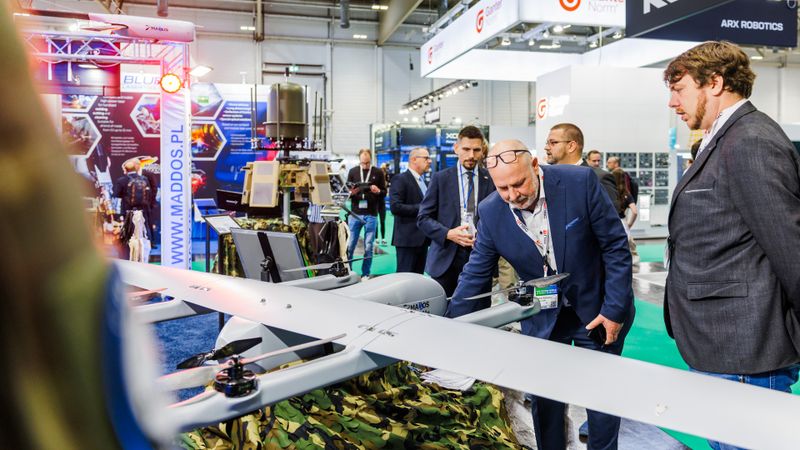
An unmanned aerial platform from Maddos, autonomous ground robots from ARX Robotics and standard parts from Ganter illustrate the breadth of Eudex. Ganter supplies components for positioning, fastening and locking in defence applications too.
(Source: Messe Essen)
Anyone expecting to see only military equipment at the first Euro Defence Expo would have been missing the point. Held in Essen from 22 to 25 September, Eudex provided a platform for numerous exhibitors from the fields of mechanical engineering, measurement technology, manufacturing equipment, enterprise software and connectivity. This brought to the fore a question that is crucial to the expansion of the defence industry: how can existing industrial expertise be applied to military uses and integrated into their supply chains? The fair aimed to bring together companies, armed forces, procurement organisations and research institutions.
Conversations and impressions gathered at the event suggest that, for at least some exhibitors, it served as a way of testing the waters in the defence market. Compared with defence trade fairs such as Enforce Tac, Eudex placed less emphasis on showcasing military equipment and weapon systems and more on industrial technologies and solutions for the defence sector. It also appeared to offer a platform for companies looking to bring their expertise to this market.
Whether this leads to lasting business relationships, however, depends on more than the technical offering alone. In the defence sector in particular, reaching the right users, systems integrators and procurement decision-makers is crucial. The quality of these contacts will be one of the key measures by which the new trade fair is judged.
From testing to production
Polytec is entering the defence market, among other ways, as a distributor for specialised manufacturers. The electro-optical test systems presented at Eudex are not in-house developments, as they are in the industrial sector, but solutions from long-standing partner CI Systems.
The portfolio includes test stations for cameras, laser rangefinders and optical sights, as well as simulators for testing missile warning systems. Blackbody sources provide defined radiation references for calibrating thermal imaging cameras; collimators and multisensor test systems support the testing of different optical channels.
One example is CI Systems’ compact, portable ILET systems, which can be used to test and characterise thermal imaging cameras and sensors operating in the visible spectrum. Polytec complements this distribution portfolio with application advice and service for optical metrology.
Virtually testing robustness
Cadfem addresses the development of industrial capabilities for the defence sector from the design perspective. Physics-based simulation makes it possible to examine stresses and the behaviour of complex systems before building costly prototypes.
A drop-test simulation of a thermal imaging camera made by Dräger shows how this can improve robustness. Using Ansys LS-DYNA, Cadfem modelled the camera being dropped from a height of two metres in five different impact orientations. The simulations revealed the areas of the casing under the greatest stress and enabled different design options to be compared.
The example comes from firefighting technology, but it illustrates a challenge also relevant to defence applications: identifying mechanical weaknesses early and adapting designs to their operating conditions. Cadfem sees simulation and digital engineering as an important means of accelerating the development of defence technologies under time pressure. Virtual testing can shorten development cycles and reduce the need for physical trials. It does not, however, replace practical testing and validation — particularly where reliability under changing operational conditions is essential.
Managing programmes across the lifecycle
At Eudex, Proalpha demonstrated how its Aerospace & Defence industry solution links manufacturing, quality assurance and traceability throughout the product lifecycle.
(Source: Proalpha)
When development results need to be translated into higher production volumes, the focus shifts to processes and capacity. However, Proalpha’s Aerospace & Defence industry solution addresses not only production ramp-up, but also the management of military programmes throughout the product lifecycle.
Date: 08.12.2025
Naturally, we always handle your personal data responsibly. Any personal data we receive from you is processed in accordance with applicable data protection legislation. For detailed information please see our privacy policy.
Consent to the use of data for promotional purposes
I hereby consent to Vogel Communications Group GmbH & Co. KG, Max-Planck-Str. 7-9, 97082 Würzburg including any affiliated companies according to §§ 15 et seq. AktG (hereafter: Vogel Communications Group) using my e-mail address to send editorial newsletters. A list of all affiliated companies can be found here
Newsletter content may include all products and services of any companies mentioned above, including for example specialist journals and books, events and fairs as well as event-related products and services, print and digital media offers and services such as additional (editorial) newsletters, raffles, lead campaigns, market research both online and offline, specialist webportals and e-learning offers. In case my personal telephone number has also been collected, it may be used for offers of aforementioned products, for services of the companies mentioned above, and market research purposes.
Additionally, my consent also includes the processing of my email address and telephone number for data matching for marketing purposes with select advertising partners such as LinkedIn, Google, and Meta. For this, Vogel Communications Group may transmit said data in hashed form to the advertising partners who then use said data to determine whether I am also a member of the mentioned advertising partner portals. Vogel Communications Group uses this feature for the purposes of re-targeting (up-selling, cross-selling, and customer loyalty), generating so-called look-alike audiences for acquisition of new customers, and as basis for exclusion for on-going advertising campaigns. Further information can be found in section “data matching for marketing purposes”.
In case I access protected data on Internet portals of Vogel Communications Group including any affiliated companies according to §§ 15 et seq. AktG, I need to provide further data in order to register for the access to such content. In return for this free access to editorial content, my data may be used in accordance with this consent for the purposes stated here. This does not apply to data matching for marketing purposes.
Right of revocation
I understand that I can revoke my consent at will. My revocation does not change the lawfulness of data processing that was conducted based on my consent leading up to my revocation. One option to declare my revocation is to use the contact form found at https://contact.vogel.de. In case I no longer wish to receive certain newsletters, I have subscribed to, I can also click on the unsubscribe link included at the end of a newsletter. Further information regarding my right of revocation and the implementation of it as well as the consequences of my revocation can be found in the data protection declaration, section editorial newsletter.
The software connects programme and contract management with engineering, manufacturing, quality assurance and maintenance. Defence-specific requirements are addressed through support for AQAP quality standards, export-control processes under ITAR, EAR and German BAFA regulations, and controlled access to sensitive technical data.
Configuration and change management make it possible to implement technical changes in a targeted way according to serial number, production batch or operational status. A digital product record brings together manufacturing documentation, inspections, certificates and approvals. Spare-parts management, repair and modernisation processes extend this data chain into the operational phase.
The solution targets a central challenge in the defence sector: not only manufacturing systems, but also maintaining traceability of their technical configurations and supply throughout decades of service.
Components, not major platforms
The fact that defence capability often depends on inconspicuous components is illustrated by Otto Ganter. The standard-parts specialist serves the defence market with industrial components that designers can select for specific applications. Indexing plungers, hinges, clamping levers and latches perform positioning, fastening and access functions.
One example is the locking mechanism for a retractable equipment carrier holding communications or electronic equipment in a military vehicle or shelter. Locking pins can secure the carrier in defined positions and release it for maintenance. The GN 816 range includes, among other features, key operation to deter unauthorised adjustment, as well as a visual indicator showing when the locating pin is retracted. A guide track prevents the pin from being inadvertently reset.
Flexible manufacturing for protected vehicles
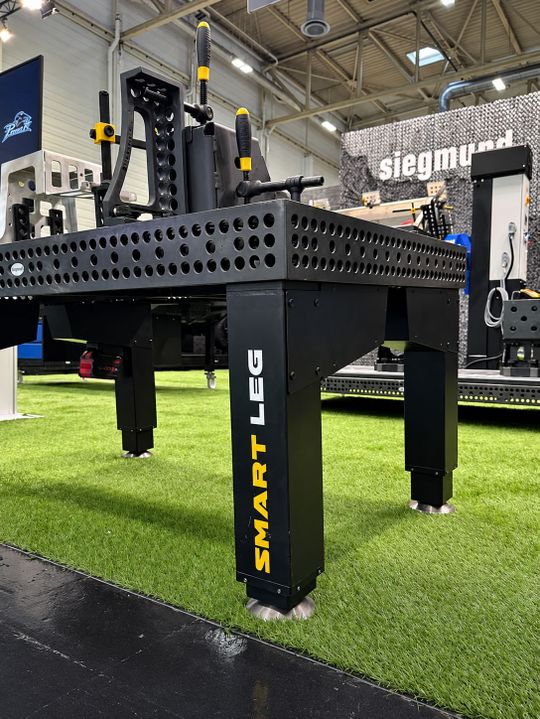
At Eudex, Siegmund showcased modular welding and clamping table systems that enable defence suppliers to position components precisely and clamp them repeatably, for example when manufacturing vehicle assemblies.
(Source: Siegmund)
Siegmund is a world leader in precision welding tables and offers modular welding and clamping systems for mechanical engineering, plant construction and vehicle manufacturing. At its Eudex stand, an armoured vehicle from customer ACS Armoured Car Systems demonstrated the company’s relevance to the defence industry. ACS develops and manufactures protected vehicles for operational use, with welding and assembly among its key value-adding processes.
Siegmund’s table systems provide a basis for accurately positioning and repeatably clamping components for these manufacturing tasks. A modular range of system holes, angles, stops, clamping bolts and clamps can be adapted to different geometries. Systems 16, 22 and 28 accommodate different component sizes and loads, while linked tables and extension elements can provide larger clamping surfaces.
For defence suppliers, the benefit lies in flexible fixturing that supports both changing assemblies and repeatable production tasks.
Compact interfaces for mobile platforms
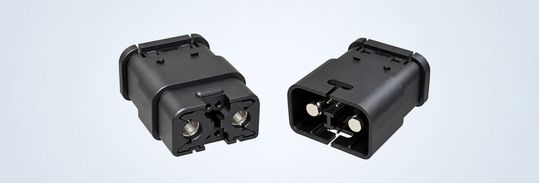
At Eudex, Harting showcased compact connectivity solutions for mobile platforms. The Han MPC combines power and data transmission with low weight and a small footprint, making it suitable for drones and unmanned ground vehicles.
(Source: Harting)
Harting provides connectivity solutions for security and defence systems. Whether for unmanned aerial vehicles, mobile ground platforms, or communications and sensor technology, connectors link power supplies, control systems and payloads, shaping the overall system architecture.
One example is the Han MPC, which combines high current-carrying capacity with low weight and a compact footprint. The series addresses typical SWaP requirements for unmanned platforms, where size, weight and power consumption must be carefully balanced. The MPC30 and MPC60 variants carry up to 30 and 60 amperes respectively at 120 volts DC. Up to four additional contacts enable data transmission via DroneCAN, for example between a control system and peripheral equipment. Proven crimp contacts from Harting’s industrial portfolio provide the basis for the electrical connection.
For developers, the installation environment remains a key consideration: the series is designed to withstand shock and vibration in accordance with IEC 61373, Category 1B. Its IP40 rating, however, makes it suitable for internal wiring rather than exposed external interfaces.
Integrating protection technology into platforms
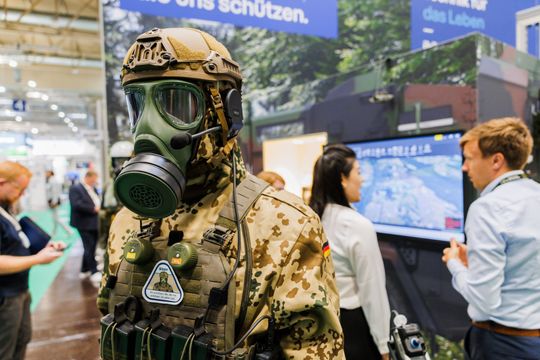
At Eudex, Dräger presented respiratory protection and gas detection for military applications, from personal protective equipment to integrated protection systems for vehicles and shelters.
(Source: Messe Essen)
At Dräger, the focus is on protecting people in vehicles and shelters. Its defence offering combines gas detection and respiratory protection with systems that can be integrated into platforms.
The Breathguard 2500 continuously monitors carbon monoxide and carbon dioxide concentrations, warning crews when the air in enclosed spaces reaches critical levels. The ColPro SBL 100 collective protection system, by contrast, supplies filtered air and maintains positive pressure to prevent hazardous substances from entering vehicles or shelters in CBRN environments.
The Multisensor Box 8500 complements these protective functions by monitoring hazardous gases and vapours. It can accommodate up to 16 sensors; integrated forced ventilation makes measurements independent of the ambient airflow. The unit can operate independently with a control terminal or as part of a larger detection system.
The three subsystems can be used individually or as a coordinated protection package, tailored to the platform, operational profile and interfaces. For vehicle and systems manufacturers, protection technology is therefore an integration task that brings together air monitoring, warnings and collective protection.
The quality of contacts is the measure of success
Alongside Eudex, Security Essen — a trade fair for civilian security technology — was taking place. Messe Essen reported a combined total of 30,000 trade visitors for the two events. For comparison, Security Essen alone attracted more than 20,000 visitors in 2024. No separate attendance figure for Eudex has been published so far. All the exhibitors interviewed agreed that the first day of the fair had been very quiet. It remains unclear to what extent the JAPCC conference, held at the same time, enabled exhibitors to connect with military decision-makers, or whether its strict access requirements deterred potential visitors.
For exhibitors, however, success at a trade fair depends less on visitor numbers than on the quality of the contacts made. This also sets a challenge for the next Eudex in 2028: it will need to sharpen its profile in relation to other defence trade fairs and reach the right users and procurement decision-makers more effectively. <his>


:quality(80)/p7i.vogel.de/wcms/b8/a1/b8a140d8496d6744a5fd8573e048bce4/esanasa-k--barber-1920x1080v1.jpeg "NASA’s SpaceX Crew-12 Splashdown (NHQ202610080008) ESA (European Space Agency) astronaut Sophie Adenot is helped out of the SpaceX Dragon Freedom spacecraft onboard the SpaceX recovery ship SHANNON after she and NASA astronauts Jessica Meir, Jack Hathaway, and Roscosmos cosmonaut Andrey Fedyaev landed in the Pacific Ocean off the coast of Los Angeles, Calif., Thursday, Oct. 8, 2026. (Source: ESA/ NASA–Keegan Barber)")
:quality(80)/p7i.vogel.de/wcms/70/78/7078a1bd268b3f708eab4913d2cd0b92/eudex-ganter-messe-essen-1920x1080v1.jpeg "An unmanned aerial platform from Maddos, autonomous ground robots from ARX Robotics and standard parts from Ganter illustrate the breadth of Eudex. Ganter supplies components for positioning, fastening and locking in defence applications too. (Source: Messe Essen)")
:quality(80)/p7i.vogel.de/wcms/a2/da/a2da4222cfe9ec14a72668ce4100fd5b/pistorius-experimentalserie-land-1400x787v1.jpeg "Defence Minister Boris Pistorius at the Land Experimental Series at the Bergen military training area in Lower Saxony. Innovative systems are being tested for their suitability for use by the troops — not in a laboratory, but out in the open. (Source: Bundeswehr/Janin Garzke)")
:quality(80)/p7i.vogel.de/wcms/ae/e3/aee34d59fdc80ce5fc6722e1107500b6/word-press-featured-image-1024x695-1024x576v1.jpeg "(Source: Bundesregierung/Tobias Koch)")
:quality(80)/p7i.vogel.de/wcms/a6/71/a6713b64fb8aee687258fcf1014ea3b5/2026-03-08-aerospike-09-980x551v1.jpeg "The engine was developed with the aid of Noyron, LEAP 71’s computer-aided design model. Noyron uses basic physical principles, engineering logic, and manufacturing specifications to design autonomously without human intervention. (Source: LEAP 71)")
:quality(80)/p7i.vogel.de/wcms/91/c9/91c93dbd66b08824c35643875aabe61f/bild1-1245x700v1.jpeg "Two scientists in front of a vacuum chamber used for testing. (Source: Busch Group)")
:quality(80)/p7i.vogel.de/wcms/76/1d/761de63f32752dc5a9722559c527fc1f/design-ohne-titel-5-1920x1079v1.png "(Source: Analog Devices)")
:quality(80)/p7i.vogel.de/wcms/33/a7/33a7f8ac37b143e73964dad10c8aafbc/0133560493v1.jpeg "Benedikt Gundling and Tobias Hannen in front of a tank component of the Ariane 6. (Source: Grob Works)")
:quality(80)/p7i.vogel.de/wcms/0c/e8/0ce8f0a9f1d56d603e7ff50f38caf7b2/abbildung-1-feierliche-er-ffnung-der-space-factory-im-esa-phi-lab-austria-1920x1079v1.jpeg "Official opening of the Space Factory at ESA Phi-Lab Austria at Vienna Airport. (Source: Vienna Airport)")
:quality(80)/p7i.vogel.de/wcms/22/f8/22f8044bacf96ce5f5c1c36a04000a34/hensec-aisvogel-seeueberwachung-1536x864v1.jpeg "aisvogel—airborne sensor platform for maritime intelligence (Source: hensec—secure solutions)")
:quality(80)/p7i.vogel.de/wcms/72/b0/72b0b2076f21d59e64cd8bdf5e9d8c57/image-1920-93a1849ed81939cb2c94fb0d76d4d72a-1920x1079v1.jpeg "Economic report on Germany as an aviation location: connectivity, competitive conditions, climate impacts and development. (Source: william87—stock.adobe.com)")
:quality(80)/p7i.vogel.de/wcms/6e/32/6e326befcb6db2834c32c9485bd3db20/hyperion-and-posidonia-satellites-1920x1079v1.png "(Source: Open Cosmos)")
:quality(80)/p7i.vogel.de/wcms/b6/6d/b66d11215bcdb8e107ca626e6cfd3643/tungart7-future-9045696-1920x1079v1.jpeg "Transparent and controllable AI architectures can support crisis management by making data sources, reasoning processes and uncertainties visible to human decision-makers. (Source: Tung Lam on Pixabay)")
:quality(80)/p7i.vogel.de/wcms/ed/e6/ede67e479952b7bad62244697e3cd3db/aa383c9a-015c-424b-95da-d8d56156c227-1536x864v1.png "Intelic's AI-supported command-and-control system Nexus can integrate sensors and interceptor drones to counter aerial threats (Illustration). (Picture: AI generated)")
:quality(80)/p7i.vogel.de/wcms/cb/a2/cba2ecda891b2874327a30f69f773bdb/hexaforce-15-1920x1079v1.jpeg "(Source: Thales/Gauthier Chauffrut)")
:quality(80)/p7i.vogel.de/wcms/9d/8a/9d8addea8cc4e6f7a4793563ca397f2a/ai-im-milit-r-1672x940v1.png "(Source: KI-generiert / Gemini)")
:quality(80)/p7i.vogel.de/wcms/d4/8e/d48e922adf87b94ec8356eabaaebc9b8/morfius-image-resize-jpg-pc-adaptive-full-medium-900x506v1.jpeg "Lockheed Martin’s MORFIUS® X-Rotor is the first of its kind counter-drone system. (Source: Lockheed Martin)")
:quality(80)/p7i.vogel.de/wcms/93/7e/937e0958ca684b36382d6025daa4880e/2026-10-06-rheinmetall-integriert-human-machine-teaming-in-gepanzerte-fahrzeuge-media-06a35258-query-2x-c641d5e7-1910x1075v1.jpeg "Rheinmetall and Breaker are integrating Human-Machine Teaming into the Boxer Combat Reconnaissance Vehicle, enabling crews to control teams of autonomous systems by voice command. (Source: Rheinmetall AG)")
:quality(80)/p7i.vogel.de/wcms/d4/8a/d48a3c3d03168bfd49db0a816aa308ae/image1-39-1294x728v1.png "(Source: Department of National Defence (DND))")
:quality(80)/p7i.vogel.de/wcms/54/d5/54d5207a3dab5139de6761523319cf84/airbus-delivers-first-batch-of-new-eutelsat-s-oneweb-satellites-23-1920x1079v1.jpeg "(Source: Airbus Defence and Space SAS 2026)")
:quality(80)/p7i.vogel.de/wcms/90/a8/90a849f0023f11d1eb642eb4751a0321/bild2-h-c3-a4nel-ict-20truck-20and-20trailer-20parts-4320x2429v1.jpeg "Product information is visible at all times and retrieval of items
is confirmed by employees directly on the display of the Hänel MP 14 N
controller. (Source: René Marks)")
:quality(80)/p7i.vogel.de/wcms/4e/ca/4ecaa39f247490eded591b652c33aee3/thilmann-hcp-web-20kleiner-20ausschnitt-1442x811v1.jpeg "Entering the defence market can be challenging for start-ups, says HCP Sense CEO Ansgar Thilmann. (Picture: HCP Sense)")
:quality(80)/p7i.vogel.de/wcms/7a/51/7a511b80041d3f1335f3a5aa56fe75da/delivery-7022432-1280-1280x720v1.png "(Source: Mohamed_hassan)")
:quality(80)/p7i.vogel.de/wcms/f9/2f/f92f1ef8c739c34c70d99f7b0997621b/stra007-20--20cover-20image-5472x3076v1.jpeg "(Source: Stratasys)")
:quality(80)/p7i.vogel.de/wcms/ec/a9/eca9062ccbe4b042f8515846340410d8/aerospace-and-defence-stairways-platforms-and-much-morev1.jpeg "Modular constructions enable flexible modification. That applies to larger structures such as stairways and platforms, too. And that means aerospace and defence companies can reconfigure their maintenance platforms fast (itemitem)")
:quality(80)/p7i.vogel.de/wcms/30/2a/302a7b5723ad38fbde812fd3a468ad04/safety-on-stairways-in-industry-key-considerationsv1.jpeg "Stairways and platforms are used widely in maintenance and assembly areas in the aerospace and defence sectors. (Source: item)")
:quality(80)/p7i.vogel.de/wcms/f3/4e/f34ed744bb30817d3432c7ad522e6f30/engine-1v1.jpeg "Engineering with aluminium profiles really can be this easy – the item Engineeringtool and its smart functions help you save valuable time. (Source: item)")
:fill(fff,0)/p7i.vogel.de/companies/69/6d/696de2483d115/logo--fastems-rgb-horizontal.jpeg "logo--fastems-rgb-horizontal (Fastems)")
:fill(fff,0)/images.vogel.de/vogelonline/companyimg/84700/84735/65.jpg "logo_item_rgb_neu.jpg ()")
:quality(80)/p7i.vogel.de/wcms/a7/e7/a7e747efafbb0725573621c20d08769b/electro-optical-system-300dpi-2-1772x997v1.jpeg "Electro optical sensor systems must be watertight. (Source: CETA Testsysteme GmbH / Canva / AI generated)")
:quality(80)/p7i.vogel.de/wcms/0a/14/0a1495d9b570ae32a5a7cc748b9a3c60/st-hannover-035-1920x1079v1-999x562v1.jpeg "Fastening technology you can experience first-hand—visitors to Schraubtec in Bochum (Germany) can see it for themselves at the Ruhr Congress on September 30, 2026. (Source: PHOTOVISION-DH GmbH)")