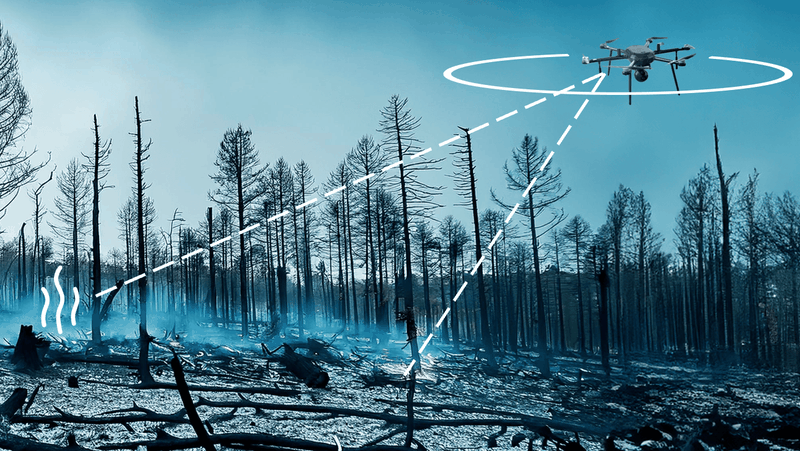
The autonomous drone is designed to provide information about hot spots before the fire department arrives, thereby making the emergency services' work considerably easier.
The autonomous drone is intended to provide information about smouldering hotspots even before the fire brigade arrives, thereby significantly easing the work of the emergency services.
In the EU-funded project PROACTIF and under the coordination of Nokia, 42 European partners from research and industry are working on a new multi-sensor system specifically designed for drones. Under the leadership of Fraunhofer IZM, the German consortium is developing an innovative multi-sensor module for automatic heat detection on drones, combining radar and infrared technology in a compact unit. By merging short- and long-range radar with three innovative packaging technologies, a lightweight and robust system is created that enables precise situational awareness even beneath the forest canopy, ensuring reliable detection of smouldering hotspots during forest fires.
Forest fires have now become one of the major challenges for fire brigades and civil defence even in Central Europe. A critical issue is the search for and extinguishing of smouldering hotspots in the undergrowth. Conventional drones quickly reach their limits here: they are too large and heavy to fly through dense vegetation. Thermal imaging cameras are often not sensitive enough to provide reliable data on concealed sources of fire. Currently, firefighters often have to locate smouldering hotspots manually with a spade, some of which lie up to 1.5 metres (approx. 5 ft) deep.
The German consortium in the PROACTIF project is developing a new solution: a multi-sensor module that combines radar and infrared sensing for the first time in an ultralight and compact unit weighing under three kilograms. Heimann Sensor GmbH supplies the infrared sensors, while researchers at the Fraunhofer Institute for Reliability and Microintegration IZM, together with InnoSenT GmbH, develop the novel radar sensor technology and integrate the infrared sensor into the system. By combining short-range and long-range radar with ranges of 80 and 200 metres (approx. 262 and 656 ft) respectively, the newly developed drone can automatically detect obstacles in its immediate surroundings, survey large forest areas with a 360-degree view, and—for the first time—fly beneath the canopy at speeds of up to 30 km/h (approx. 18 mph), while the infrared sensor identifies the smouldering hotspots.
Three Packaging Technologies for Optimal Implementation
Fraunhofer IZM’s unique expertise enables the combination of three key technologies from advanced packaging:
LTCC technology (Low-Temperature Co-fired Ceramic) enables high-performance high-frequency antennas and stable signal processing even at high temperatures.
Moulding technology allows three-dimensional shaping of antenna structures and minimises signal losses, which is crucial for the long-range radar.
Embedding technology integrates the short-range sensors space-efficiently into flexible materials, reducing weight and size.
Project manager and scientist at Fraunhofer IZM, Dr.-Ing. Christian Tschoban, summarises: “Only through the interaction of LTCC, moulding, and embedding technologies is it possible to combine short- and long-range radar with infrared sensors in an ultracompact module. The result is a so-called multi-sensor package, a lightweight sensor unit that combines high resolution, robustness, and energy efficiency.”
Field Demonstration in German Forests
The multi-sensor module will soon be tested in Germany in a practice-oriented scenario. In close coordination with the forestry office and fire brigade, researchers will test the use of the drones in Münsterland and near Wiesenburg (both located in Germany). During the simulated fire, special attention will be paid to ensuring that it takes place outside dry periods and to protecting birdlife. The drones are intended to fly autonomously through the forested area, detecting obstacles and smouldering hotspots in real time. In the long term, the drones are expected to automatically take off upon receiving a forest fire alert and, even before emergency crews arrive, generate an accurate situational picture and provide information on how many responders are actually needed.
Beyond this, the technology opens up opportunities for search and rescue operations or the monitoring of critical infrastructures. With around 25 percent of the entire PROACTIF consortium, the German partners are making a decisive contribution to making autonomous systems in Europe more powerful and safer.
Date: 08.12.2025
Naturally, we always handle your personal data responsibly. Any personal data we receive from you is processed in accordance with applicable data protection legislation. For detailed information please see our privacy policy.
Consent to the use of data for promotional purposes
I hereby consent to Vogel Communications Group GmbH & Co. KG, Max-Planck-Str. 7-9, 97082 Würzburg including any affiliated companies according to §§ 15 et seq. AktG (hereafter: Vogel Communications Group) using my e-mail address to send editorial newsletters. A list of all affiliated companies can be found here
Newsletter content may include all products and services of any companies mentioned above, including for example specialist journals and books, events and fairs as well as event-related products and services, print and digital media offers and services such as additional (editorial) newsletters, raffles, lead campaigns, market research both online and offline, specialist webportals and e-learning offers. In case my personal telephone number has also been collected, it may be used for offers of aforementioned products, for services of the companies mentioned above, and market research purposes.
Additionally, my consent also includes the processing of my email address and telephone number for data matching for marketing purposes with select advertising partners such as LinkedIn, Google, and Meta. For this, Vogel Communications Group may transmit said data in hashed form to the advertising partners who then use said data to determine whether I am also a member of the mentioned advertising partner portals. Vogel Communications Group uses this feature for the purposes of re-targeting (up-selling, cross-selling, and customer loyalty), generating so-called look-alike audiences for acquisition of new customers, and as basis for exclusion for on-going advertising campaigns. Further information can be found in section “data matching for marketing purposes”.
In case I access protected data on Internet portals of Vogel Communications Group including any affiliated companies according to §§ 15 et seq. AktG, I need to provide further data in order to register for the access to such content. In return for this free access to editorial content, my data may be used in accordance with this consent for the purposes stated here. This does not apply to data matching for marketing purposes.
Right of revocation
I understand that I can revoke my consent at will. My revocation does not change the lawfulness of data processing that was conducted based on my consent leading up to my revocation. One option to declare my revocation is to use the contact form found at https://contact.vogel.de. In case I no longer wish to receive certain newsletters, I have subscribed to, I can also click on the unsubscribe link included at the end of a newsletter. Further information regarding my right of revocation and the implementation of it as well as the consequences of my revocation can be found in the data protection declaration, section editorial newsletter.
The PROACTIF project runs from 01 June 2025 to 30 April 2028 and is funded under the Chips Joint Undertaking (HORIZON-JU-Chips-2024-1-IA-T1) with a total of €41.8 million (approx. 48.7 million USD), including €2.02 million (approx. 2.36 million USD) from the Federal Ministry for Research, Technology and Space Travel (BMFTR), €320,000 (approx. 372,000 USD) from the Free State of Saxony, and €90,000 (approx. 105,000 USD) from the Free State of Thuringia. The project, which involves 42 European institutions—including five from Germany—is part of Germany’s strategy for securing technological sovereignty in quantum research. Its overarching goal is to significantly enhance Europe’s competitiveness in technology for unmanned missions and to increase the cost-effectiveness and efficiency of autonomous monitoring of critical infrastructures.




:quality(80)/p7i.vogel.de/wcms/f6/95/f6954fa7c09ba58863a3730f5e384a62/arek-socha-on-pixabay-1707x960v1.jpeg "A new national space strategy brings together UK’s plans for growth, defence, and national security to help reindustrialise the UK. (Source: Arek Socha on Pixabay)")
:quality(80)/p7i.vogel.de/wcms/63/0f/630f214fa760b8c7f7f7d6279d411fcf/d4ceed8f2f52-2026-08-30-hydef-06--msc4159-1200x675v1.webp "(Source: Diehl Defence)")
:quality(80)/p7i.vogel.de/wcms/4e/7d/4e7d38327c6c928b403249e3c24a2a7c/0132118791v1.jpeg "Porsche Holding SE announces that it is once again turning to rocket technology. Following its investment in Isar Aerospace, the company is now acquiring a stake in a U.S. firm ... (Source: Porsche)")
:quality(80)/p7i.vogel.de/wcms/1c/08/1c082bbd9d05b634168b617aa26fcdcf/safe-bg-lv-ro-v1-991x557v1.png "(Source: European Commission)")
:quality(80)/p7i.vogel.de/wcms/0a/14/0a1495d9b570ae32a5a7cc748b9a3c60/st-hannover-035-1920x1079v1-999x562v1.jpeg "Fastening technology you can experience first-hand—visitors to Schraubtec in Bochum (Germany) can see it for themselves at the Ruhr Congress on September 30, 2026. (Source: PHOTOVISION-DH GmbH)")
:quality(80)/p7i.vogel.de/wcms/cd/a9/cda92b173afa9d0b455d4f11b281c9ea/0094-to-image--capstone-cdr-1440x810v1.png "(Source: Terran Orbital)")
:quality(80)/p7i.vogel.de/wcms/e0/45/e045bc5414d7263fb308bdd501b5fcc1/0133113962v1.jpeg "The HSWL 354 is the transmission used, for example, in the Leopard 2 main battle tank. Renk manufactures this system and is now preparing to significantly increase its cycle time. As a result, Renk is placing greater emphasis on the military sector as a customer ... (Source: Renk)")
:quality(80)/p7i.vogel.de/wcms/a1/5c/a15c2aeba563d5bc3e11fb879b21eb2c/0132989650v1.jpeg "FSS, the flexible clamping system for varying free-form surfaces, is designed for the aerospace industry and other sectors. (Source: Römheld GmbH Friedrichshütte)")
:quality(80)/p7i.vogel.de/wcms/46/8e/468effa87546a2b036dc88ca40e2843e/129fbcac92ce7da872b13af0281b0799-l-png-1920x1079v1.webp "(Source: Arianespace)")
:quality(80)/p7i.vogel.de/wcms/8f/10/8f10697d4bfbd70edf615cca76eaedfd/pete-linforth-on-pixabay-1920x1080v1.jpeg "(Source: Pete Linforth on Pixabay / AI-generated)")
:quality(80)/p7i.vogel.de/wcms/0f/99/0f99561bf51818af92b2960656405aa5/roland-4d-pippes-on-pixabay-1460x820v1.jpeg "(Source: Roland 4D Pippes on Pixabay)")
:quality(80)/p7i.vogel.de/wcms/05/49/054906f874b94ef08b09d5920396e27d/airbus-h160-1920x1079v1.jpeg "Airbus H160 (Source: Airbus)")
:quality(80)/p7i.vogel.de/wcms/9d/8a/9d8addea8cc4e6f7a4793563ca397f2a/ai-im-milit-r-1672x940v1.png "(Source: KI-generiert / Gemini)")
:quality(80)/p7i.vogel.de/wcms/7f/5f/7f5fba2c729ec3aa256bf1a18d74529b/ai-chip-1672x940v1.png "(Source: KI-generiert / Gemini)")
:quality(80)/p7i.vogel.de/wcms/64/1b/641b6474b2a614cde7730c89ef2a3015/2026-09-09-rheinmetall-veroeffentlicht-battlesuite-schnittstellen-e8c18194-1225x690v1.jpeg "Rheinmetall’s Battlesuite provides a modular digital platform for connecting and integrating sensors, hardware and software components. (Source: Rheinmetall AG)")
:quality(80)/p7i.vogel.de/wcms/6f/fe/6ffef325e7f233cc3521943158eb1ebd/0132763535v1.jpeg "Two companies are planning to establish, for the first time in 2027, an optical laser communication link directly between a satellite in low Earth orbit (LEO) and a re-entering spacecraft. (Source: ATMOS Space Cargo)")
:quality(80)/p7i.vogel.de/wcms/8f/f9/8ff91b78b26cb5a2b8a29e39835005b1/2026-09-10-repmus-teaser-images-retouched-dsc01292-1024x683-1024x576v1.jpeg "(Source: Quantum Systems GmbH)")
:quality(80)/p7i.vogel.de/wcms/bf/4a/bf4a237e60d3d4bd1bbdbad918f3c697/airbus-defence-and-space-3-1280x720v1.jpeg "(Source: Airbus Defence and Space)")
:quality(80)/p7i.vogel.de/wcms/e0/d1/e0d112a0d54a4fa9603ec855f7d25b47/t-rex-content-photo-jpg-pc-adaptive-990-medium-988x556v1.jpeg "Swarm of UAVs conducting a fully autonomous collaborative swarm mission. (Source: Lockheed Martin)")
:quality(80)/p7i.vogel.de/wcms/79/fc/79fcaa7ca33e393b11a4740d7d8f3dbe/vilkasss-handshake-9459740-1911x1076v1.jpeg "(Source: Vilius Kukanauskas on Pixabay)")
:quality(80)/p7i.vogel.de/wcms/90/a8/90a849f0023f11d1eb642eb4751a0321/bild2-h-c3-a4nel-ict-20truck-20and-20trailer-20parts-4320x2429v1.jpeg "Product information is visible at all times and retrieval of items
is confirmed by employees directly on the display of the Hänel MP 14 N
controller. (Source: René Marks)")
:quality(80)/p7i.vogel.de/wcms/4e/ca/4ecaa39f247490eded591b652c33aee3/thilmann-hcp-web-20kleiner-20ausschnitt-1442x811v1.jpeg "Entering the defence market can be challenging for start-ups, says HCP Sense CEO Ansgar Thilmann. (Picture: HCP Sense)")
:quality(80)/p7i.vogel.de/wcms/7a/51/7a511b80041d3f1335f3a5aa56fe75da/delivery-7022432-1280-1280x720v1.png "(Source: Mohamed_hassan)")
:quality(80)/p7i.vogel.de/wcms/f9/2f/f92f1ef8c739c34c70d99f7b0997621b/stra007-20--20cover-20image-5472x3076v1.jpeg "(Source: Stratasys)")
:quality(80)/p7i.vogel.de/wcms/ec/a9/eca9062ccbe4b042f8515846340410d8/aerospace-and-defence-stairways-platforms-and-much-morev1.jpeg "Modular constructions enable flexible modification. That applies to larger structures such as stairways and platforms, too. And that means aerospace and defence companies can reconfigure their maintenance platforms fast (itemitem)")
:quality(80)/p7i.vogel.de/wcms/30/2a/302a7b5723ad38fbde812fd3a468ad04/safety-on-stairways-in-industry-key-considerationsv1.jpeg "Stairways and platforms are used widely in maintenance and assembly areas in the aerospace and defence sectors. (Source: item)")
:quality(80)/p7i.vogel.de/wcms/f3/4e/f34ed744bb30817d3432c7ad522e6f30/engine-1v1.jpeg "Engineering with aluminium profiles really can be this easy – the item Engineeringtool and its smart functions help you save valuable time. (Source: item)")
:fill(fff,0)/p7i.vogel.de/companies/69/6d/696de2483d115/logo--fastems-rgb-horizontal.jpeg "logo--fastems-rgb-horizontal (Fastems)")
:fill(fff,0)/images.vogel.de/vogelonline/companyimg/84700/84735/65.jpg "logo_item_rgb_neu.jpg ()")
:quality(80)/p7i.vogel.de/wcms/b2/f9/b2f9a21ab26f0c771bf23348a71fbfb6/2025-11-11-drohnenerkennung-pm-1500x1000-c-fraunhofer-idmt-leona-hofmann-1440x810v1.jpeg "The system provides 360° coverage, with detection ranges from 50 to 200 meters depending on environmental noise, and updates every second. (Source: Fraunhofer IDMT/Leona Hofmann)")
:quality(80)/p7i.vogel.de/wcms/f8/8e/f88e718457a57ca9d2a9432b5e032c53/amboss-test-c-fraunhoferidmt-hanneskalter-2720x1613px-1440x810v1.jpeg "Hearing drones before you see them: Fraunhofer IDMT’s solution detects and localizes drones also beyond the line of sight using intelligent acoustic sensing. (Source: Fraunhofer IDMT/ Hannes Kalter)")