From police drones to military quadcopters, Vizgard's UKDI-funded visual AI is helping to keep the skies safer.
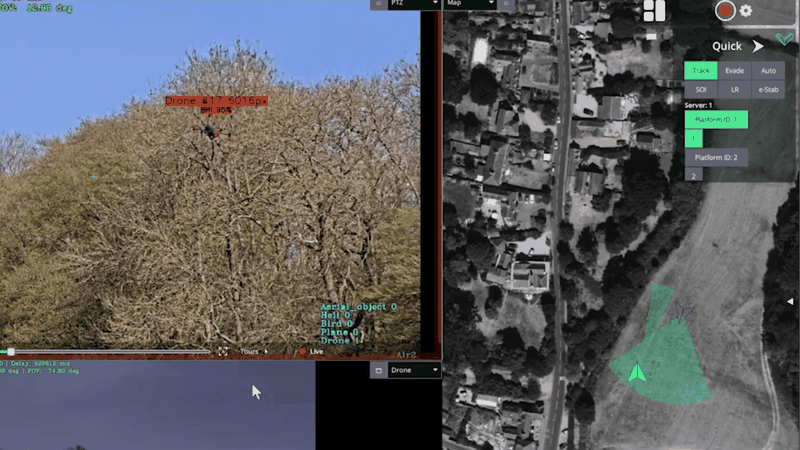
Vizgard’s FortifAI in action
(Source: GOV.UK)
The skies are getting busier, and the stakes are getting higher. The UK is exploring the use of drones for improved safety and security, but this same technology that can help monitor crowds and scan for threats can also be used by adversaries. This means that detecting adversary threats, whilst also making the most of operational and tactical efficiencies out of drones has become a priority.
Eyes in the sky: Introducing Vizgard
Vizgard, a London-based SME founded by former Royal Navy service member (submariner) Alex Kehoe, has spent the last five years building the software to meet operational drone challenges head-on.
Developed with UK Defence Innovation (UKDI) funding, and Defence Science technology Laboratory (Dstl) technical expertise, Vizgard set out to support police drone operations beyond visual line of sight.
Their platform, FortifAI, is a real-time visual AI system that plugs into existing defence and security camera infrastructure across land, air, and sea environments. Using AI and machine learning, the tech can dramatically reduce the cognitive burden on operators by automating detection, tracking, and threat identification across multiple visual streams. The technology comprises three key components:
1. AI onboard police drones to assist with obstacle avoidance and manoeuvring around the environment
2. A low-power computer located next to the camera, so that police data remains secure and does not require internet access.
3. Ground-based steerable cameras that scan the sky to find other aerial objects and investigate reports from third-party radar and radio frequency sensors
Working with UKDI
Vizgard has been funded several times by UKDI, but it was their Security Open Call project where they overcame the greatest hurdles and challenges, helped by UKDI support.
“We had to completely re-architect the software,” Alex Kehoe, CEO of Vizgard explains. “Early on, FortifAI 2.0 could only handle one camera stream for one drone. For this project, we needed to process multiple streams simultaneously. It was a significant undertaking, but UKDI funding gave us the runway to do it properly.”
The result was FortifAI 2.0, a production-grade, scalable platform capable of handling dozens of concurrent streams. Today, it can process over 100. That leap didn’t happen in a vacuum: it happened because UKDI backed Vizgard at precisely the right moment; when the technology had real promise but needed investment to become operationally viable.
“UKDI gave us our very first commercial contract back in 2021, seeing something special in us before others,” Alex explains. “The project involved sea trials on the Royal Navy’s uncrewed test submarine, and it was the first time our AI was used in the real world. We fused radio tracks with visual AI to find vessels masking their identity, as well as showcasing automatic tracking of fast-moving vessels. This early validation opened doors for us with primes working in coastal security.”
The technology has moved quickly from funded prototype to frontline tool, with UK Policing exploring their application to drone and counter-drone operations.
The system not only gives users automated visual tracking of their own systems, but also continuous sky-scanning for other aerial objects. This tactical aid is valuable in operational contexts where a human observer watching the sky can easily miss something.
“Operators are inundated with visual sensor data in real time,” explains Alex. “Even the most skilled, attentive operator isn’t always going to be looking at the right camera stream at the right time. We help them know when they need to pay attention, and to what.”
Date: 08.12.2025
Naturally, we always handle your personal data responsibly. Any personal data we receive from you is processed in accordance with applicable data protection legislation. For detailed information please see our privacy policy.
Consent to the use of data for promotional purposes
I hereby consent to Vogel Communications Group GmbH & Co. KG, Max-Planck-Str. 7-9, 97082 Würzburg including any affiliated companies according to §§ 15 et seq. AktG (hereafter: Vogel Communications Group) using my e-mail address to send editorial newsletters. A list of all affiliated companies can be found here
Newsletter content may include all products and services of any companies mentioned above, including for example specialist journals and books, events and fairs as well as event-related products and services, print and digital media offers and services such as additional (editorial) newsletters, raffles, lead campaigns, market research both online and offline, specialist webportals and e-learning offers. In case my personal telephone number has also been collected, it may be used for offers of aforementioned products, for services of the companies mentioned above, and market research purposes.
Additionally, my consent also includes the processing of my email address and telephone number for data matching for marketing purposes with select advertising partners such as LinkedIn, Google, and Meta. For this, Vogel Communications Group may transmit said data in hashed form to the advertising partners who then use said data to determine whether I am also a member of the mentioned advertising partner portals. Vogel Communications Group uses this feature for the purposes of re-targeting (up-selling, cross-selling, and customer loyalty), generating so-called look-alike audiences for acquisition of new customers, and as basis for exclusion for on-going advertising campaigns. Further information can be found in section “data matching for marketing purposes”.
In case I access protected data on Internet portals of Vogel Communications Group including any affiliated companies according to §§ 15 et seq. AktG, I need to provide further data in order to register for the access to such content. In return for this free access to editorial content, my data may be used in accordance with this consent for the purposes stated here. This does not apply to data matching for marketing purposes.
Right of revocation
I understand that I can revoke my consent at will. My revocation does not change the lawfulness of data processing that was conducted based on my consent leading up to my revocation. One option to declare my revocation is to use the contact form found at https://contact.vogel.de. In case I no longer wish to receive certain newsletters, I have subscribed to, I can also click on the unsubscribe link included at the end of a newsletter. Further information regarding my right of revocation and the implementation of it as well as the consequences of my revocation can be found in the data protection declaration, section editorial newsletter.
This success is just what UKDI funding is designed to produce; innovations that reach end users and generate real-world impact. For Vizgard, the funding and engagement with UKDI has been a genuine accelerant. When they first engaged with UKDI, the company had around five employees, which has now risen to 20.
The future for Vizgard
Their ambition hasn’t slowed down. Vizgard secured £1.5 million in venture capital funding in early 2025, enabling them to develop UnifAI, a machine learning ops platform that streamlines AI model improvement in the field from weeks to days, even for non-technical users. They are now exporting the technology via a Defence Innovation Unit (DIU) contract for field testing with the US Marines.
This year, they secured a place in NATO DIANA’s competitive 2026 cohort for autonomous and unmanned technologies, being one of only 150 companies out of over 3,500 applicants. Closer to home, UKDI support has led Vizgard to work with Dstl on edge-based AI that helps quadcopter drones identify unexploded mines in automated ISR missions.
“Working with UKDI and Dstl has been excellent. It’s 100% funded, the application process is thorough but not unreasonable, and the projects were focused on genuine end-user problems,” says Alex. “As an SME, it provided crucial early funding to help accelerate our R&D and helped us get in front of potential end users both during the project and after.”




:quality(80)/p7i.vogel.de/wcms/32/7e/327ed05e51beca5080e525480a58a4f1/260806-a-ut471-1002-1920x1081v1.jpeg "A test system of Covenant Industries' Anthem cruise missile during trials in Morocco. (Photo: US Army/Capt. Jordan Beagle - Public Domain)")
:quality(80)/p7i.vogel.de/wcms/0d/ed/0dedc1c5dde85d778033c134cb1bc838/chatgpt-image-28--aug--2026-01-42-15-1672x940v1.png "The U.S. Army plans to deploy nuclear microreactors at an initial five locations to strengthen the resilience of its energy supply. (Picture: AI-generated)")
:quality(80)/p7i.vogel.de/wcms/30/c4/30c4bcdb7194b70ce1e4b5be37c3e898/military-material-soldier-2533669-1920x1079v1.jpeg "(Source: Military_Material on Pixabay)")
:quality(80)/p7i.vogel.de/wcms/54/d3/54d3e06331303ae0ec74b40b1a9ac6f9/dusan-cvetanovic-ukraine-7062255-1920x1079v1.jpeg "(Source: Dušan Cvetanović on Pixabay)")
:quality(80)/p7i.vogel.de/wcms/e5/a0/e5a0e00314fd3da7e907765929162d52/bx-25-10-produktanwendungen-08-1-800x450v1.jpeg "Approved in the relevant colour shades of the Swiss military: Instead of using wet coatings, industrial coaters can now also use powder coatings for military applications in Switzerland. (Source: Brillux Industrielack)")
:quality(80)/p7i.vogel.de/wcms/13/d3/13d32efa083b6345f06f1e1f3b085330/0132829332v1.jpeg "Powell Electronics expands its portfolio with GAPS and HAPS proximity sensors from Honeywell for aerospace applications. (Source: Honeywell)")
:quality(80)/p7i.vogel.de/wcms/ad/2c/ad2c22bc21956e7675fa22f46a7c7372/198989-1920x1079v1.jpeg "Successful launch of the FV-014 Loitering Munition System. (Source: Rheinmetall AG)")
:quality(80)/p7i.vogel.de/wcms/6a/c1/6ac15ac9e2f36be33d6b3d662473a1f8/spartan-space-642x361v1.png "Photographs of the drone’s launch and flight at an altitude of more than 24 km (approx. 14.9 miles). (Source: SPARTAN SPACE)")
:quality(80)/p7i.vogel.de/wcms/d8/3c/d83c20ea0c25c1411e3c3bf4eb8fd927/catl-passagier-evtols-2-1920x1079v1.jpeg "(Source: CATL)")
:quality(80)/p7i.vogel.de/wcms/18/d1/18d16c77426eaa7812c7c21ddce79374/0132853627v1.jpeg "Heart Aerospace has completed the first flight with its fully battery-electric aircraft study X1. (Source: Heart Aerospace)")
:quality(80)/p7i.vogel.de/wcms/6f/cd/6fcd5adc102297f720e2fda94abd8277/0132966421v1.jpeg "Aerofugia and Sysgo have entered into a cooperation. (Source: Aerofugia)")
:quality(80)/p7i.vogel.de/wcms/b3/7c/b37c4ae902b609855f68e9795cc71a9d/251116-pegasus-02-wichita-bombardier-1920x1080v1.jpeg "A modified Bombardier Global 6000 for Germany’s PEGASUS program at Bombardier Defense in Wichita, Kansas. The aircraft is one of three platforms being prepared for the Bundeswehr’s future airborne signals-intelligence capability. (Source: Bombardier Defense)")
:quality(80)/p7i.vogel.de/wcms/b2/6a/b26a277a3578fc2956b2c30d3b3b0146/0132928076v1.jpeg "Compact and standardised: CubeSats enable cost-effective space missions and are increasingly serving as a platform for testing new technologies—from sensors and communications to innovative power systems. (Source: City Labs, Inc.)")
:quality(80)/p7i.vogel.de/wcms/6d/f2/6df225601e1f8d4f9d07d53fd527cdb9/epc7050-7065-7066-pr-graphic-clean-1500x844v1.jpeg "(Source: EPC Space)")
:quality(80)/p7i.vogel.de/wcms/2a/ae/2aae2c389f328a77a3c1eb502b79f019/mc1779-image-space-csac-sa-65-1898x1067v1.jpeg "The Space CSAC-SA65 combines atomic-clock accuracy with built-in 1 PPS disciplining and low-power consumption. (Source: Microchip Technology Inc.)")
:quality(80)/p7i.vogel.de/wcms/d0/70/d070157885d390faeede32e7ed4d6697/nord069-image-1920x1080v1.jpeg "The Skylo certification inherited from embedded modem developer LooUQ enables IoT developers to develop devices faster that connect via cellular and satellite networks using Skylo’s standards-based NTN service. (Source: Nordic Semiconductor)")
:quality(80)/p7i.vogel.de/wcms/ba/60/ba60f1a3891348d3bfb414721911c7bd/chatgpt-image-28--aug--2026-11-44-26-1228x691v1.png "(Source: AI - generated / ChatGPT)")
:quality(80)/p7i.vogel.de/wcms/86/bb/86bb77517bba1aa32ffdd827d3e86934/s960-vizgard-960-x-640px-2-960x540v1.png "Vizgard’s FortifAI in action (Source: GOV.UK)")
:quality(80)/p7i.vogel.de/wcms/c2/4f/c24fcb0b6f2bdf01f06c2c27973dc774/0132916289v1.jpeg "With this unmanned flight system, a novel reconnaissance drone, the Lower Saxony company Aerodata aims to help combat drone attacks in Germany more effectively ... (Source: Aerodata)")
:quality(80)/p7i.vogel.de/wcms/f8/8e/f88e718457a57ca9d2a9432b5e032c53/amboss-test-c-fraunhoferidmt-hanneskalter-2720x1613px-1440x810v1.jpeg "Hearing drones before you see them: Fraunhofer IDMT’s solution detects and localizes drones also beyond the line of sight using intelligent acoustic sensing. (Source: Fraunhofer IDMT/ Hannes Kalter)")
:quality(80)/p7i.vogel.de/wcms/90/a8/90a849f0023f11d1eb642eb4751a0321/bild2-h-c3-a4nel-ict-20truck-20and-20trailer-20parts-4320x2429v1.jpeg "Product information is visible at all times and retrieval of items
is confirmed by employees directly on the display of the Hänel MP 14 N
controller. (Source: René Marks)")
:quality(80)/p7i.vogel.de/wcms/4e/ca/4ecaa39f247490eded591b652c33aee3/thilmann-hcp-web-20kleiner-20ausschnitt-1442x811v1.jpeg "Entering the defence market can be challenging for start-ups, says HCP Sense CEO Ansgar Thilmann. (Picture: HCP Sense)")
:quality(80)/p7i.vogel.de/wcms/7a/51/7a511b80041d3f1335f3a5aa56fe75da/delivery-7022432-1280-1280x720v1.png "(Source: Mohamed_hassan)")
:quality(80)/p7i.vogel.de/wcms/f9/2f/f92f1ef8c739c34c70d99f7b0997621b/stra007-20--20cover-20image-5472x3076v1.jpeg "(Source: Stratasys)")
:quality(80)/p7i.vogel.de/wcms/ec/a9/eca9062ccbe4b042f8515846340410d8/aerospace-and-defence-stairways-platforms-and-much-morev1.jpeg "Modular constructions enable flexible modification. That applies to larger structures such as stairways and platforms, too. And that means aerospace and defence companies can reconfigure their maintenance platforms fast (itemitem)")
:quality(80)/p7i.vogel.de/wcms/30/2a/302a7b5723ad38fbde812fd3a468ad04/safety-on-stairways-in-industry-key-considerationsv1.jpeg "Stairways and platforms are used widely in maintenance and assembly areas in the aerospace and defence sectors. (Source: item)")
:quality(80)/p7i.vogel.de/wcms/f3/4e/f34ed744bb30817d3432c7ad522e6f30/engine-1v1.jpeg "Engineering with aluminium profiles really can be this easy – the item Engineeringtool and its smart functions help you save valuable time. (Source: item)")
:fill(fff,0)/p7i.vogel.de/companies/69/6d/696de2483d115/logo--fastems-rgb-horizontal.jpeg "logo--fastems-rgb-horizontal (Fastems)")
:fill(fff,0)/images.vogel.de/vogelonline/companyimg/84700/84735/65.jpg "logo_item_rgb_neu.jpg ()")
:quality(80)/p7i.vogel.de/wcms/2b/50/2b508b99f3b5a0fcfc4c6888799b26c6/s960-novel-autonomy-and-robotics-image-960x540v1.png "s960-novel-autonomy-and-robotics-image-960x540v1 (Source: Government UK)")
:quality(80)/p7i.vogel.de/wcms/1c/3c/1c3c68f404be8d9b19ee63770f65ef78/lichtbogenschweissen-sensorik-lessmueller-lasertechnik-300dpi-2480x1394v1.jpeg "lichtbogenschweissen-sensorik-lessmueller-lasertechnik-300dpi-2480x1394v1 (Copyright: Lessmüller Lasertechnik GmbH)")