




















The sensor that saw the wrong flash: How Weather Satellites Are Becoming Planetary-Defence Sensors
Related Vendors


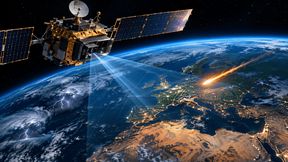
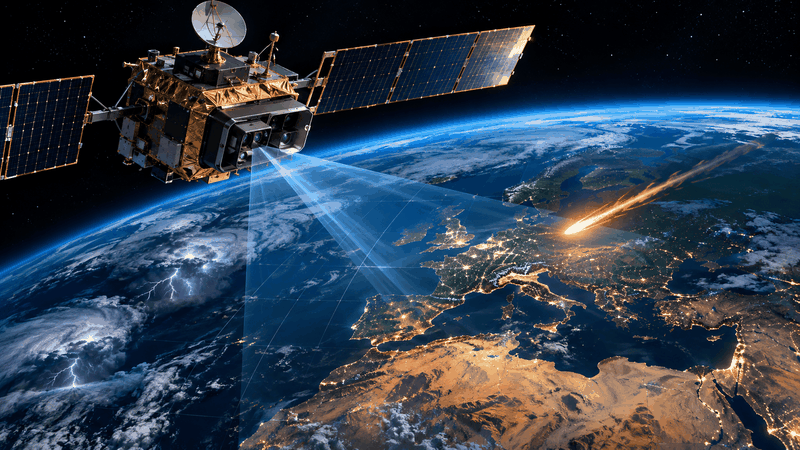
Europe’s Meteosat Third Generation Lightning Imager was built to detect thunderstorms, not asteroids. ESA and EUMETSAT are now adapting the lightning-processing chain to identify these events automatically.
One detector, two completely different events
The Lightning Imager aboard Meteosat Third Generation was designed for meteorology. From geostationary orbit, four optical telescopes continuously monitor more than 80 percent of the visible Earth disc. Their task is to detect lightning rapidly enough to support severe-weather nowcasting. The instrument operates in a narrow spectral band centred near 777 nanometres, reads its detectors at 1 kHz and produces observations day and night. That architecture also makes it sensitive to something it was never primarily designed to see: Fireballs. When a sufficiently large meteoroid enters the atmosphere at several kilometres per second, compression, ablation and fragmentation create an intense optical transient.
Sign in or register and read on
Please log in or register and read this article. To be able to read this article in full, you must be registered. Free registration gives you access to exclusive specialist information.
Already registered? Log in here