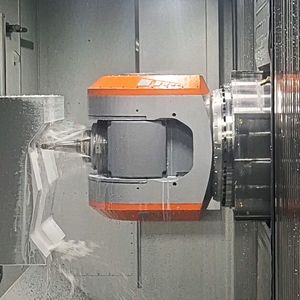
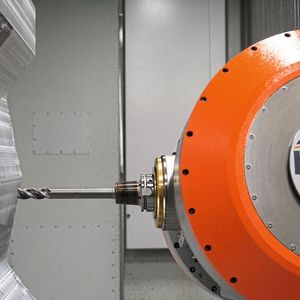
To check the stability of long overhanging tools with a small HSK interface, bavius technologie tested under real-world conditions. Iscar tools for roughing and finishing exceeded all expectations.
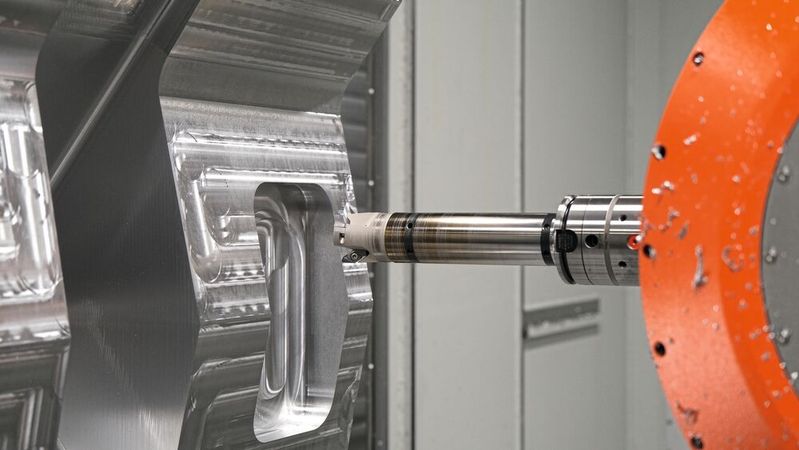
Even with tool lengths of up to 357 millimeters (approx. 14 inches), the processes ran safely and without vibration.
(Source: Iscar)
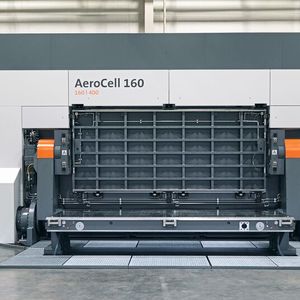
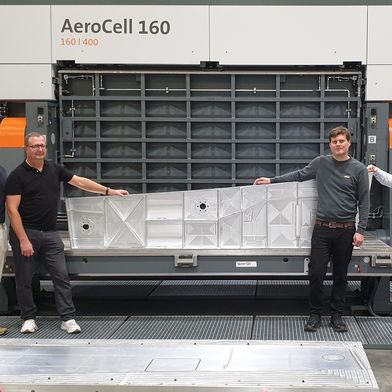
Bavius Technologie, headquartered in Baienfurt (Germany), has been operating since 2017 as an independent, family-run company with around 120 employees in the development and production of high-speed CNC systems for high-volume aluminum machining. In doing so, Bavius focuses on two product lines: PBZ profile machining centers and HBZ horizontal machining centers with the AeroCell series.
An American company in the aerospace sector was looking for a machine that offers high material removal rates, dynamics, and availability while also providing high machining quality in order to manufacture large structural aluminum components.
Dominik Merz, Director Global Sales/Applications at bavius
“A perfect job for our HBZ AeroCell 160 I 400.” The system features a high-performance spindle that runs at up to 30,000 revolutions per minute and delivers 140 kilowatts in continuous operation (duty type S1). In duty type S6, short-term outputs of up to 175 kilowatts can be called up. “Since the 140 kilowatts are already available at 19,000 revolutions per minute, high outputs can already be tapped in the mid-speed range, which offers several advantages,” explains Dominik Merz.
Only the tool interface HSK-A63/80 used as standard by bavius caused concern for the US customer. Based on experience and for stability reasons, he preferred a larger one. However, that would have significantly limited the available machining performance of the system.
To be able to operate at 30,000 rpm, the AeroCell 160 is equipped with an HSK 63/80 tool holder, which, thanks to its larger contact surfaces, provides the necessary stability to the tool even with long overhangs.
Stefan Diem, application technician at bavius
“With a 100-receiving setup, only 20,000 revolutions per minute would have been possible. That was initially not an option for bavius and would have limited the machine’s advantages.” Dominik Merz adds: “Above all, the machining of such parts, which often takes several hours, runs 70 or 80 percent of the time with short tools. In production, you quickly notice whether the user can utilize the full speed and full power.”
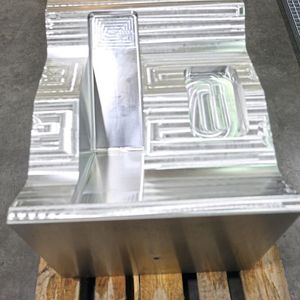
To demonstrate to the customer that the smaller holder provides the necessary stability even with long tools, the bavius team arranged a live test run under real-world conditions with the customer at bavius in Baienfurt. The plan: a 170 × 626 mm (approx. 6.69 × 24.65 inches), 260 mm (approx. 10.24 inches) deep V-shaped pocket—typical of structural components in aerospace—was to be machined into a 600 × 780 × 500 mm (approx. 23.62 × 30.71 × 19.69 inches) block of aluminum wrought alloy EN AW-7012 (AlZn6Mg2Cu).
“We contacted our long-standing partner Iscar to put together the optimum tooling package for roughing and finishing,” explains Stefan Diem. Michele Piccolantonio, Consulting and Sales for Equipment Projects, Calogero La Quatra, product specialist for Multi Master, solid carbide and PCD tools, and Anton Kress, product specialist for milling, were briefed on the task and, together with the bavius team, compiled a set precisely tailored to the job and the material.
“Aluminum can generally be machined quickly and easily, but it still has its own peculiarities,” says Anton Kress. Highly positive systems with very sharp, polished cutting edges are required here to prevent chips from sticking to the cutting edge and the surface, ensuring reliable process stability. This also results in lower cutting forces during machining. When using long tools, this brings enormous advantages and significantly reduces deflection and vibrations.
“Important selection criteria therefore included, among other things, that we use soft-cutting standard tools that support the machine’s high dynamics, allow high speeds, and run reliably to keep the system availability high,” says Michele Piccolantonio. “In addition, very high material removal rates should be possible during roughing—keyword high-volume machining—and top surface finishes during finishing,” adds Anton Kress. In the end, a tool set was created featuring cutters from the Helialu, MegaAlu, and Multimaster families.
Rapidly rough-remove a lot of material
To remove large quantities of material in a short time, Helialu milling cutters with targeted JHP cooling in a diameter of 50 millimeters (approx. 2 inches) were used. For roughing the surface contour and the first part of the pocket, the cutter was designed as a monoblock tool with a length of 110 millimeters, equipped with four indexable inserts (WSP) featuring two helical cutting edges. The peripherally ground, 22-millimeter-long (approx. 0.9 inches-long), sharp cutting edges with a highly positive rake angle and polished chip faces cut smoothly and ensure excellent chip flow. “With that, we rough-machined at a spindle speed of 25,400 revolutions per minute and were able to draw up to 148 kilowatts at the spindle,” Stefan Diem is pleased to report.
Date: 08.12.2025
Naturally, we always handle your personal data responsibly. Any personal data we receive from you is processed in accordance with applicable data protection legislation. For detailed information please see our privacy policy.
Consent to the use of data for promotional purposes
I hereby consent to Vogel Communications Group GmbH & Co. KG, Max-Planck-Str. 7-9, 97082 Würzburg including any affiliated companies according to §§ 15 et seq. AktG (hereafter: Vogel Communications Group) using my e-mail address to send editorial newsletters. A list of all affiliated companies can be found here
Newsletter content may include all products and services of any companies mentioned above, including for example specialist journals and books, events and fairs as well as event-related products and services, print and digital media offers and services such as additional (editorial) newsletters, raffles, lead campaigns, market research both online and offline, specialist webportals and e-learning offers. In case my personal telephone number has also been collected, it may be used for offers of aforementioned products, for services of the companies mentioned above, and market research purposes.
Additionally, my consent also includes the processing of my email address and telephone number for data matching for marketing purposes with select advertising partners such as LinkedIn, Google, and Meta. For this, Vogel Communications Group may transmit said data in hashed form to the advertising partners who then use said data to determine whether I am also a member of the mentioned advertising partner portals. Vogel Communications Group uses this feature for the purposes of re-targeting (up-selling, cross-selling, and customer loyalty), generating so-called look-alike audiences for acquisition of new customers, and as basis for exclusion for on-going advertising campaigns. Further information can be found in section “data matching for marketing purposes”.
In case I access protected data on Internet portals of Vogel Communications Group including any affiliated companies according to §§ 15 et seq. AktG, I need to provide further data in order to register for the access to such content. In return for this free access to editorial content, my data may be used in accordance with this consent for the purposes stated here. This does not apply to data matching for marketing purposes.
Right of revocation
I understand that I can revoke my consent at will. My revocation does not change the lawfulness of data processing that was conducted based on my consent leading up to my revocation. One option to declare my revocation is to use the contact form found at https://contact.vogel.de. In case I no longer wish to receive certain newsletters, I have subscribed to, I can also click on the unsubscribe link included at the end of a newsletter. Further information regarding my right of revocation and the implementation of it as well as the consequences of my revocation can be found in the data protection declaration, section editorial newsletter.
With a feed rate of 25,400 millimetres (approx. 1000 inch) per minute and a cutting depth of 16.5 millimetres (approx. 0.6 inches), we were able to remove up to 14.5 litres of material per minute.
Stefan Diem, Application Engineer at bavius
Bavius reliably machined the deeper areas of the pocket using Helialu insert milling cutters in lengths of 157, 207 and 257 millimetres (approx. 6.18, 8.15 and 10.12 inches), equipped with 14-mm (approx. 0.5 inches) indexable inserts—at speeds of up to 28,000 rpm, power outputs of up to 65 kilowatts, and feed rates of up to 16,500 millimeters per minute. “It was really impressive how the machine tore through the material,” says Dominik Merz.
Using four three-flute MegaAlu solid-carbide end mills with a diameter of 25 millimeters and lengths of 5xD to 8xD, bavius reduced the corner radii from R50 and R25 to R12.5 and rough-machined the pocket to its final depth of 260 millimeters. “For this we also use the only exceptions to the standard. The two cutters in 7xD and 8xD are special tools,” says Calogero La Quatra. “A particular advantage of these three-flute aluminum specialists: they have an uneven pitch, and thanks to their special cutting-edge geometry the process is almost vibration-free even with such long overhangs.”
When manufacturing aerospace components, it is not only about quickly removing large quantities of material. Equally important is high quality of the component surfaces. This makes finishing a decisive process. In the test, screw-on solid-carbide ball-nose and barrel cutters from Iscar’s Multimaster family were used, with tool lengths between 155 and 293 millimeters (approx. between 6.10 and 11.54 inches). With spindle speeds set between 21,000 and 27,000 revolutions per minute, fine, groove-free surfaces with a roughness depth of 6.5 micrometers were produced on the bottom and walls of the pocket within a few minutes.
A three-flute EBA ball-nose end mill with a diameter of 16 millimetres (approx. 0.63 inches) and an 8-mm radius (approx. 0.31 inches) was used for finishing the pocket floor. Mounted on the 200-mm shank (approx. 7.87 inches), the tool measures 280 millimetres (approx. 11.02 inches). To finish the larger sides of the pocket, bavius used the teardrop-shaped EOBA barrel cutter with a 16-mm diameter (approx. 0.63 inches), four cutting edges, and a 75-mm profile radius (approx. 2.95 in) on the 200-mm shank (approx. 7.87 in). “This barrel cutter finishes up to nine times faster than a comparable ball-nose cutter. That’s because the radius acts as a mathematical factor, and accordingly the line spacing can be increased axially by a multiple,” explains Calogero La Quatra. “And that at low speed and independently of the cutting parameters.”
Test result exceeds expectations
In just three hours, around 70 kilograms of material were removed, and the pocket was milled into the block in a process-reliable manner and to the required quality. “The combination of a dynamic, powerful machine and the right tool ensures a shorter machining time and significantly increases productivity,” Stefan Diem summarises the result. “And as predicted, the long overhanging tools with the 63/80 holder also ran absolutely stable and vibration-free.”
Using a 357-millimetre-long Helialu (approx. 14.06 inches) with a 50-millimetre diameter (approx. 1.97 inches), the mechanical engineers pushed this stability test to the limit: In addition to the V-pocket, they milled another cavity into the aluminium block with process reliability at a feed rate of 8,100 millimetres per minute (approx. 319 inches/min) and a spindle speed of 18,000 revolutions per minute.
“The test run exceeded all expectations. The customer was completely convinced and so enthusiastic that he would have preferred to take the machine with him right away,” says Dominik Merz. “Thanks to the interplay between our dynamic AeroCell and Iscar’s innovative tools, we were able to offer him an efficient solution.”