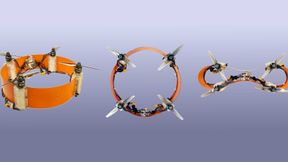
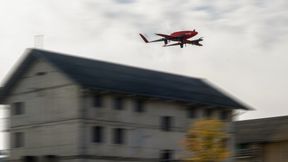
ETH Zurich researchers have developed FlexiQuad, a soft drone whose frame deforms in a controlled manner when it collides with obstacles. They have filed a patent application for the structural design. Despite its soft frame, the drone can fly fast and manoeuvre nimbly.
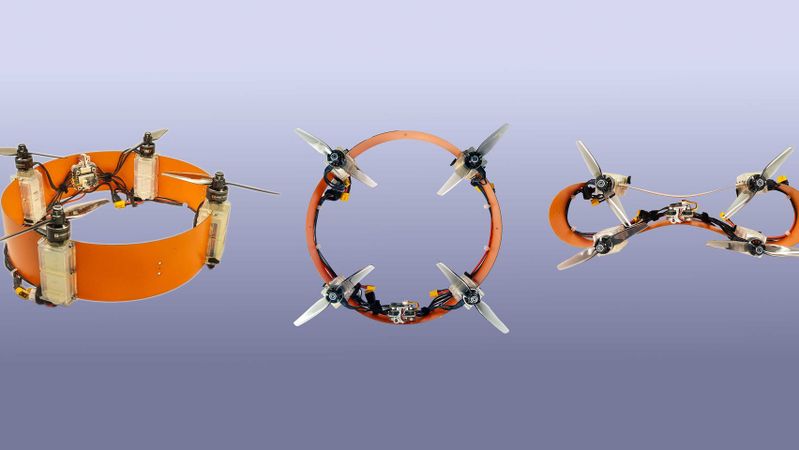
The FlexiQuad drone has four rotors and a deformable body.
(Source: Luca Girardi / ETH Zurich)
For more than a hundred years, quadcopters have been built according to the same basic principle. Four arms, each with a propeller, extend from a rigid central body. This design is ideal for precise, agile flight, but it has one major weakness—the drones are highly sensitive to unexpected contact with their surroundings. If they bump into a wall or another obstacle, they can become destabilised or even break apart.
Researchers at ETH Zurich hope to solve this problem with a new structural design. Their FlexiQuad drone features a soft, ring-shaped frame without a central body. The rotors, batteries and control module are evenly distributed along the frame. This design allows the drone to deform on impact, thereby absorbing some of the collision energy.
FlexiQuad was developed by Luca Girardi and Stefano Mintchev, then a professor at ETH Zurich, at the Environmental Robotics Lab Girardi is currently conducting research at the Mobile Robotics Lab at ETH Zurich, whilst Mintchev has since taken up a professorship in Agricultural Robotics at the University of Bonn. The pair have filed a patent application for FlexiQuad, and the invention has been nominated for this year’s Spark Award.
Soft on impact, stiff in flight
The frame is not equally flexible in all directions. As Girardi explains, the researchers drew inspiration from birds and insects. “We were interested in how stiff their wings are and how they bend them—or don’t bend them—in different directions.” Following this principle, they designed a frame that flexes laterally, where deformation is desired. Vertically, the frame is stiffer, allowing the rotors to transmit the forces needed for flight.
Despite its flexible frame, FlexiQuad is fast and nimble. “Our drone is very agile and can fly at speeds of up to 80 km/h. It reaches linear and angular accelerations comparable to those of rigid drones. Soft doesn’t automatically mean slow,” says Girardi. In collision tests, the researchers flew FlexiQuad into obstacles at speeds of up to around 25 km/h. The flexible frame briefly deforms on impact, reducing the forces acting on the drone and allowing it to continue flying. According to Girardi, the test speed was limited mainly by the space needed to accelerate the drone before impact. This flexibility can also be used to grasp and carry objects.
Use in searches for missing persons and to defend against unwanted drones
The patent envisages applications in cluttered environments, including inspecting ships’ ballast tanks, supporting search-and-rescue operations in collapsed buildings, and taking environmental measurements in dense forests. Girardi also foresees further applications fitting a net within FlexiQuad’s hollow center to capture rogue or unwanted drones.
Deformability could be particularly advantageous during inspections, as a larger drone could carry more sensors and stay airborne longer while squeezing through narrow openings. This concept could also be useful for transporting small items. In tests, FlexiQuad has already grasped, carried and set down a soft first-aid kit, and lifted a payload heavier than the drone itself.
“When a mission requires a drone to cover long distances quickly, a drone is supposed to fly fast, but its sensors may detect obstacles—such as a tree—too late to avoid a collision. For a rigid drone, such an impact can end the mission. FlexiQuad’s ability to withstand collisions could allow it to fly at speeds that would be too risky for a drone that relies entirely on detecting and avoiding obstacles” Girardi explains.
FlexiQuad also features a modular and cost-effective design. The airframe materials cost less than 15 Swiss Francs (approx. 18 USD), with ample margin for further reductions. When you open the ring, the flat frame elements can be compactly stowed. Girardi already transported a prototype this way in a medium-sized suitcase. With quick-release fasteners and slide-in batteries, the drone could, in the future, be assembled on site in a short time, the researcher explains.
Date: 08.12.2025
Naturally, we always handle your personal data responsibly. Any personal data we receive from you is processed in accordance with applicable data protection legislation. For detailed information please see our privacy policy.
Consent to the use of data for promotional purposes
I hereby consent to Vogel Communications Group GmbH & Co. KG, Max-Planck-Str. 7-9, 97082 Würzburg including any affiliated companies according to §§ 15 et seq. AktG (hereafter: Vogel Communications Group) using my e-mail address to send editorial newsletters. A list of all affiliated companies can be found here
Newsletter content may include all products and services of any companies mentioned above, including for example specialist journals and books, events and fairs as well as event-related products and services, print and digital media offers and services such as additional (editorial) newsletters, raffles, lead campaigns, market research both online and offline, specialist webportals and e-learning offers. In case my personal telephone number has also been collected, it may be used for offers of aforementioned products, for services of the companies mentioned above, and market research purposes.
Additionally, my consent also includes the processing of my email address and telephone number for data matching for marketing purposes with select advertising partners such as LinkedIn, Google, and Meta. For this, Vogel Communications Group may transmit said data in hashed form to the advertising partners who then use said data to determine whether I am also a member of the mentioned advertising partner portals. Vogel Communications Group uses this feature for the purposes of re-targeting (up-selling, cross-selling, and customer loyalty), generating so-called look-alike audiences for acquisition of new customers, and as basis for exclusion for on-going advertising campaigns. Further information can be found in section “data matching for marketing purposes”.
In case I access protected data on Internet portals of Vogel Communications Group including any affiliated companies according to §§ 15 et seq. AktG, I need to provide further data in order to register for the access to such content. In return for this free access to editorial content, my data may be used in accordance with this consent for the purposes stated here. This does not apply to data matching for marketing purposes.
Right of revocation
I understand that I can revoke my consent at will. My revocation does not change the lawfulness of data processing that was conducted based on my consent leading up to my revocation. One option to declare my revocation is to use the contact form found at https://contact.vogel.de. In case I no longer wish to receive certain newsletters, I have subscribed to, I can also click on the unsubscribe link included at the end of a newsletter. Further information regarding my right of revocation and the implementation of it as well as the consequences of my revocation can be found in the data protection declaration, section editorial newsletter.
What flexible drones still need to learn
Before FlexiQuad can be deployed outside the laboratory, it needs to be able to perceive its surroundings reliably and navigate autonomously. “We continue to challenge the century-old tradition of designing drones with rigid structures, which exists because a rigid structure makes precise control easier,” says Girardi.
After a collision, oscillations in the flexible frame can blur camera images and make navigation more difficult. In their latest work, Girardi and his colleagues therefore took inspiration from natural reflexes: using reinforcement learning, they taught FlexiQuad to first stabilise itself after an impact using its onboard motion sensors and then return to autonomous flight.
At the same time, the team is investigating whether the frame’s flexibility could itself become a source of information. Inspired by how insects sense deformations in their wings, the researchers are exploring whether measurements of how FlexiQuad bends and vibrates could one day provide additional feedback for flight control.
Girardi has been developing the flexible drone for around five years. One moment that particularly stayed with him was when FlexiQuad first took off without a central reinforcement: “At first, I was sceptical whether the drone would fly without the central reinforcement. But I really liked the approach. Then we tried it—and it worked.”