Japan’s MMX mission is set to launch in October 2026, carrying the German-French Idefix® rover on a pioneering journey to Mars and its moons.
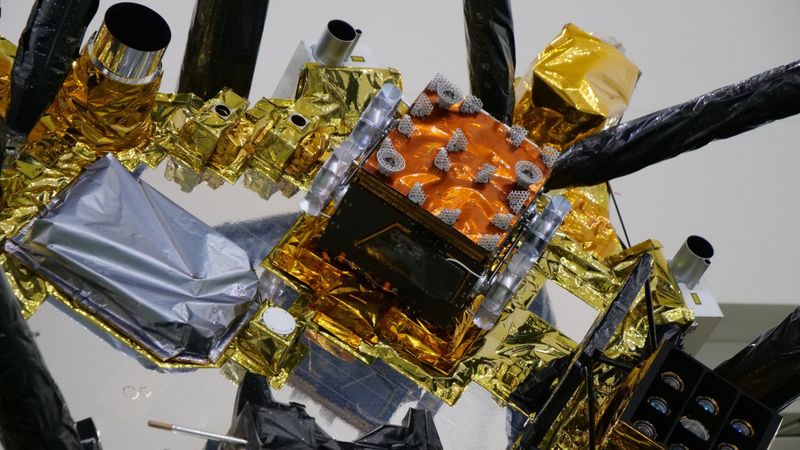
The Idefix® rover is firmly mounted between the landing legs of the MMX spacecraft. Despite its compact size, Idefix® essentially contains all the elements of a fully fledged scientific rover, yet thanks to its highly integrated design, it has a mass of only 25 kilograms (approx. 55 pounds).
(Source: DLR (CC BY-NC-ND 3.0))
The MMX (Martian Moons eXploration) spacecraft will launch for Mars on October 19, 2026, at 9:41 p.m. CEST. The Japanese space agency Japanese Aerospace Exploration Agency (JAXA) recently announced the date. It is the largest Japanese mission to the solar system to date: for the first time ever, it will land on the Martian moon Phobos and, in 2031, bring the first-ever samples from Phobos and thus from the Martian system back to Earth. An important part of the mission is the German-French Idefix® rover, which will become the first lander ever to touch down on Phobos in 2029, in order to explore its surface at close range for 100 days.
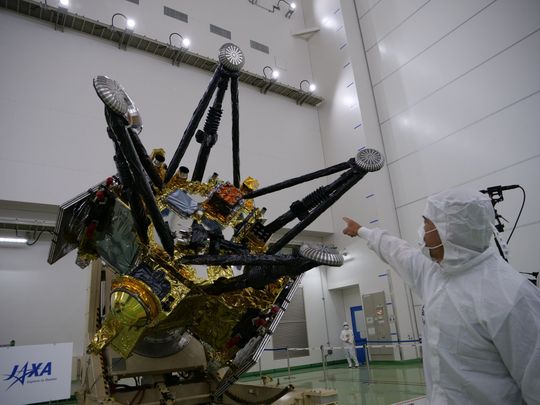
In August, JAXA presented the completed spacecraft, including the mounted rover, to the public at the spaceport in Tanegashima in the presence of the German Aerospace Center (DLR). DLR and the French space agency CNES (Centre National d’Études Spatiales) jointly provided Idefix®. The final launch preparations are now under way, including mounting the spacecraft on JAXA’s new, powerful H3 rocket, which will carry MMX to the Martian system. The launch window to Mars extends until November 7, 2026.
“Our Idefix® rover and the MMX spacecraft of our Japanese partners will begin their journey to the Martian system as one unit. Only at Phobos will their paths diverge. There, Idefix® will make history—as the first rover ever to leave tracks on a Martian moon,” said DLR Project Manager Prof. Markus Grebenstein and CNES Project Manager Julien Baroukh.
Idefix®—a German-French rover for the Martian moon Phobos
DLR completed the partially assembled Idefix® rover and two instruments as early as 2022. It was subsequently fully assembled at the French space agency CNES in Toulouse (Germany) and supplemented with additional instruments and components. After completion in July 2023, Idefix® successfully underwent space qualification tests. The focus was on ensuring flawless operation and resistance to the vibrations experienced during rocket launch, as well as the extreme temperatures on Phobos, ranging from minus 170 to 70 degrees Celsius (approx. minus 274 to 158 degrees Fahrenheit). From 2024 onwards, the rover was integrated into the MMX mother spacecraft in Japan.
In August 2026, JAXA presented the completed spacecraft to the public. The approximately beverage-crate-sized Idefix® was clearly visible in its cruise position between the spacecraft’s landing legs. What makes Idefix® particularly special is its extremely compact design. Idefix® essentially contains all the elements of a fully fledged scientific rover, yet thanks to its highly integrated design, it has a mass of only 25 kilograms (approx. 55 pounds). Due to its low weight and the low gravity, Idefix® will be able to land directly on Phobos without the assistance of a landing vehicle.
Around the turn of the year 2028/2029, the MMX mother spacecraft is expected to release the Idefix® rover from an altitude of approximately 40 meters (approx. 131 feet) above the surface, sending it into free fall towards Phobos. Once it has landed, it will right itself autonomously and will then be ready for the approximately three-month mission phase on the Martian moon. On the surface, Idefix® will specifically search for and analyse scientifically interesting areas of Phobos. In doing so, Idefix® will break new technological ground, as no wheeled exploration vehicle has ever driven on a celestial body with less than one-thousandth of Earth’s gravitational force. The rover’s preliminary exploration of the surface will also help prepare the mother spacecraft for a landing on Phobos at a suitable location for sample collection.
“More than a decade ago, we began the MMX journey. Despite countless challenges, the dedication and ingenuity of scientists and engineers throughout Japan and around the world have brought us to this moment. The launch of MMX will be an emotional milestone for all of us,” said Dr. Yasuhiro Kawakatsu, MMX Project Manager at JAXA.
Date: 08.12.2025
Naturally, we always handle your personal data responsibly. Any personal data we receive from you is processed in accordance with applicable data protection legislation. For detailed information please see our privacy policy.
Consent to the use of data for promotional purposes
I hereby consent to Vogel Communications Group GmbH & Co. KG, Max-Planck-Str. 7-9, 97082 Würzburg including any affiliated companies according to §§ 15 et seq. AktG (hereafter: Vogel Communications Group) using my e-mail address to send editorial newsletters. A list of all affiliated companies can be found here
Newsletter content may include all products and services of any companies mentioned above, including for example specialist journals and books, events and fairs as well as event-related products and services, print and digital media offers and services such as additional (editorial) newsletters, raffles, lead campaigns, market research both online and offline, specialist webportals and e-learning offers. In case my personal telephone number has also been collected, it may be used for offers of aforementioned products, for services of the companies mentioned above, and market research purposes.
Additionally, my consent also includes the processing of my email address and telephone number for data matching for marketing purposes with select advertising partners such as LinkedIn, Google, and Meta. For this, Vogel Communications Group may transmit said data in hashed form to the advertising partners who then use said data to determine whether I am also a member of the mentioned advertising partner portals. Vogel Communications Group uses this feature for the purposes of re-targeting (up-selling, cross-selling, and customer loyalty), generating so-called look-alike audiences for acquisition of new customers, and as basis for exclusion for on-going advertising campaigns. Further information can be found in section “data matching for marketing purposes”.
In case I access protected data on Internet portals of Vogel Communications Group including any affiliated companies according to §§ 15 et seq. AktG, I need to provide further data in order to register for the access to such content. In return for this free access to editorial content, my data may be used in accordance with this consent for the purposes stated here. This does not apply to data matching for marketing purposes.
Right of revocation
I understand that I can revoke my consent at will. My revocation does not change the lawfulness of data processing that was conducted based on my consent leading up to my revocation. One option to declare my revocation is to use the contact form found at https://contact.vogel.de. In case I no longer wish to receive certain newsletters, I have subscribed to, I can also click on the unsubscribe link included at the end of a newsletter. Further information regarding my right of revocation and the implementation of it as well as the consequences of my revocation can be found in the data protection declaration, section editorial newsletter.
MMX—a Japanese spacecraft for exploring the Martian moons
The exploration and landing module of the spacecraft with the Idefix® rover and return module. At the end of the MMX mission, this module will bring samples from the Martian moon Phobos back to Earth.
(Source: DLR)
The launch of the MMX mission is scheduled for October 19, 2026, with the launch window to Mars lasting 19 days. After approximately one year of flight, the MMX spacecraft will reach Mars in the second half of 2027 and enter its orbit. The eight scientific instruments on the exploration module will then begin mapping and characterising the surfaces of Phobos and Deimos. To meet the mission’s extensive requirements, the Japanese space agency JAXA has opted for a three-module spacecraft design, making MMX the heaviest Japanese interplanetary spacecraft to date: a powerful propulsion module will provide the transfer and braking manoeuvres at Mars, an exploration and landing module will carry the scientific instruments, including telescope cameras, spectrometers and the German-French Idefix® rover, while a return module will include the sample-return capsule with its thermal shields for the journey back to Earth.
Where did “fear” and “terror” come from?
Phobos and Deimos are, alongside Earth’s Moon, the only two moons in the inner solar system. They are much smaller than Earth’s Moon and are not spherical, but irregularly shaped. Phobos has a maximum diameter of just under 27 kilometres (approx. 17 miles), while Deimos measures only 15 kilometres (approx. 9 miles). The moons Phobos and Deimos received their names, meaning “fear” and “terror”, respectively, after their discovery in 1877 by American astronomer Asaph Hall. In Homer’s Iliad, they are two brothers accompanying the Greek god of war Ares (the Roman god of war Mars). Around 150 years after their discovery, the origin of the Martian moons remains an open question: are they captured asteroids, or did they form after a massive meteorite impact on Mars? MMX is intended to help answer this question and shed light on the history of Phobos and Deimos.
The formation of the Martian system is also a key to gaining a better understanding of the processes involved in planet formation throughout the solar system. In any case, traces of Martian rocks are likely to be found on the surface of Phobos, having landed there as ejecta from later asteroid impacts on Phobos. This means that the Phobos samples could also contain material from Mars, which could then be transported to Earth in the return capsule and made available for analysis in terrestrial laboratories.




:quality(80)/p7i.vogel.de/wcms/eb/e8/ebe871d26ae9dac0e71e99e23a8d7b43/c92090dc-3b0d-5e12-bf8b-0a763c150000-1506x847v1.png "Pioneering launch: The first Ariane 1 lifts off on December 24, 1979. (Source: ESA/CNES/Arianespace)")
:quality(80)/p7i.vogel.de/wcms/71/ec/71ecf89b9e6300685faabfbbf59343bb/0132787041v1.jpeg "Archer plans to acquire the Boeing subsidiaries, as well as Wisk, SkyGrid, and Insitu. (Source: Created with AI)")
:quality(80)/p7i.vogel.de/wcms/32/7e/327ed05e51beca5080e525480a58a4f1/260806-a-ut471-1002-1920x1081v1.jpeg "A test system of Covenant Industries' Anthem cruise missile during trials in Morocco. (Photo: US Army/Capt. Jordan Beagle - Public Domain)")
:quality(80)/p7i.vogel.de/wcms/0d/ed/0dedc1c5dde85d778033c134cb1bc838/chatgpt-image-28--aug--2026-01-42-15-1672x940v1.png "The U.S. Army plans to deploy nuclear microreactors at an initial five locations to strengthen the resilience of its energy supply. (Picture: AI-generated)")
:quality(80)/p7i.vogel.de/wcms/9f/07/9f070dc919a95a6f19bcc1848e9f3089/image-2000-c966ec423c4d86c3769c5a9f1fff7655-1920x1079v1.jpeg "The Idefix® rover is firmly mounted between the landing legs of the MMX spacecraft. Despite its compact size, Idefix® essentially contains all the elements of a fully fledged scientific rover, yet thanks to its highly integrated design, it has a mass of only 25 kilograms (approx. 55 pounds). (Source: DLR (CC BY-NC-ND 3.0))")
:quality(80)/p7i.vogel.de/wcms/e5/a0/e5a0e00314fd3da7e907765929162d52/bx-25-10-produktanwendungen-08-1-800x450v1.jpeg "Approved in the relevant colour shades of the Swiss military: Instead of using wet coatings, industrial coaters can now also use powder coatings for military applications in Switzerland. (Source: Brillux Industrielack)")
:quality(80)/p7i.vogel.de/wcms/13/d3/13d32efa083b6345f06f1e1f3b085330/0132829332v1.jpeg "Powell Electronics expands its portfolio with GAPS and HAPS proximity sensors from Honeywell for aerospace applications. (Source: Honeywell)")
:quality(80)/p7i.vogel.de/wcms/ad/2c/ad2c22bc21956e7675fa22f46a7c7372/198989-1920x1079v1.jpeg "Successful launch of the FV-014 Loitering Munition System. (Source: Rheinmetall AG)")
:quality(80)/p7i.vogel.de/wcms/d8/3c/d83c20ea0c25c1411e3c3bf4eb8fd927/catl-passagier-evtols-2-1920x1079v1.jpeg "(Source: CATL)")
:quality(80)/p7i.vogel.de/wcms/18/d1/18d16c77426eaa7812c7c21ddce79374/0132853627v1.jpeg "Heart Aerospace has completed the first flight with its fully battery-electric aircraft study X1. (Source: Heart Aerospace)")
:quality(80)/p7i.vogel.de/wcms/6f/cd/6fcd5adc102297f720e2fda94abd8277/0132966421v1.jpeg "Aerofugia and Sysgo have entered into a cooperation. (Source: Aerofugia)")
:quality(80)/p7i.vogel.de/wcms/b3/7c/b37c4ae902b609855f68e9795cc71a9d/251116-pegasus-02-wichita-bombardier-1920x1080v1.jpeg "A modified Bombardier Global 6000 for Germany’s PEGASUS program at Bombardier Defense in Wichita, Kansas. The aircraft is one of three platforms being prepared for the Bundeswehr’s future airborne signals-intelligence capability. (Source: Bombardier Defense)")
:quality(80)/p7i.vogel.de/wcms/6f/fe/6ffef325e7f233cc3521943158eb1ebd/0132763535v1.jpeg "Two companies are planning to establish, for the first time in 2027, an optical laser communication link directly between a satellite in low Earth orbit (LEO) and a re-entering spacecraft. (Source: ATMOS Space Cargo)")
:quality(80)/p7i.vogel.de/wcms/b2/6a/b26a277a3578fc2956b2c30d3b3b0146/0132928076v1.jpeg "Compact and standardised: CubeSats enable cost-effective space missions and are increasingly serving as a platform for testing new technologies—from sensors and communications to innovative power systems. (Source: City Labs, Inc.)")
:quality(80)/p7i.vogel.de/wcms/6d/f2/6df225601e1f8d4f9d07d53fd527cdb9/epc7050-7065-7066-pr-graphic-clean-1500x844v1.jpeg "(Source: EPC Space)")
:quality(80)/p7i.vogel.de/wcms/2a/ae/2aae2c389f328a77a3c1eb502b79f019/mc1779-image-space-csac-sa-65-1898x1067v1.jpeg "The Space CSAC-SA65 combines atomic-clock accuracy with built-in 1 PPS disciplining and low-power consumption. (Source: Microchip Technology Inc.)")
:quality(80)/p7i.vogel.de/wcms/ba/60/ba60f1a3891348d3bfb414721911c7bd/chatgpt-image-28--aug--2026-11-44-26-1228x691v1.png "(Source: AI - generated / ChatGPT)")
:quality(80)/p7i.vogel.de/wcms/86/bb/86bb77517bba1aa32ffdd827d3e86934/s960-vizgard-960-x-640px-2-960x540v1.png "Vizgard’s FortifAI in action (Source: GOV.UK)")
:quality(80)/p7i.vogel.de/wcms/c2/4f/c24fcb0b6f2bdf01f06c2c27973dc774/0132916289v1.jpeg "With this unmanned flight system, a novel reconnaissance drone, the Lower Saxony company Aerodata aims to help combat drone attacks in Germany more effectively ... (Source: Aerodata)")
:quality(80)/p7i.vogel.de/wcms/f8/8e/f88e718457a57ca9d2a9432b5e032c53/amboss-test-c-fraunhoferidmt-hanneskalter-2720x1613px-1440x810v1.jpeg "Hearing drones before you see them: Fraunhofer IDMT’s solution detects and localizes drones also beyond the line of sight using intelligent acoustic sensing. (Source: Fraunhofer IDMT/ Hannes Kalter)")
:quality(80)/p7i.vogel.de/wcms/90/a8/90a849f0023f11d1eb642eb4751a0321/bild2-h-c3-a4nel-ict-20truck-20and-20trailer-20parts-4320x2429v1.jpeg "Product information is visible at all times and retrieval of items
is confirmed by employees directly on the display of the Hänel MP 14 N
controller. (Source: René Marks)")
:quality(80)/p7i.vogel.de/wcms/4e/ca/4ecaa39f247490eded591b652c33aee3/thilmann-hcp-web-20kleiner-20ausschnitt-1442x811v1.jpeg "Entering the defence market can be challenging for start-ups, says HCP Sense CEO Ansgar Thilmann. (Picture: HCP Sense)")
:quality(80)/p7i.vogel.de/wcms/7a/51/7a511b80041d3f1335f3a5aa56fe75da/delivery-7022432-1280-1280x720v1.png "(Source: Mohamed_hassan)")
:quality(80)/p7i.vogel.de/wcms/f9/2f/f92f1ef8c739c34c70d99f7b0997621b/stra007-20--20cover-20image-5472x3076v1.jpeg "(Source: Stratasys)")
:quality(80)/p7i.vogel.de/wcms/ec/a9/eca9062ccbe4b042f8515846340410d8/aerospace-and-defence-stairways-platforms-and-much-morev1.jpeg "Modular constructions enable flexible modification. That applies to larger structures such as stairways and platforms, too. And that means aerospace and defence companies can reconfigure their maintenance platforms fast (itemitem)")
:quality(80)/p7i.vogel.de/wcms/30/2a/302a7b5723ad38fbde812fd3a468ad04/safety-on-stairways-in-industry-key-considerationsv1.jpeg "Stairways and platforms are used widely in maintenance and assembly areas in the aerospace and defence sectors. (Source: item)")
:quality(80)/p7i.vogel.de/wcms/f3/4e/f34ed744bb30817d3432c7ad522e6f30/engine-1v1.jpeg "Engineering with aluminium profiles really can be this easy – the item Engineeringtool and its smart functions help you save valuable time. (Source: item)")
:fill(fff,0)/images.vogel.de/vogelonline/companyimg/84700/84735/65.jpg "logo_item_rgb_neu.jpg ()")
:quality(80)/p7i.vogel.de/wcms/bb/39/bb39d9fc067e723c1f6a4a9a0896bf6f/esa-20artemis-1920x1079v1.jpeg "esa-20artemis-1920x1079v1 (Source: NASA)")
:quality(80)/p7i.vogel.de/wcms/31/f5/31f56cbdc291dc844a5ec34464d99a65/dsc4647-small-1200x674v1.jpeg "ESA and JAXA signed the agreement in the presence of European and Japanese institutional and industry leaders. (Source: Jorge Pérez de Lara)")