What do you get when scientists and engineers on a new degree programme join forces to tinker with new business models, concepts and case studies for the space industry? The Master’s in Space Systems has produced its first graduates, and they join the programme director to reflect on the journey.
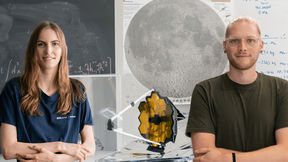
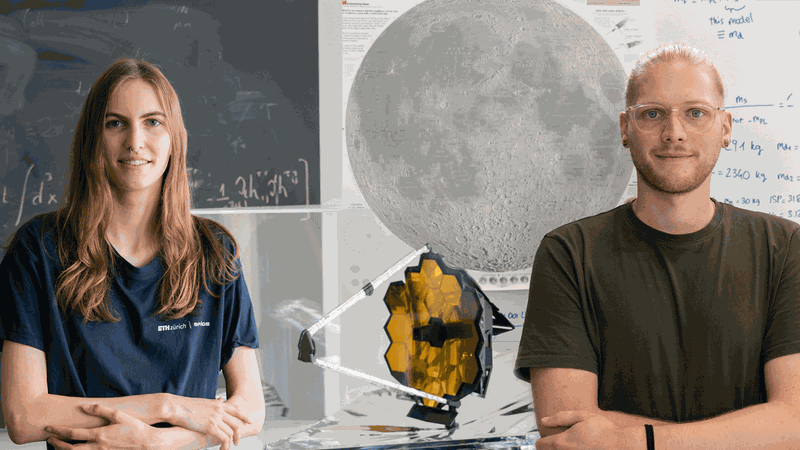
Kira Seliner and Daniel Schmid were among the first Space Master’s students at ETH Zurich.
(Source: Nicole Davidson / ETH Zurich)
No degree programme at ETH Zurich has ever got off the ground this fast: it took just eight months from the start of planning in 2023 to the first student signing up for the Master’s in Space Systems. By September 2024, the first students were already attending lectures, including Kira Seliner and Daniel Schmid.
“What I enjoyed most was that we didn’t just learn technical knowledge but also gained an understanding of the entire spaceflight system,” says Schmid two years later. “I’ve always been fascinated by space,” adds Seliner. “But for a long time, I thought studying this field in Switzerland was unrealistic.” The degree programme, she says, made it possible for her to pursue her career ambitions in space and sustainability.
ETH had wanted to offer a space degree for quite a while. What finally got the programme off the ground was Thomas Zurbuchen, formerly of NASA, returning to Switzerland in 2023 as a professor and head of ETH Zurich Space. Under his direction, the interests of various stakeholders were merged and channelled into the new Master’s in Space Systems. Since then, the number of students has been growing: there were 27 in 2024, 37 in 2025 and 47 starting this fall. There are about three applications for every slot in the programme.
From space communications to robotics
Programme director Simon Stähler describes the past two years as intense. “We had to get a lot of things off the ground at the same time,” he says. “But it was exciting to work with so many people: with professors from different departments, and with students who each bring a very different outlook.”
Over the course of four semesters, students learn about the innerworkings of launch vehicles, satellites, telescopes and spacecraft alongside astrophysics and the fundamentals of Earth and planetary sciences. Students can choose a specialisation in aerospace engineering, space communications, robotics, Earth observation or planetary sciences.
A motley crew of astrophysicists and mechanical engineers
The students come from more than ten different fields of study, which is intentional. The Master’s programme trains systems engineers who can oversee a complex system—such as a satellite—from concept through to operation. “You can't build something that satisfies a scientific mission’s requirements unless you understand where those requirements come from,” says Stähler.
Growth happens in both directions: the scientists gradually find their feet as engineers, while the engineering students get a taste for planetary research. “Suddenly, they were the ones asking the most questions during a lecture on comets,” says Stähler. “Why is there water in there? Why is that important?”
Designing a Mars camera for the ESA
Team projects are at the heart of the programme. One minute, students are dropping a home-built satellite from an aeroplane over Dübendorf; the next, they’re designing a new Mars camera for the European Space Agency (ESA) in a matter of weeks. “It’s exactly this kind of interdisciplinary work in the project groups that brings the students closer together,” says Stähler.
The private sector is involved too: an engineer from the Dübendorf start-up Stellar Alpina teaches propulsion systems. Teaching is also done by staff from EPFL, the University of Bern and the Paul Scherrer Institute. The first graduates of the Master’s programme are now working at aerospace companies in Germany and the United States or pursuing their doctoral studies.
It would be a bit much to claim we’ve got it all figured out.
Simon Stähler, programme director Master’s in Space Systems
Trial by fire
The team keeps tweaking the programme as it goes. “We wanted to hit the ground running so we could see first-hand what works and what doesn’t,” says Stähler. That fits the thinking behind what’s known as New Space: the young, commercial end of the space industry, where development happens in quick, short cycles.
That’s how the team realised the first semester was simply overloaded. “Learning to work under pressure matters,” says Stähler. “But past a certain point, quality starts to slip, teaching included.” So one course now stretches across two semesters rather than being squeezed into one. The team leans heavily on teaching assistants from the more advanced cohort, who coach the project groups and design exercises of their own.
Date: 08.12.2025
Naturally, we always handle your personal data responsibly. Any personal data we receive from you is processed in accordance with applicable data protection legislation. For detailed information please see our privacy policy.
Consent to the use of data for promotional purposes
I hereby consent to Vogel Communications Group GmbH & Co. KG, Max-Planck-Str. 7-9, 97082 Würzburg including any affiliated companies according to §§ 15 et seq. AktG (hereafter: Vogel Communications Group) using my e-mail address to send editorial newsletters. A list of all affiliated companies can be found here
Newsletter content may include all products and services of any companies mentioned above, including for example specialist journals and books, events and fairs as well as event-related products and services, print and digital media offers and services such as additional (editorial) newsletters, raffles, lead campaigns, market research both online and offline, specialist webportals and e-learning offers. In case my personal telephone number has also been collected, it may be used for offers of aforementioned products, for services of the companies mentioned above, and market research purposes.
Additionally, my consent also includes the processing of my email address and telephone number for data matching for marketing purposes with select advertising partners such as LinkedIn, Google, and Meta. For this, Vogel Communications Group may transmit said data in hashed form to the advertising partners who then use said data to determine whether I am also a member of the mentioned advertising partner portals. Vogel Communications Group uses this feature for the purposes of re-targeting (up-selling, cross-selling, and customer loyalty), generating so-called look-alike audiences for acquisition of new customers, and as basis for exclusion for on-going advertising campaigns. Further information can be found in section “data matching for marketing purposes”.
In case I access protected data on Internet portals of Vogel Communications Group including any affiliated companies according to §§ 15 et seq. AktG, I need to provide further data in order to register for the access to such content. In return for this free access to editorial content, my data may be used in accordance with this consent for the purposes stated here. This does not apply to data matching for marketing purposes.
Right of revocation
I understand that I can revoke my consent at will. My revocation does not change the lawfulness of data processing that was conducted based on my consent leading up to my revocation. One option to declare my revocation is to use the contact form found at https://contact.vogel.de. In case I no longer wish to receive certain newsletters, I have subscribed to, I can also click on the unsubscribe link included at the end of a newsletter. Further information regarding my right of revocation and the implementation of it as well as the consequences of my revocation can be found in the data protection declaration, section editorial newsletter.
More startups, more applications from universities of applied sciences
The ETH Space team wants to give students a bigger nudge towards starting their own businesses, with the ZKB Philanthropy Foundation's “Lift Off Challenge” as one possible route. There, teams receive seed funding and mentoring to turn an idea into a business
Looking ahead, Stähler hopes that more Bachelor’s degree graduates from universities of applied sciences will apply for the Master’s programme. “Students from universities of applied sciences have often already been in the workplace for two or three years and know how to put ideas into practice,” he says. “That can be very enriching.”
His verdict after the first graduating class? “It would be a bit much to claim we’ve got it all figured out,” says Stähler, who notes that new challenges keep popping up. “It's a bit overwhelming sometimes, but it's still hugely exciting.”