For the first time, companies are planning a direct optical laser link between a satellite in low Earth orbit (LEO) and a re-entering spacecraft for the year 2027. This partnership sets new standards for European space logistics and presents exciting hardware challenges for the field of communications engineering.
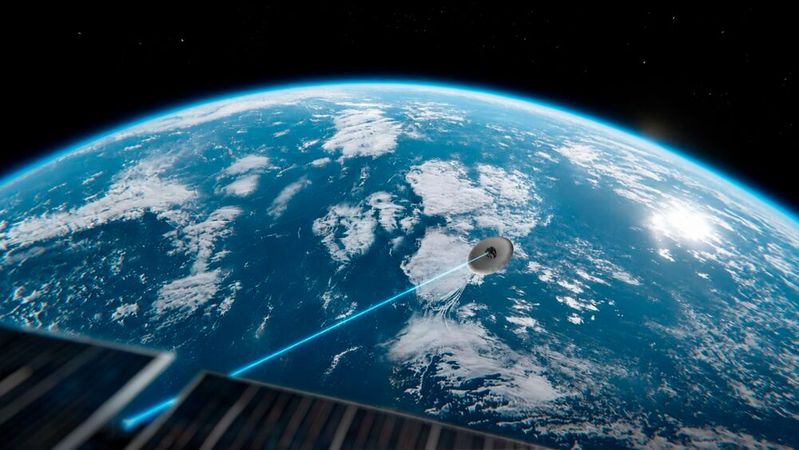
Two companies are planning to establish, for the first time in 2027, an optical laser communication link directly between a satellite in low Earth orbit (LEO) and a re-entering spacecraft.
(Source: ATMOS Space Cargo)
Traditional radio communication quickly reaches its physical limits during space missions, especially during the critical reentry into Earth’s atmosphere. Due to the plasma gas layer formed during reentry, the telemetry link is frequently lost or severely disrupted. This is referred to as a radio blackout. For engineers, this often means a nerve-wracking period of flying blind until the capsule is physically recovered.
This is where laser communication—known as free-space optical communications—comes into play. It uses highly focused infrared beams that not only enable data rates up to 100 times higher than those of conventional radio, but are also less susceptible to typical interference signals.
While laser communication between satellites or from satellites to Earth (ground-to-space) has made great strides in recent years, the connection between a moving re-entry vehicle and an orbiting satellite is uncharted technological territory. For electronics developers and system architects, this means designing compact, vibration-resistant, and highly thermally resistant optical terminals that must perform reliably in the harsh environments of space and reentry.
PHOENIX 2 Meets ATLAS-X
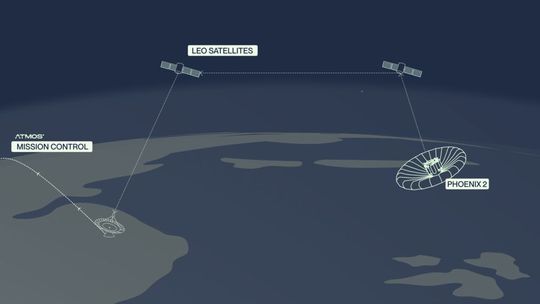
Schematic representation of the joint demonstration mission involving LEO satellites, the PHOENIX 2 reentry vehicle, and ground control.
(Source: ATMOS Space Cargo)
Astrolight, a Lithuanian technology company specialising in laser communication solutions, and ATMOS Space Cargo, a provider of commercial cargo return services from orbit, have signed a memorandum of understanding (MoU) to close this gap. A joint demonstration mission is scheduled for 2027.
Astrolicht’s ATLAS-X optical terminal is to be installed both on board the LEO test satellite and on ATMOS’s PHOENIX 2 re-entry vehicle. The goal is to establish a real-time, optical space-to-space link and transmit system and payload data at a data rate of up to 2.5 Gbit/s. This will take place throughout the entire orbital flight, extending into the critical phase of atmospheric reentry.
Limited installation space and harsh environmental conditions
A key technical challenge in missions of this kind is the so-called SWaP profile—that is, size, weight, and power consumption. On board reentry capsules such as PHOENIX, communication components compete fiercely with the actual payload and essential subsystems for mass and energy.
The ATLAS-X terminal was specifically designed as a compact, low-SWaP solution to enable the integration of a high-speed optical connection into small satellites or capsules, even under strict constraints.
“Until now, this capability has mostly been tested only under laboratory-like conditions on Earth. Together with ATMOS Space Cargo, we are now taking it into space,” explains Laurynas Mačiulis, CEO of Astrolight. “Our goal is for re-entry vehicles to be able to connect directly with satellites and future constellations. This will provide operators with maximum real-time data, making control safer and more scalable.”
Strategic importance for Europe
Another factor behind the collaboration is Europe’s pursuit of technological independence in space logistics. To date, Europe has been heavily reliant on international partners to return cargo from low Earth orbit. Initiatives such as the European Space Agency’s (ESA) LEO Cargo Return Services Initiative aim to build up Europe’s own capabilities.
With growing commercial interest in space experiments, semiconductor manufacturing in microgravity, and the return of critical scientific samples, the demand for continuous telemetry is rising rapidly. Sebastian Klaus, CEO of ATMOS Space Cargo, emphasises the importance of the partnership: “As cargo return missions become more autonomous and data-intensive, seamless connectivity throughout the entire mission cycle is essential. Our partnership with ATMOS [Editor’s note: referring to Astrolight] is a crucial step toward firmly establishing laser communication as a strategic layer for payload monitoring and autonomous reentry within the PHOENIX system.”
Date: 08.12.2025
Naturally, we always handle your personal data responsibly. Any personal data we receive from you is processed in accordance with applicable data protection legislation. For detailed information please see our privacy policy.
Consent to the use of data for promotional purposes
I hereby consent to Vogel Communications Group GmbH & Co. KG, Max-Planck-Str. 7-9, 97082 Würzburg including any affiliated companies according to §§ 15 et seq. AktG (hereafter: Vogel Communications Group) using my e-mail address to send editorial newsletters. A list of all affiliated companies can be found here
Newsletter content may include all products and services of any companies mentioned above, including for example specialist journals and books, events and fairs as well as event-related products and services, print and digital media offers and services such as additional (editorial) newsletters, raffles, lead campaigns, market research both online and offline, specialist webportals and e-learning offers. In case my personal telephone number has also been collected, it may be used for offers of aforementioned products, for services of the companies mentioned above, and market research purposes.
Additionally, my consent also includes the processing of my email address and telephone number for data matching for marketing purposes with select advertising partners such as LinkedIn, Google, and Meta. For this, Vogel Communications Group may transmit said data in hashed form to the advertising partners who then use said data to determine whether I am also a member of the mentioned advertising partner portals. Vogel Communications Group uses this feature for the purposes of re-targeting (up-selling, cross-selling, and customer loyalty), generating so-called look-alike audiences for acquisition of new customers, and as basis for exclusion for on-going advertising campaigns. Further information can be found in section “data matching for marketing purposes”.
In case I access protected data on Internet portals of Vogel Communications Group including any affiliated companies according to §§ 15 et seq. AktG, I need to provide further data in order to register for the access to such content. In return for this free access to editorial content, my data may be used in accordance with this consent for the purposes stated here. This does not apply to data matching for marketing purposes.
Right of revocation
I understand that I can revoke my consent at will. My revocation does not change the lawfulness of data processing that was conducted based on my consent leading up to my revocation. One option to declare my revocation is to use the contact form found at https://contact.vogel.de. In case I no longer wish to receive certain newsletters, I have subscribed to, I can also click on the unsubscribe link included at the end of a newsletter. Further information regarding my right of revocation and the implementation of it as well as the consequences of my revocation can be found in the data protection declaration, section editorial newsletter.
If the demonstration in 2027 is successful, it is likely to not only increase acceptance of optical satellite links for commercial and mission-critical applications, but also set new standards for the reliability and data availability of future European space missions. (heh)




:quality(80)/p7i.vogel.de/wcms/eb/e8/ebe871d26ae9dac0e71e99e23a8d7b43/c92090dc-3b0d-5e12-bf8b-0a763c150000-1506x847v1.png "Pioneering launch: The first Ariane 1 lifts off on December 24, 1979. (Source: ESA/CNES/Arianespace)")
:quality(80)/p7i.vogel.de/wcms/71/ec/71ecf89b9e6300685faabfbbf59343bb/0132787041v1.jpeg "Archer plans to acquire the Boeing subsidiaries, as well as Wisk, SkyGrid, and Insitu. (Source: Created with AI)")
:quality(80)/p7i.vogel.de/wcms/32/7e/327ed05e51beca5080e525480a58a4f1/260806-a-ut471-1002-1920x1081v1.jpeg "A test system of Covenant Industries' Anthem cruise missile during trials in Morocco. (Photo: US Army/Capt. Jordan Beagle - Public Domain)")
:quality(80)/p7i.vogel.de/wcms/0d/ed/0dedc1c5dde85d778033c134cb1bc838/chatgpt-image-28--aug--2026-01-42-15-1672x940v1.png "The U.S. Army plans to deploy nuclear microreactors at an initial five locations to strengthen the resilience of its energy supply. (Picture: AI-generated)")
:quality(80)/p7i.vogel.de/wcms/e5/a0/e5a0e00314fd3da7e907765929162d52/bx-25-10-produktanwendungen-08-1-800x450v1.jpeg "Approved in the relevant colour shades of the Swiss military: Instead of using wet coatings, industrial coaters can now also use powder coatings for military applications in Switzerland. (Source: Brillux Industrielack)")
:quality(80)/p7i.vogel.de/wcms/13/d3/13d32efa083b6345f06f1e1f3b085330/0132829332v1.jpeg "Powell Electronics expands its portfolio with GAPS and HAPS proximity sensors from Honeywell for aerospace applications. (Source: Honeywell)")
:quality(80)/p7i.vogel.de/wcms/ad/2c/ad2c22bc21956e7675fa22f46a7c7372/198989-1920x1079v1.jpeg "Successful launch of the FV-014 Loitering Munition System. (Source: Rheinmetall AG)")
:quality(80)/p7i.vogel.de/wcms/6a/c1/6ac15ac9e2f36be33d6b3d662473a1f8/spartan-space-642x361v1.png "Photographs of the drone’s launch and flight at an altitude of more than 24 km (approx. 14.9 miles). (Source: SPARTAN SPACE)")
:quality(80)/p7i.vogel.de/wcms/d8/3c/d83c20ea0c25c1411e3c3bf4eb8fd927/catl-passagier-evtols-2-1920x1079v1.jpeg "(Source: CATL)")
:quality(80)/p7i.vogel.de/wcms/18/d1/18d16c77426eaa7812c7c21ddce79374/0132853627v1.jpeg "Heart Aerospace has completed the first flight with its fully battery-electric aircraft study X1. (Source: Heart Aerospace)")
:quality(80)/p7i.vogel.de/wcms/6f/cd/6fcd5adc102297f720e2fda94abd8277/0132966421v1.jpeg "Aerofugia and Sysgo have entered into a cooperation. (Source: Aerofugia)")
:quality(80)/p7i.vogel.de/wcms/b3/7c/b37c4ae902b609855f68e9795cc71a9d/251116-pegasus-02-wichita-bombardier-1920x1080v1.jpeg "A modified Bombardier Global 6000 for Germany’s PEGASUS program at Bombardier Defense in Wichita, Kansas. The aircraft is one of three platforms being prepared for the Bundeswehr’s future airborne signals-intelligence capability. (Source: Bombardier Defense)")
:quality(80)/p7i.vogel.de/wcms/6f/fe/6ffef325e7f233cc3521943158eb1ebd/0132763535v1.jpeg "Two companies are planning to establish, for the first time in 2027, an optical laser communication link directly between a satellite in low Earth orbit (LEO) and a re-entering spacecraft. (Source: ATMOS Space Cargo)")
:quality(80)/p7i.vogel.de/wcms/b2/6a/b26a277a3578fc2956b2c30d3b3b0146/0132928076v1.jpeg "Compact and standardised: CubeSats enable cost-effective space missions and are increasingly serving as a platform for testing new technologies—from sensors and communications to innovative power systems. (Source: City Labs, Inc.)")
:quality(80)/p7i.vogel.de/wcms/6d/f2/6df225601e1f8d4f9d07d53fd527cdb9/epc7050-7065-7066-pr-graphic-clean-1500x844v1.jpeg "(Source: EPC Space)")
:quality(80)/p7i.vogel.de/wcms/2a/ae/2aae2c389f328a77a3c1eb502b79f019/mc1779-image-space-csac-sa-65-1898x1067v1.jpeg "The Space CSAC-SA65 combines atomic-clock accuracy with built-in 1 PPS disciplining and low-power consumption. (Source: Microchip Technology Inc.)")
:quality(80)/p7i.vogel.de/wcms/ba/60/ba60f1a3891348d3bfb414721911c7bd/chatgpt-image-28--aug--2026-11-44-26-1228x691v1.png "(Source: AI - generated / ChatGPT)")
:quality(80)/p7i.vogel.de/wcms/86/bb/86bb77517bba1aa32ffdd827d3e86934/s960-vizgard-960-x-640px-2-960x540v1.png "Vizgard’s FortifAI in action (Source: GOV.UK)")
:quality(80)/p7i.vogel.de/wcms/c2/4f/c24fcb0b6f2bdf01f06c2c27973dc774/0132916289v1.jpeg "With this unmanned flight system, a novel reconnaissance drone, the Lower Saxony company Aerodata aims to help combat drone attacks in Germany more effectively ... (Source: Aerodata)")
:quality(80)/p7i.vogel.de/wcms/f8/8e/f88e718457a57ca9d2a9432b5e032c53/amboss-test-c-fraunhoferidmt-hanneskalter-2720x1613px-1440x810v1.jpeg "Hearing drones before you see them: Fraunhofer IDMT’s solution detects and localizes drones also beyond the line of sight using intelligent acoustic sensing. (Source: Fraunhofer IDMT/ Hannes Kalter)")
:quality(80)/p7i.vogel.de/wcms/90/a8/90a849f0023f11d1eb642eb4751a0321/bild2-h-c3-a4nel-ict-20truck-20and-20trailer-20parts-4320x2429v1.jpeg "Product information is visible at all times and retrieval of items
is confirmed by employees directly on the display of the Hänel MP 14 N
controller. (Source: René Marks)")
:quality(80)/p7i.vogel.de/wcms/4e/ca/4ecaa39f247490eded591b652c33aee3/thilmann-hcp-web-20kleiner-20ausschnitt-1442x811v1.jpeg "Entering the defence market can be challenging for start-ups, says HCP Sense CEO Ansgar Thilmann. (Picture: HCP Sense)")
:quality(80)/p7i.vogel.de/wcms/7a/51/7a511b80041d3f1335f3a5aa56fe75da/delivery-7022432-1280-1280x720v1.png "(Source: Mohamed_hassan)")
:quality(80)/p7i.vogel.de/wcms/f9/2f/f92f1ef8c739c34c70d99f7b0997621b/stra007-20--20cover-20image-5472x3076v1.jpeg "(Source: Stratasys)")
:quality(80)/p7i.vogel.de/wcms/ec/a9/eca9062ccbe4b042f8515846340410d8/aerospace-and-defence-stairways-platforms-and-much-morev1.jpeg "Modular constructions enable flexible modification. That applies to larger structures such as stairways and platforms, too. And that means aerospace and defence companies can reconfigure their maintenance platforms fast (itemitem)")
:quality(80)/p7i.vogel.de/wcms/30/2a/302a7b5723ad38fbde812fd3a468ad04/safety-on-stairways-in-industry-key-considerationsv1.jpeg "Stairways and platforms are used widely in maintenance and assembly areas in the aerospace and defence sectors. (Source: item)")
:quality(80)/p7i.vogel.de/wcms/f3/4e/f34ed744bb30817d3432c7ad522e6f30/engine-1v1.jpeg "Engineering with aluminium profiles really can be this easy – the item Engineeringtool and its smart functions help you save valuable time. (Source: item)")
:fill(fff,0)/p7i.vogel.de/companies/69/6d/696de2483d115/logo--fastems-rgb-horizontal.jpeg "logo--fastems-rgb-horizontal (Fastems)")
:fill(fff,0)/images.vogel.de/vogelonline/companyimg/84700/84735/65.jpg "logo_item_rgb_neu.jpg ()")
:quality(80)/p7i.vogel.de/wcms/5f/69/5f69c2c76e58ee6e9a59f605035927d9/astrolight-20solution-20scheme-3840x2158v1.png "Visualisation of the Astrolight solution (Source: Astrolight)")
:quality(80)/p7i.vogel.de/wcms/6b/60/6b6093c1422eac49327283ed89d81307/astrolight-labaratorija-20--2010-6123x3442v1.jpeg "astrolight-labaratorija-20--2010-6123x3442v1 (Source: Astrolight)")