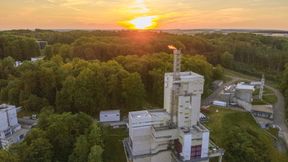
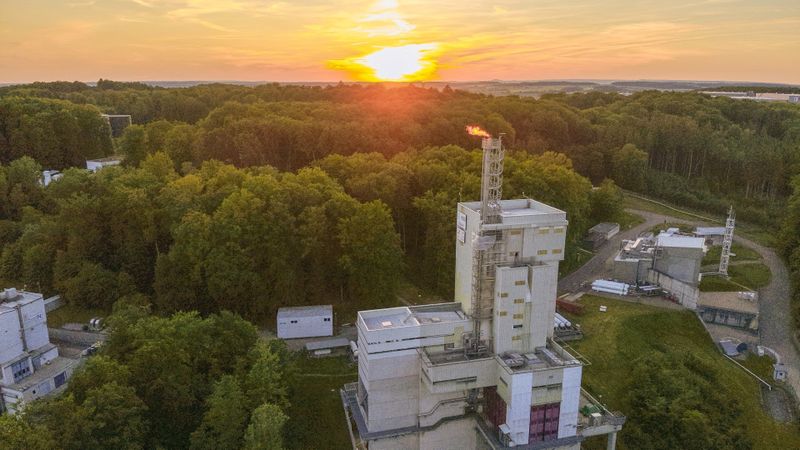
The German Aerospace Center has successfully tested the Prometheus engine on the modernised P5 test stand in Lampoldshausen. For the first time in the test stand's history, the engine – which runs on liquid methane and liquid oxygen – was ignited several times in a single test day and run at stable operating points within one continuous test sequence.
The modernised P5 test stand expands the testing capabilities for Prometheus
(Source: DLR)
The test campaign with the engine, developed by ArianeGroup, builds on previous trials at the company's French site in Vernon. At the same time, it demonstrates the expanded capabilities of the P5 test stand, which is part of the European Space Agency's (ESA) test infrastructure and is operated by DLR. Thanks to the comprehensive modernisation for operation with liquid methane, complex operating sequences of methane-fuelled rocket engines can now also be investigated.
P5 modernisation expands test capabilities
The P5 test stand has been upgraded for operation with liquid methane and multiple consecutive engine ignitions, among other things. This flexibility makes it possible to investigate operating sequences of the kind that can occur during the flight of a reusable rocket stage.
During the trials, the test stand supplies the engine with the required propellants and gases and ensures the necessary pressure and temperature conditions. Extensive measurement systems record such variables as thrust, propellant flow, pressure ratios and temperatures. The measurement data obtained makes it possible to analyse in detail both the behaviour of the engine and the processes at the test stand.
With the modernised P5, we can test high-thrust methane-fuelled rocket engines reliably and comprehensively. In doing so, we investigate not only individual operating states but also the interplay of different phases, from longer hot-fire tests through large changes in thrust to the re-ignition of the engine. This means we have created an important prerequisite for the development of future reusable rocket propulsion systems.
Anja Frank, Head of the DLR Institute of Space Propulsion
Multiple ignitions place high demands
Reusable rocket engines must be capable of being ignited multiple times during a mission. For example, it may be necessary to shut down the engine after launch and then re-ignite it for a return or landing manoeuvre. Reliable re-ignition places high demands on the engine and the test infrastructure. The current test campaign demonstrates that even complex sequences comprising repeated ignitions and stable operating phases can be successfully tested on the modernised P5.
Such repeated ignitions also place significant demands on the test stand. After each hot run, the engine and the supply systems must be safely shut down and prepared for the next start. This procedure includes, among other things, draining and purging the supply systems and re-establishing the required pressure and temperature conditions. "Up to five ignitions in a single test day place high demands on the coordination of the test stand systems. The fact that we can carry out these procedures automatically, safely and in a reproducible manner is an important step towards testing reusable propulsion systems," says Frank.
Variable thrust for launch, return and landing
In addition to multiple ignitions, reusable rocket engines require targeted thrust control. While high thrust is required during launch, the engine's performance must be precisely adjusted during later phases of flight – particularly during the return and landing of a reusable stage.
The upgraded P5 test stand makes it possible to investigate different thrust levels and the transitions between them under controlled conditions. This capability allows researchers to determine the engine's stability at various power levels, how it reacts to rapid changes in thrust and the thermal and mechanical stresses it experiences in the process. The results will inform the further development and testing of the Prometheus engine.
Prometheus as a technology for Europe's future launch systems
ArianeGroup is developing Prometheus on behalf of ESA. The 100-tonne thrust-class engine uses the propellant combination of liquid methane and liquid oxygen. Using liquid methane as propellant is a key innovation of the Prometheus concept. Compared with liquid hydrogen, it has a considerably higher density and can be stored at higher temperatures. This simplifies the design and handling of the tanks and supply systems.
ArianeGroup is developing Prometheus on behalf of ESA. The 100-tonne thrust-class engine uses the propellant combination of liquid methane and liquid oxygen. Using liquid methane as propellant is a key innovation of the Prometheus concept. Compared with liquid hydrogen, it has a considerably higher density and can be stored at higher temperatures. This simplifies the design and handling of the tanks and supply systems.
Date: 08.12.2025
Naturally, we always handle your personal data responsibly. Any personal data we receive from you is processed in accordance with applicable data protection legislation. For detailed information please see our privacy policy.
Consent to the use of data for promotional purposes
I hereby consent to Vogel Communications Group GmbH & Co. KG, Max-Planck-Str. 7-9, 97082 Würzburg including any affiliated companies according to §§ 15 et seq. AktG (hereafter: Vogel Communications Group) using my e-mail address to send editorial newsletters. A list of all affiliated companies can be found here
Newsletter content may include all products and services of any companies mentioned above, including for example specialist journals and books, events and fairs as well as event-related products and services, print and digital media offers and services such as additional (editorial) newsletters, raffles, lead campaigns, market research both online and offline, specialist webportals and e-learning offers. In case my personal telephone number has also been collected, it may be used for offers of aforementioned products, for services of the companies mentioned above, and market research purposes.
Additionally, my consent also includes the processing of my email address and telephone number for data matching for marketing purposes with select advertising partners such as LinkedIn, Google, and Meta. For this, Vogel Communications Group may transmit said data in hashed form to the advertising partners who then use said data to determine whether I am also a member of the mentioned advertising partner portals. Vogel Communications Group uses this feature for the purposes of re-targeting (up-selling, cross-selling, and customer loyalty), generating so-called look-alike audiences for acquisition of new customers, and as basis for exclusion for on-going advertising campaigns. Further information can be found in section “data matching for marketing purposes”.
In case I access protected data on Internet portals of Vogel Communications Group including any affiliated companies according to §§ 15 et seq. AktG, I need to provide further data in order to register for the access to such content. In return for this free access to editorial content, my data may be used in accordance with this consent for the purposes stated here. This does not apply to data matching for marketing purposes.
Right of revocation
I understand that I can revoke my consent at will. My revocation does not change the lawfulness of data processing that was conducted based on my consent leading up to my revocation. One option to declare my revocation is to use the contact form found at https://contact.vogel.de. In case I no longer wish to receive certain newsletters, I have subscribed to, I can also click on the unsubscribe link included at the end of a newsletter. Further information regarding my right of revocation and the implementation of it as well as the consequences of my revocation can be found in the data protection declaration, section editorial newsletter.
The development of the Prometheus engine is funded as part of ESA's Future Launchers Preparatory Programme (FLPP), which advances new technologies for future European launch vehicles. Germany contributes approximately 80 million euros to this programme from the Federal Ministry of Research, Technology and Space (Bundesministerium für Forschung, Technologie und Raumfahrt; BMFTR). The funds are coordinated by the German Space Agency at DLR.